
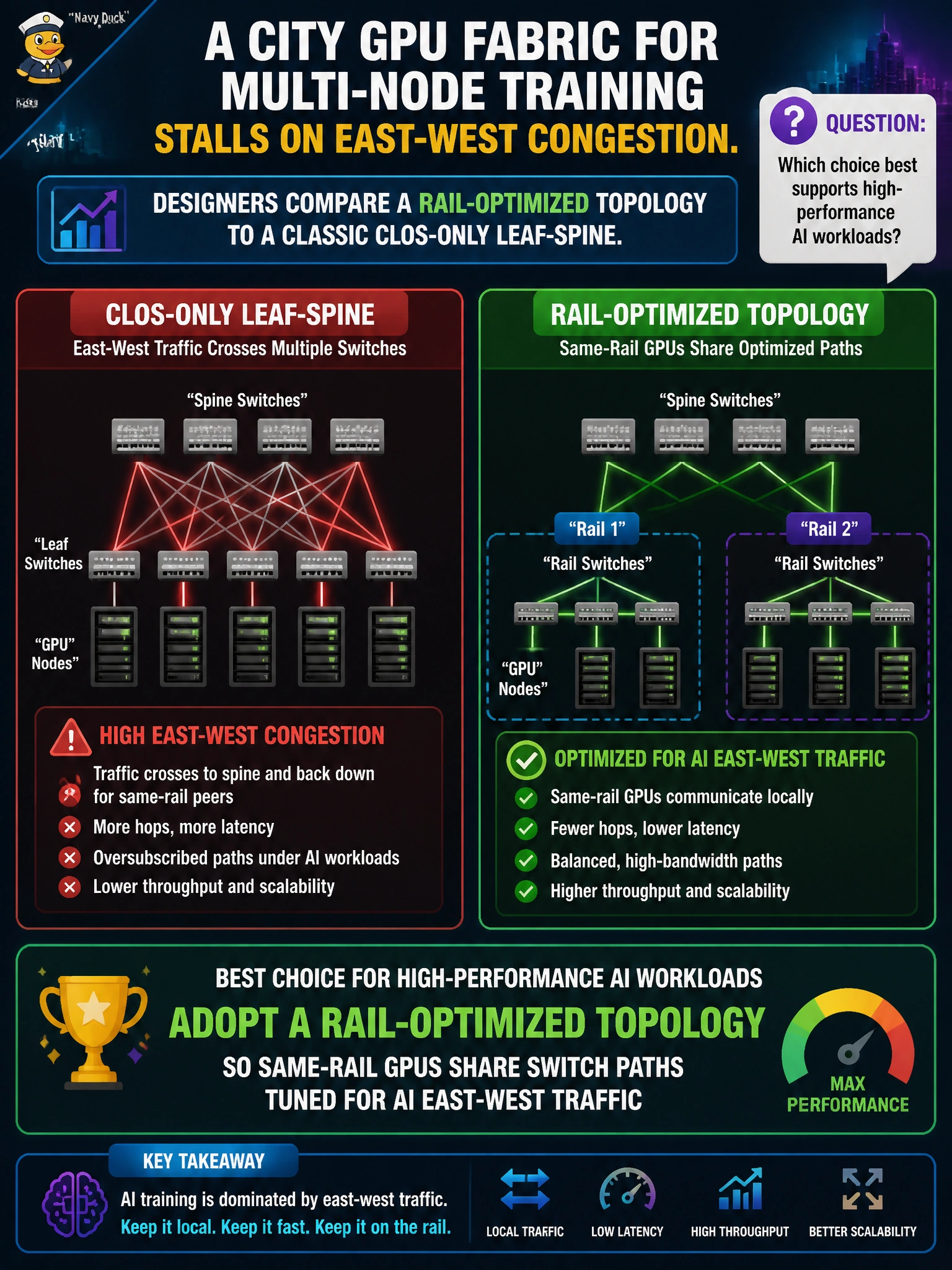
A city GPU fabric for multi-node training stalls on east-west congestion. Designers compare a rail-optimized topology to a classic Clos-only leaf-spine. Which choice best supports high-performance AI workloads?
Select an answer to reveal the explanation.
Short Explanation
Rail-optimized design is like giving every subway line its own dedicated track set so express trains don't fight local traffic at every junction. For your city multi-node training, aligning GPU rails onto shared switch paths cuts unnecessary hops and east-west congestion that extra spines, a backend VLAN with ECMP, or staggered scheduling won't fix.
Full Explanation
When a city GPU fabric stalls on east-west congestion during multi-node training, a rail-optimized topology better supports high-performance AI workloads than simply expanding a Clos-only leaf-spine with added spine switches for increased east-west bisection bandwidth, because raw capacity does not align same-rail GPUs to shared switch paths. Rail optimization places same-rail GPUs on shared, AI-tuned switch paths so NCCL and similar collectives stay local to the rail instead of taking extra hops and fighting unrelated east-west contention. For municipal training rows, that alignment reduces latency variance and improves all-reduce behavior under load while still allowing hierarchical scale-out.
Expanding Clos-only leaf-spine capacity with added spine switches leaves GPU collectives subject to generic ECMP hashing and cross-rail interference because more spines do not place same-rail GPUs on AI-tuned switch paths. Placing GPU east-west flows on a dedicated backend VLAN using standard ECMP for spine load sharing still treats collectives like generic traffic; standard ECMP does not keep same-rail GPUs on shared paths, so AI flows can still cross unrelated leaf boundaries and contend. Staggering GPU collective scheduling across leaf switches to smooth bursts on the existing Clos uplinks only paces when collectives start; it does not align rails, so GPU traffic still takes extra hops and fights contention instead of staying on dedicated switch paths.
Exam caveat: Clos remains a valid underlay pattern, but the exam distinction is whether GPU rails are aligned to switch groups for AI east-west traffic—not whether "any leaf-spine" is enough.
Operational check: map each city GPU rail to its leaf (and spine) set, measure collective hop counts and hot links under training load, and confirm rail-optimized attachment before accepting an expanded Clos-only design that adds spines but never checked rail locality; do not rely on a dedicated backend VLAN with standard ECMP or staggered collective scheduling as a congestion workaround.