
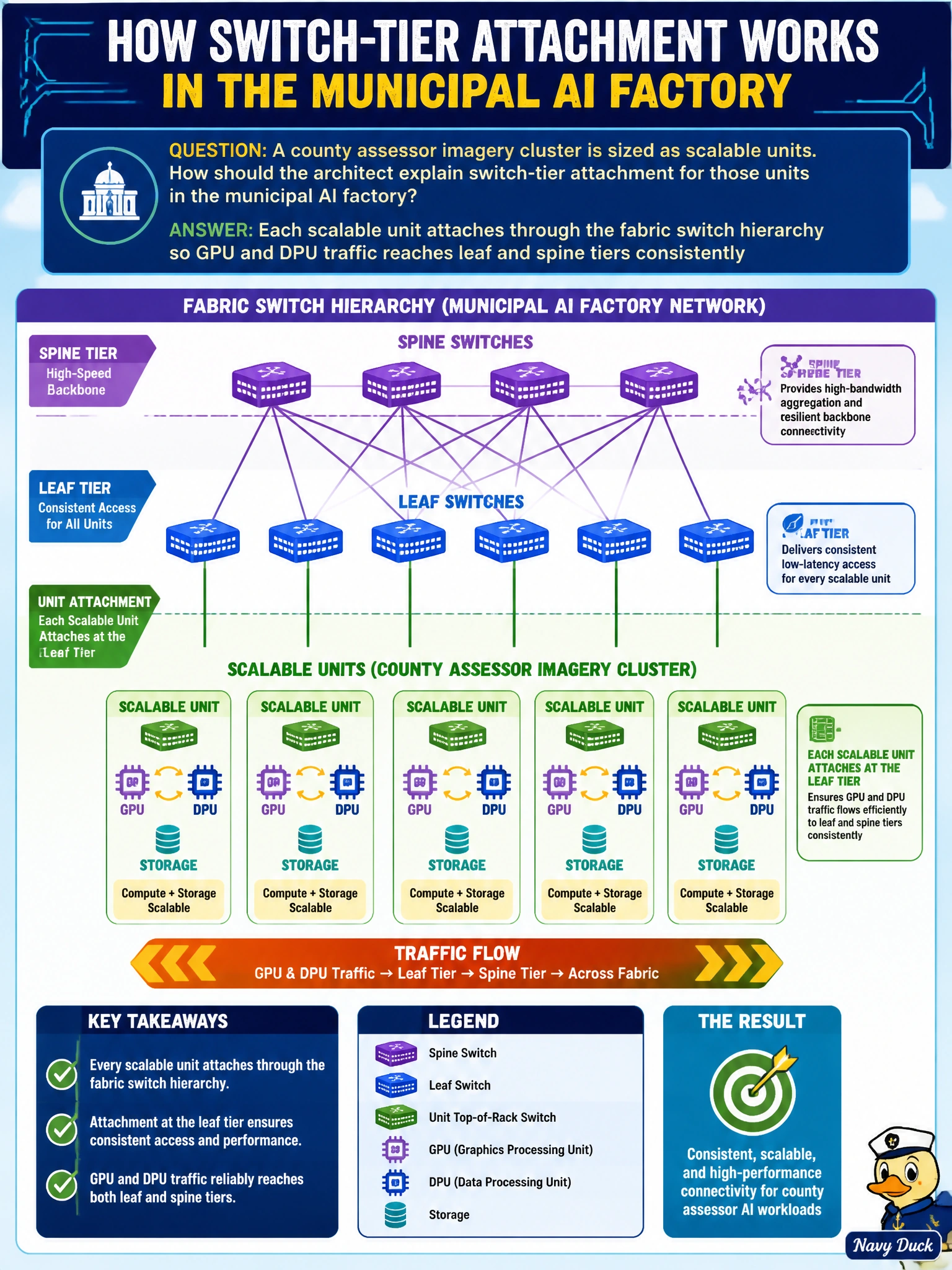
A county assessor imagery cluster is sized as scalable units. How should the architect explain switch-tier attachment for those units in the municipal AI factory?
Select an answer to reveal the explanation.
Short Explanation
Scalable units are like modular civic building floors—you still need elevators and corridors (the switch hierarchy) so people and freight move between floors. Attach each unit through leaf and spine so GPU and BlueField traffic has a predictable path, not a thumb-drive workaround.
Full Explanation
In a county assessor imagery cluster sized as scalable units, each unit must attach through the fabric switch hierarchy so GPU and DPU traffic reaches leaf and spine tiers consistently. Scalable units are modular packages of AI compute and networking, not islands: imagery jobs move tensors and collectives across unit boundaries, which requires predictable leaf attachment and spine aggregation. Explaining switch-tier attachment this way keeps municipal capacity planning honest—add a unit, and you also add its place in the Spectrum (or InfiniBand) hierarchy for both GPU and BlueField paths.
Bypassing all switches to communicate only over USB thumb drives is operationally absurd for assessor imagery and conceptually wrong: removable media is not an AI east-west fabric. Claiming switch tiers attach exclusively to printers and badge systems, never to GPU units, inverts the AI factory design; those civic systems may share a campus network elsewhere, but the fabric hierarchy in this context exists to serve GPU/DPU traffic. A single unmanaged hub for every scalable unit without hierarchy destroys oversubscription control, multi-pathing, and rail/Clos structure that high-performance AI networking depends on.
Exam caveat: “scalable unit” does not mean “switchless”—it means a repeatable block that still lands on leaf and spine tiers. Operational check: for each assessor scalable unit, document which leaf ports terminate GPU and DPU links, how those leafs uplink to spines, and that traffic matrices for imagery collectives follow that hierarchy; reject designs that USB-sneakernet between units, reserve switches only for badge/print VLANs, or collapse everything into one unmanaged hub.