
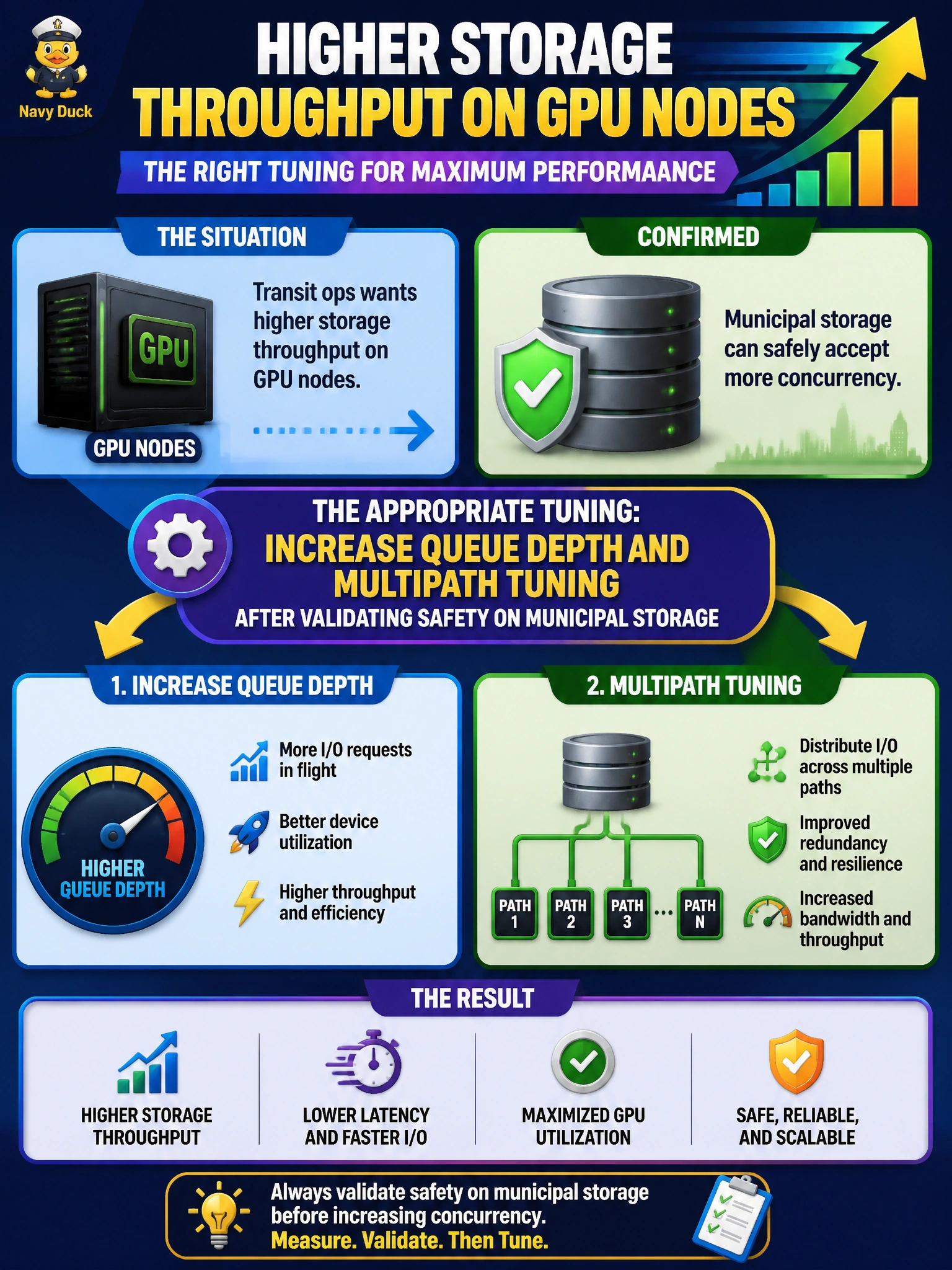
Transit ops wants higher storage throughput on GPU nodes after confirming municipal storage can safely accept more concurrency. What tuning is appropriate?
Select an answer to reveal the explanation.
Short Explanation
More lanes help only if the bridge can take the traffic—validate first, then raise queue depth and multipath knobs. Transit GPU nodes get the speed without collapsing the array.
Full Explanation
Transit ops seeking higher storage throughput on GPU nodes after confirming municipal storage can safely accept more concurrency should increase queue depth and multipath tuning after that safety validation. Domain 5 storage-path optimization raises concurrency knobs only when the array and fabric evidence says it is safe for civic workloads. The confirmation step is part of the correct answer: throughput chasing without safety checks is how shared municipal arrays get overloaded. Raising queue depth without any safety validation can overload controllers and create latency storms worse than the original throughput limit. Disabling multipath to simplify troubleshooting permanently removes path redundancy that municipal GPU nodes rely on for resilience. Setting queue depth to 1 on every path for maximum parallelism is conceptually backwards—depth 1 minimizes outstanding I/O and hurts parallelism. Exam caveat: validate with storage and fabric owners using representative transit AI I/O; safe limits differ by array model and path count. Operational check: with safety sign-off recorded, raise queue depth and multipath settings on transit GPU nodes in controlled steps, measure throughput and latency, and roll back if civic storage SLOs regress.