
County health public-health GPUs contend when checkpoints and datasets share one volume. What storage-layout optimization helps?
Select an answer to reveal the explanation.
Short Explanation
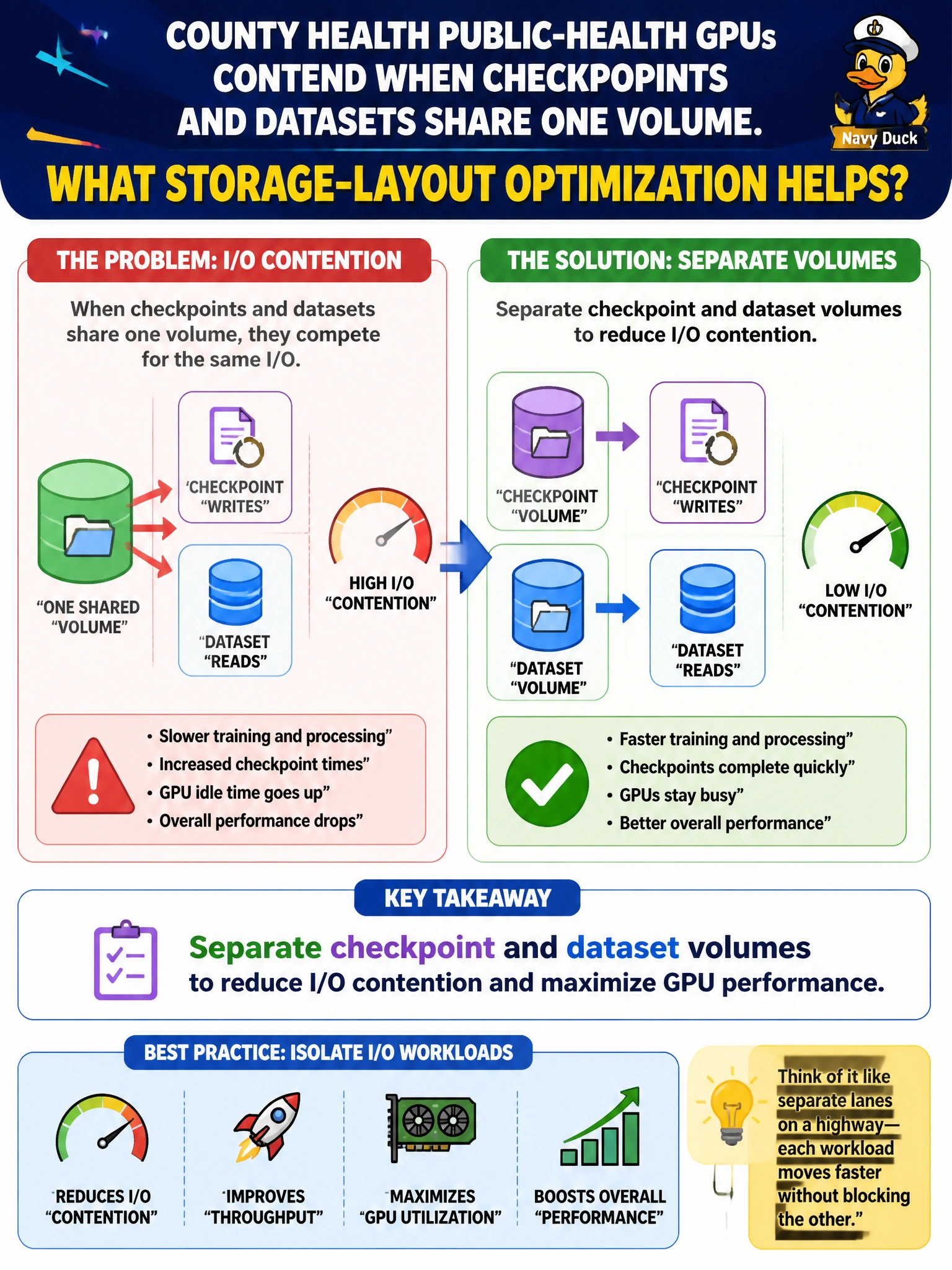
Don’t make the ambulance and the supply truck fight over one lane—give checkpoints and datasets their own volumes. You’ll help county health GPUs breathe easier by reducing I/O contention.
Full Explanation
County health public-health GPUs that contend when checkpoints and datasets share one volume need a storage-layout optimization: separate checkpoint and dataset volumes to reduce I/O contention. Write-heavy checkpoint traffic and read-heavy training reads otherwise compete for the same municipal LUN, stretching Domain 5 storage-optimization goals and elongating job runtime. Isolating the workloads is often cheaper and safer than adding raw capacity to an already contended volume. Merging even more workloads onto the same LUN increases contention, the opposite of isolation. Deleting datasets nightly to make room for checkpoints destroys training inputs and does not address the layout problem. Moving checkpoints to local workstation folders while keeping datasets on the shared volume abandons the shared AI filesystem for unmanaged endpoints and breaks cluster access patterns. Exam caveat: separation can use different volumes, pools, or quality-of-service classes, depending on the municipal storage platform; the key concept is isolating checkpoint write bursts from dataset reads. Practical check: place county health checkpoints on a dedicated volume or pool, keep datasets on a separate path, and compare GPU I/O wait and job runtime during concurrent checkpointing.