
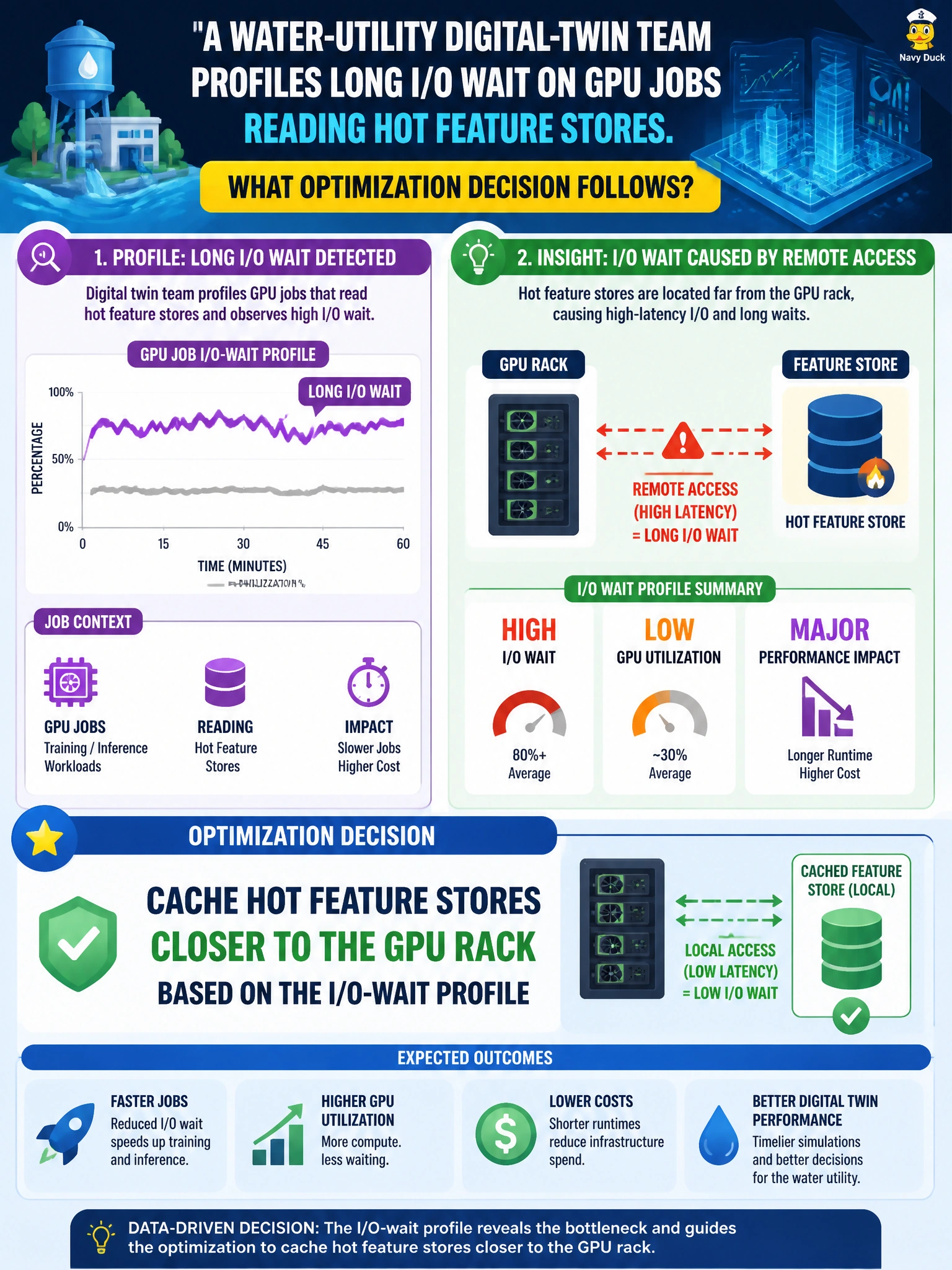
A water-utility digital-twin team profiles long I/O wait on GPU jobs reading hot feature stores. What optimization decision follows?
Select an answer to reveal the explanation.
Short Explanation
If the diggers keep walking across town for the same shovel, park a cache next to the trench. Water utility GPUs should keep hot feature stores close after profiling shows the I/O wait.
Full Explanation
A water-utility digital-twin team that profiles long I/O wait on GPU jobs reading hot feature stores should cache those hot feature stores closer to the GPU rack based on the I/O-wait profile. Domain 5 optimization uses profiling evidence to improve locality so civic digital-twin GPUs spend less time stalled on remote reads. Profile-driven placement beats guesswork because it targets the working set that actually dominates wait time. Ignoring profiling and buying random NVMe without a placement plan spends capital without proving the new media sits on the hot path the profile identified. Moving the feature store to an offline tape library for speed is the wrong direction for hot data latency. Disabling profiling tools so I/O wait no longer appears removes observability without fixing stall time. Exam caveat: caching closer may mean rack-local NVMe, a nearer flash tier, or client-side cache—choose based on the profiled working set size and consistency needs of the digital twin. Operational check: from the profile, identify hot feature objects, place a cache or replica near the water-utility GPU rack, re-run the jobs, and confirm I/O wait and job duration drop versus the baseline profile.