
City GPU jobs stall on I/O after storage tests show the parallel filesystem is the bottleneck. What optimization fits?
Select an answer to reveal the explanation.
Short Explanation
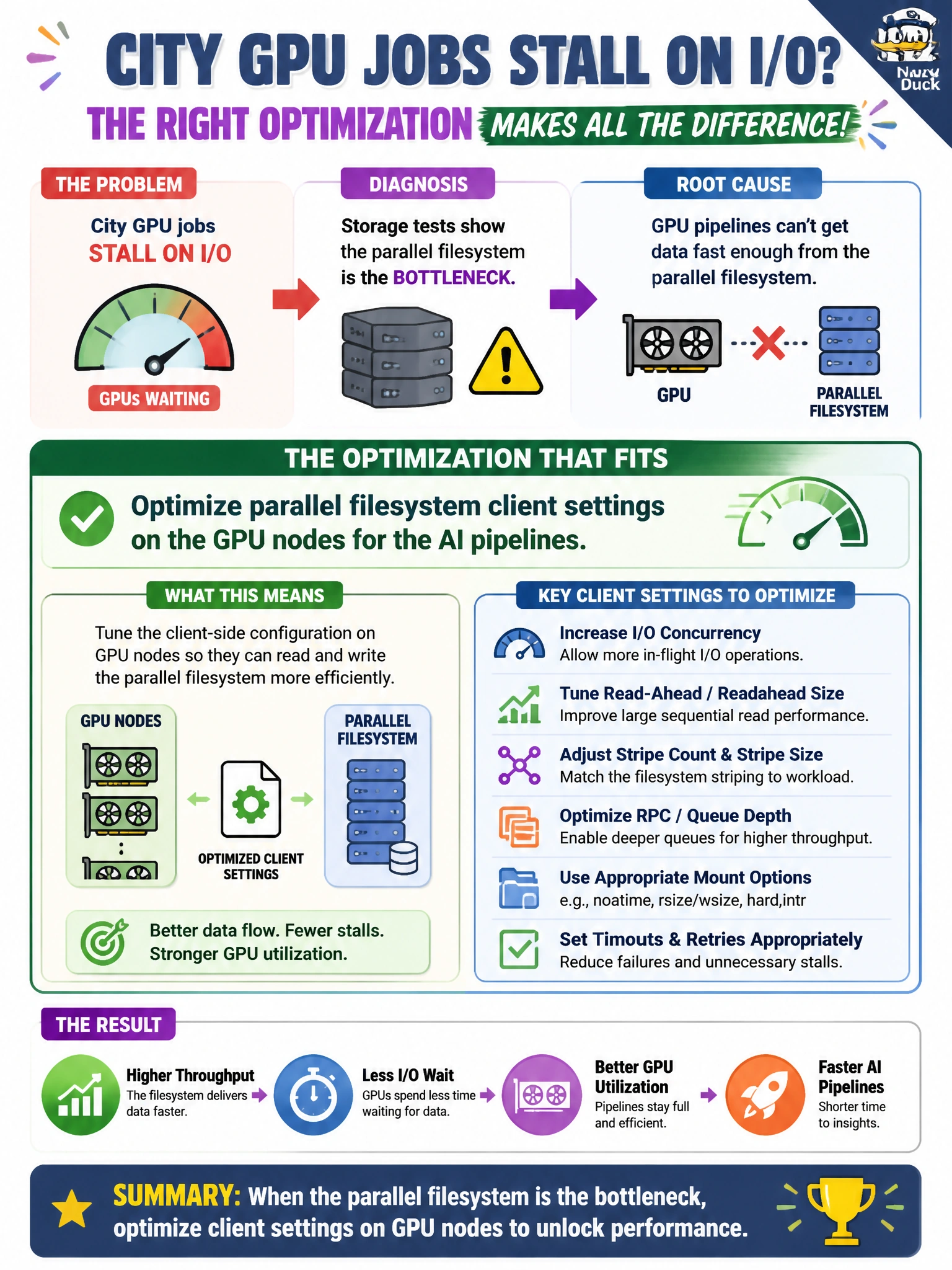
When the GPUs are waiting on the filing cabinet, tune the client that talks to that cabinet—not DNS parlor tricks. City nodes need parallel filesystem client settings aimed at AI pipelines.
Full Explanation
When city GPU jobs stall on I/O after storage tests show the parallel filesystem is the bottleneck, the fitting optimization is to tune parallel filesystem client settings on the GPU nodes for the AI pipelines. Domain 5 storage optimization acts on the proven bottleneck with client parameters aligned to municipal training I/O patterns. Adding random DNS CNAMEs for the mount path changes naming, not client caching, concurrency, or read-ahead behavior that would relieve I/O wait. Disabling checksums on every municipal database as a shortcut attacks unrelated integrity controls and does not fix parallel filesystem client efficiency for GPU jobs. Moving all checkpoints exclusively to tmpfs forever without capacity planning may hide some writes briefly but risks memory pressure and unplanned loss without addressing the filesystem bottleneck sustainably. Exam caveat: client tuning should follow the parallel filesystem vendor’s AI or HPC guidance for the city’s mount options and concurrency limits. Operational check: after confirming the PFS bottleneck, adjust GPU-node client settings, re-run the stalled city jobs, and verify reduced I/O wait and higher throughput against the prior storage-test baseline.