
Transit ops tunes CPU/platform settings across mixed AMD and Intel GPU racks. How should they prove the change helped?
Select an answer to reveal the explanation.
Short Explanation
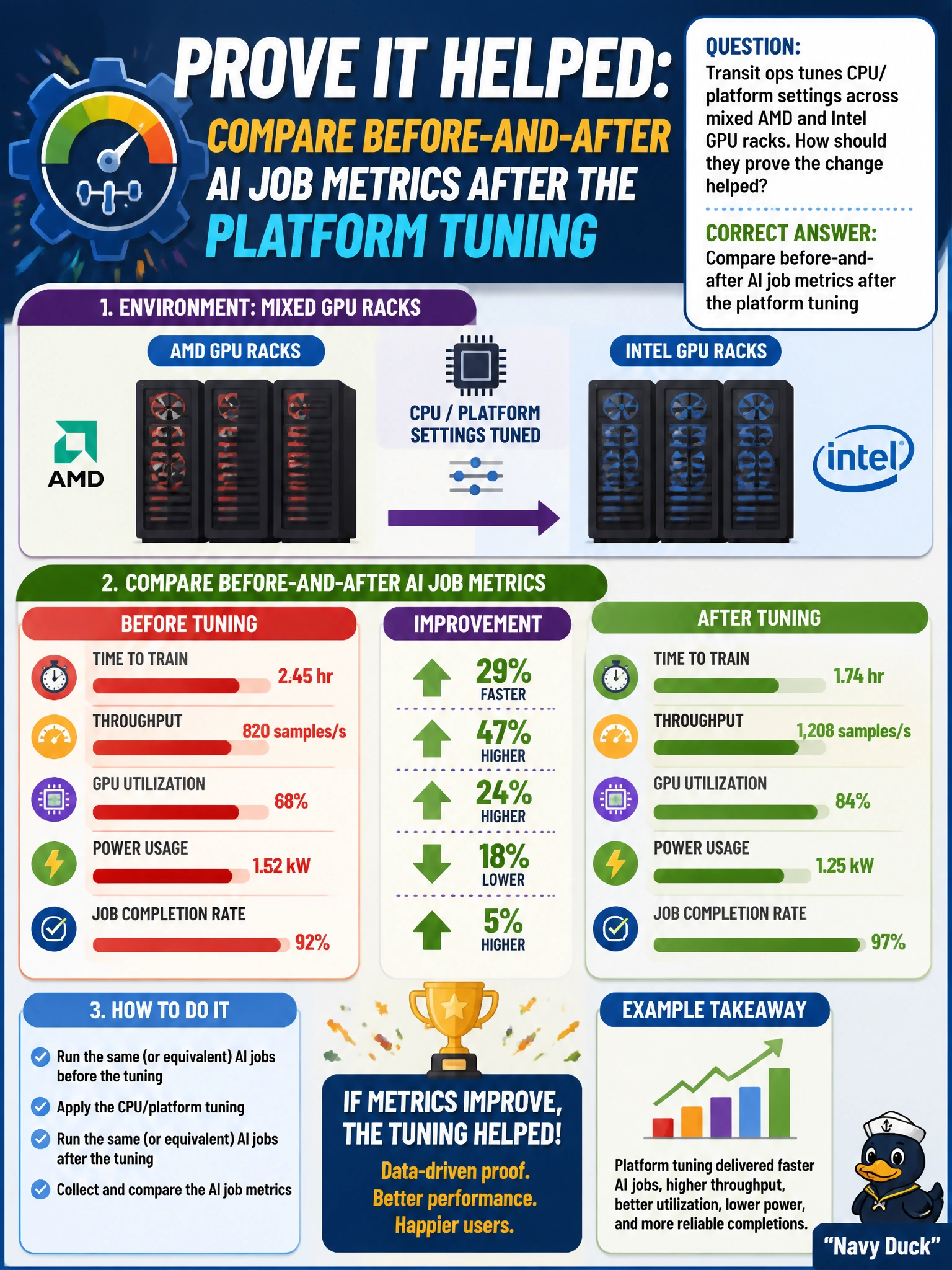
If you didn't measure the bus schedule before and after, you didn't prove the shortcut works. Transit ops need before/after AI job metrics after platform tuning.
Full Explanation
Transit ops tuning CPU and platform settings across mixed AMD and Intel GPU racks must prove the change helped by comparing before-and-after AI job metrics. Domain 5 performance work is incomplete without quantified evidence that municipal training or inference improved on the workloads that matter. Mixed fleets make this discipline especially important because a knob that helps one vendor SKU may be neutral or harmful on the other, so each platform family needs its own measured delta. Declaring success if the BIOS splash screen loads faster measures boot cosmetics, not GPU job throughput or latency. Assuming optimization worked without measuring jobs skips the only evidence that matters to transit AI SLOs. Using only the number of sticky notes on the rack door is not a metric system and cannot support rollback decisions. Exam caveat: keep the job mix, dataset paths, and node sets comparable across the before and after window so platform tuning is not confounded by unrelated schedule or data changes. Operational check: baseline representative transit AI jobs on both AMD and Intel racks, apply the platform changes, re-run the same jobs, and retain the metric delta with the change record for each platform family.