
County health GPU hosts run on AMD servers with uneven training throughput. What optimization guidance applies?
Select an answer to reveal the explanation.
Short Explanation
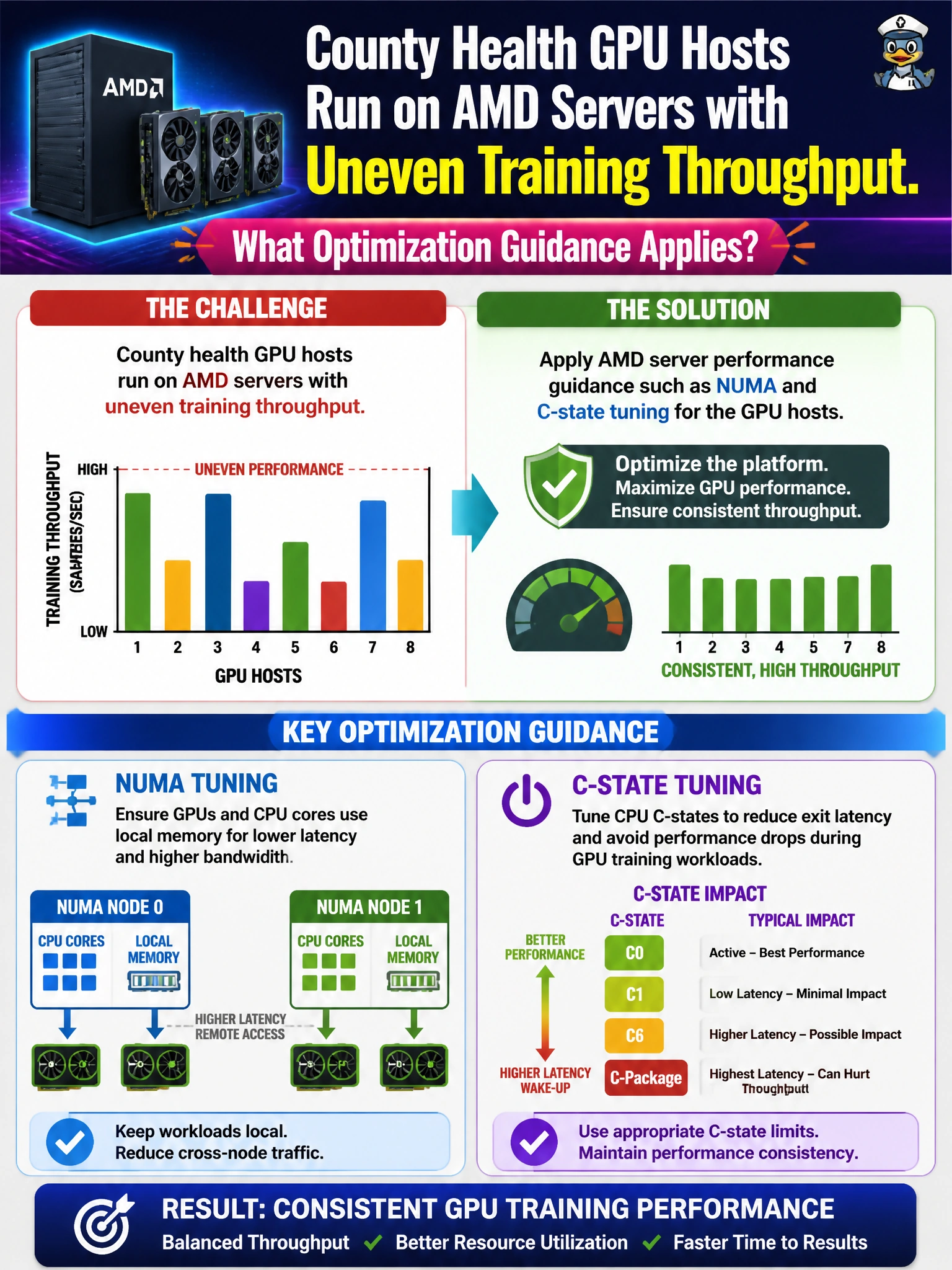
GPUs still drink from the CPU's neighborhood plumbing—NUMA and C-states matter on AMD boxes too. County health should apply that AMD performance guidance on the GPU hosts.
Full Explanation
County health GPU hosts on AMD servers with uneven training throughput need AMD server performance guidance applied—such as NUMA placement and C-state related tuning—because GPU consistency still depends on the CPU and platform path that feeds them. Domain 5 skill 5.4 covers AMD-specific platform optimization for AI servers, not GPU-only tunnel vision. Cross-NUMA memory and PCIe attachment patterns commonly create the unevenness operators see in multi-GPU public-health jobs. Ignoring NUMA and C-state settings because only GPUs matter leaves locality and latency jitter unaddressed on the AMD hosts. Forcing legacy IDE mode on storage to stabilize GPUs is an unrelated storage controller mode that does not fix NUMA or C-state behavior for GPU jobs. Pinning all AI jobs to the BMC network namespace confuses out-of-band management networking with the data path GPUs use for training. Exam caveat: AMD guidance varies by EPYC generation and topology; validate NUMA and C-state changes against county health job SLOs rather than copying a generic blog checklist. Operational check: review AMD performance settings on the public-health GPU hosts, apply supported NUMA and C-state guidance, and compare training throughput variance before and after.