
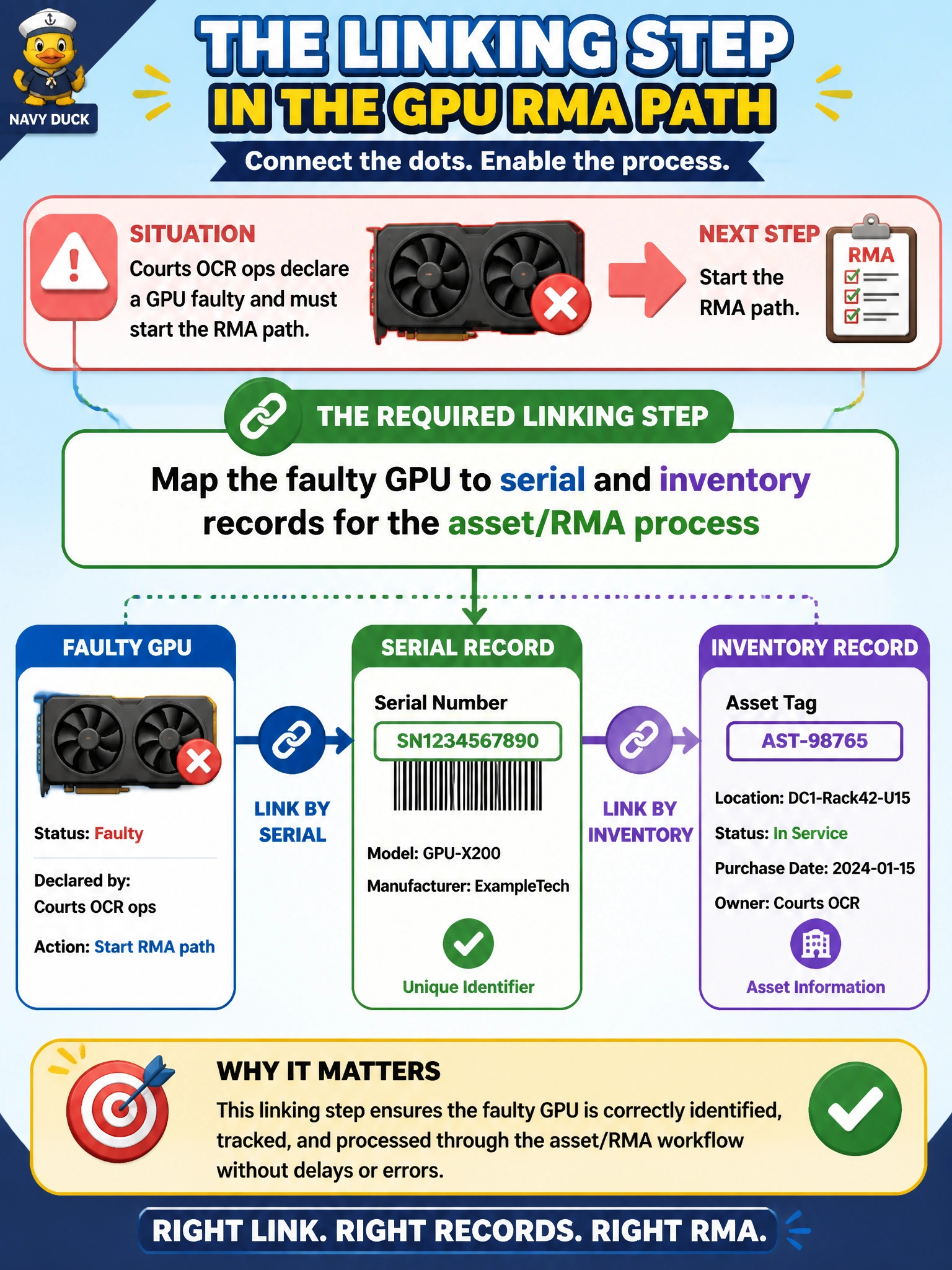
Courts OCR ops declare a GPU faulty and must start the RMA path. What linking step is required?
Select an answer to reveal the explanation.
Short Explanation
A bad GPU without a serial is like a lost library book with no barcode—you can't process the return. Courts OCR needs that serial/inventory map before RMA.
Full Explanation
Once courts OCR ops declare a GPU faulty and start the RMA path, they must map that faulty GPU to serial and inventory records for the asset and RMA process. Domain 5 ties hardware fault identity to civic asset tracking so warranty, CMDB, and spare replacement stay consistent from chassis seat to vendor return. Without that link, packing labels, RMA portals, and capacity dashboards diverge and the wrong spare may be staged. Discarding serial numbers to speed packing breaks chain of custody and can invalidate RMA acceptance or delay credit. Reusing another node’s inventory ID for the failed GPU corrupts CMDB truth and may ship the wrong identity to the vendor while the healthy peer looks missing. Marking the GPU healthy in CMDB so RMA is unnecessary contradicts the fault declaration and hides depleted OCR capacity from capacity planning. Exam caveat: record both board serial and GPU UUID where the platform exposes both, because packing labels and in-band tools sometimes disagree after prior swaps. Operational check: before boxing the courts OCR GPU, verify serial and UUID against CMDB and the RMA form, update asset state to failed or in-RMA, and retain a copy of the mapping with the ticket.