
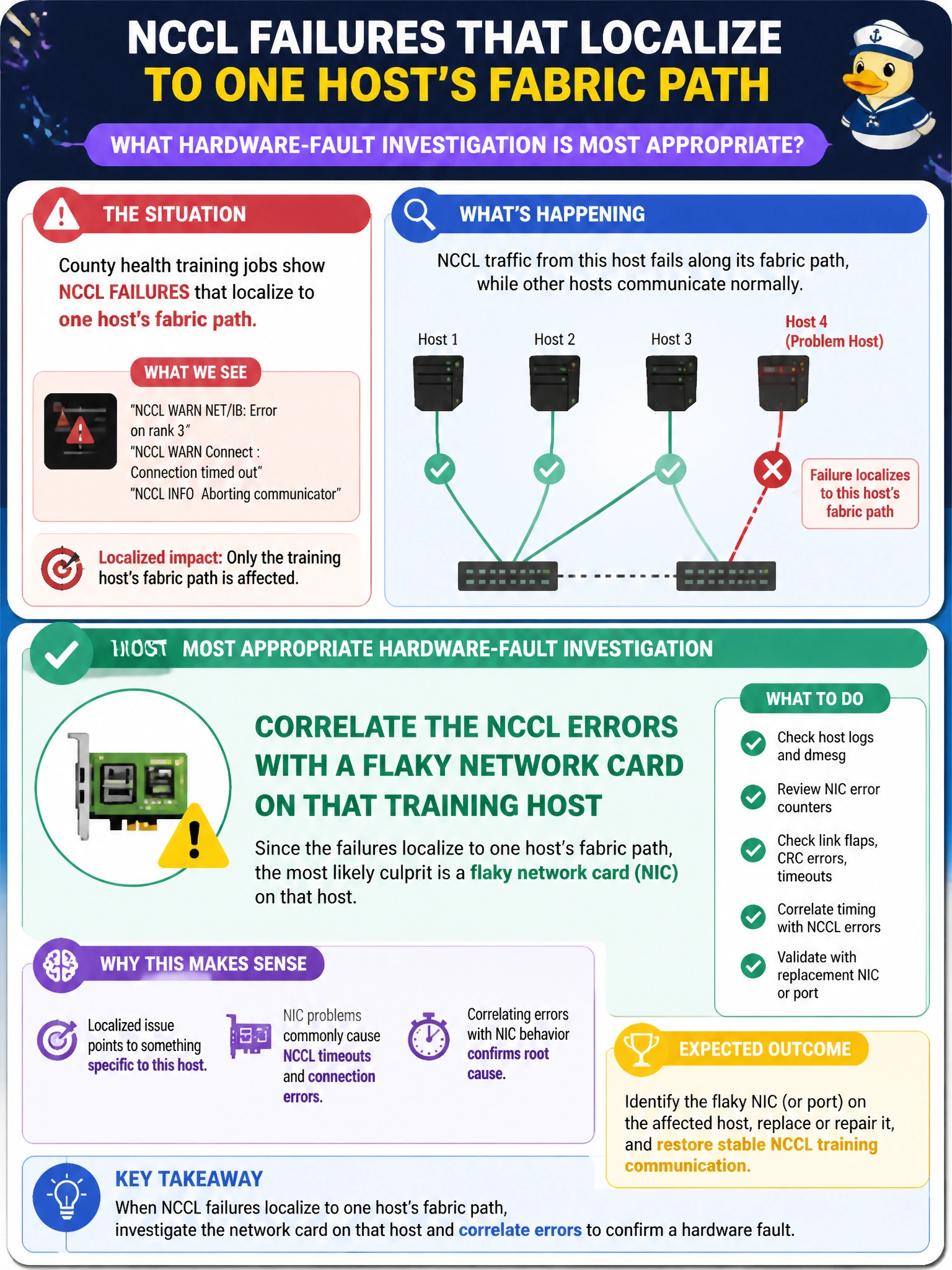
County health training jobs show NCCL failures that localize to one host's fabric path. What hardware-fault investigation is most appropriate?
Select an answer to reveal the explanation.
Short Explanation
If the collective traffic keeps tripping on one driveway, check that driveway's NIC—not the whole neighborhood. County health should correlate those NCCL failures with a flaky network card on the bad host.
Full Explanation
County health training jobs that show NCCL failures localized to one host's fabric path point strongly at a host-local interconnect fault, most often a flaky network card or its link path, rather than a cluster-wide application bug. Correlating the NCCL error stream with that training host's NIC telemetry, link flaps, and PCIe AER events is the Domain 5 hardware-fault investigation that restores public-health training collectives. Reimaging every healthy node to match the failing host spreads risk and destroys good state without fixing the bad fabric endpoint. Ignoring NCCL errors merely because idle GPU power looks normal confuses quiescent electrical draw with collective communication health under load. Raising the HPL problem size until NCCL stops logging is unrelated stress tuning that papers over interconnect faults instead of isolating them. On the exam, localized NCCL plus one-host fabric symptoms mean follow the NIC or link FRU path first. Caveat: firmware or driver mismatches on a single host can mimic NIC failure, so capture adapter firmware and driver versions with the hardware evidence before RMA. Operational check: on the suspect county health training host, record NCCL error timestamps against NIC counters, cable/transceiver state, and peer ping/bandwidth tests; swap or reseat only after the correlation pins that fabric path.