
Transit ops must decide whether a GPU fault on a scheduling node is software-induced or a hardware FRU issue. Which approach fits?
Select an answer to reveal the explanation.
Short Explanation
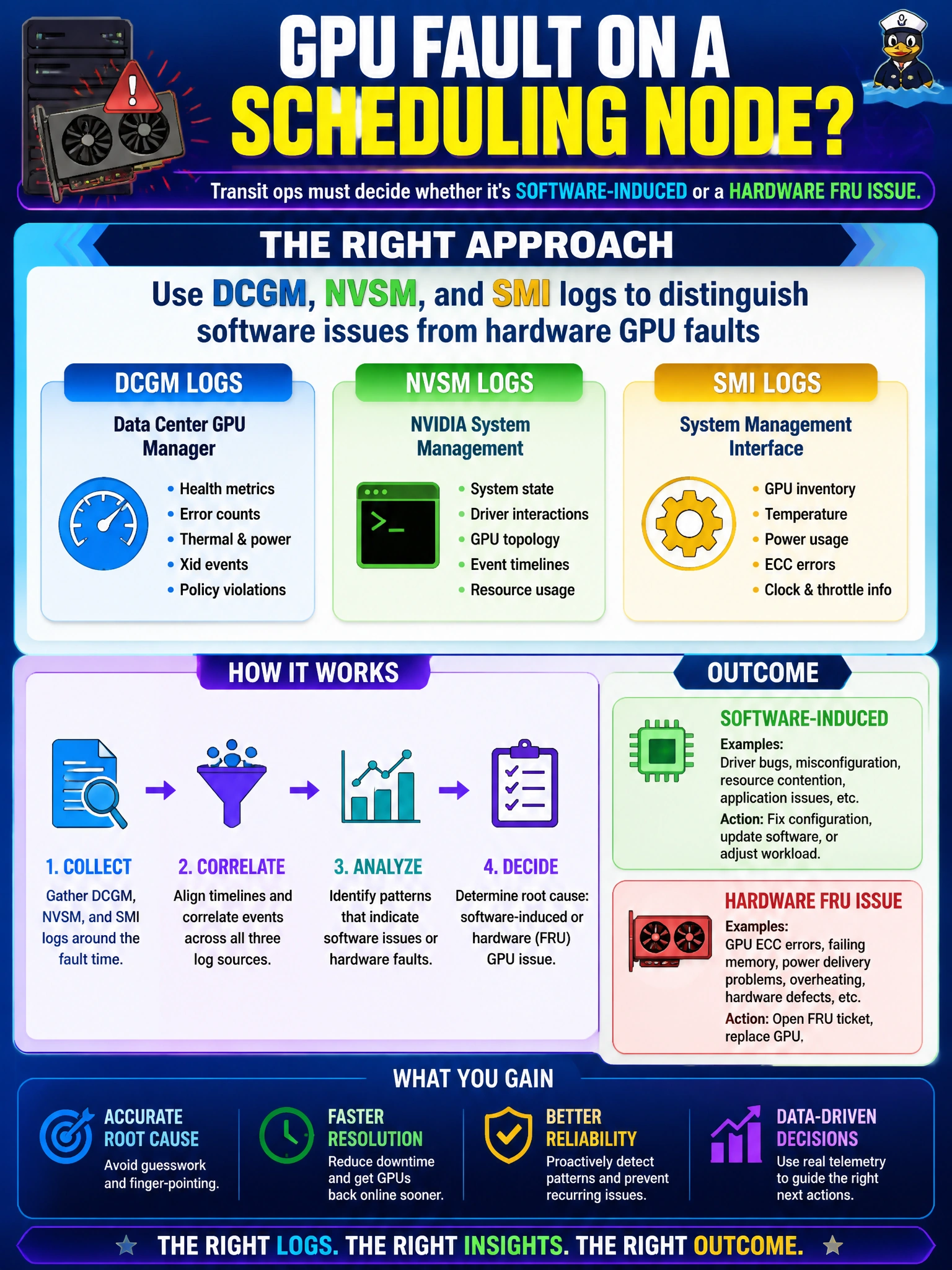
Don't trust aisle vibes—read the GPU's own black box. Transit ops should lean on DCGM, NVSM, and SMI logs to tell a soft glitch from a real FRU problem.
Full Explanation
Transit ops deciding whether a GPU fault on a scheduling node is software-induced or a hardware FRU issue must use DCGM, NVSM, and nvidia-smi style logs to separate transient software symptoms from persistent hardware failure signatures. Evidence-based triage protects civic spare budgets and avoids wiping systems that only needed a driver or job isolation step. Domain 5 fault identification hinges on that telemetry, not aisle feel or scheduler folklore. Guessing from how warm the aisle feels is not a diagnostic method and cannot distinguish GPU ECC, XID, or thermal FRU states from ambient HVAC. Wiping the OS immediately without capturing diagnostics destroys the very logs needed to justify RMA or to prove a software fix. Blaming Slurm accounting whenever nvidia-smi is slow conflates scheduler metadata latency with GPU device health; slow SMI can still be a hung GPU or driver path that needs GPU-side tools. Exam caveat: some software hangs clear after reset while hardware faults recur under the same load pattern—recurrence after clean software remediation is the FRU signal. Operational check: archive DCGM/NVSM/SMI output from the transit scheduling node, classify codes as soft versus hard per vendor guidance, and only then choose reset, driver remediation, or GPU FRU replacement.