
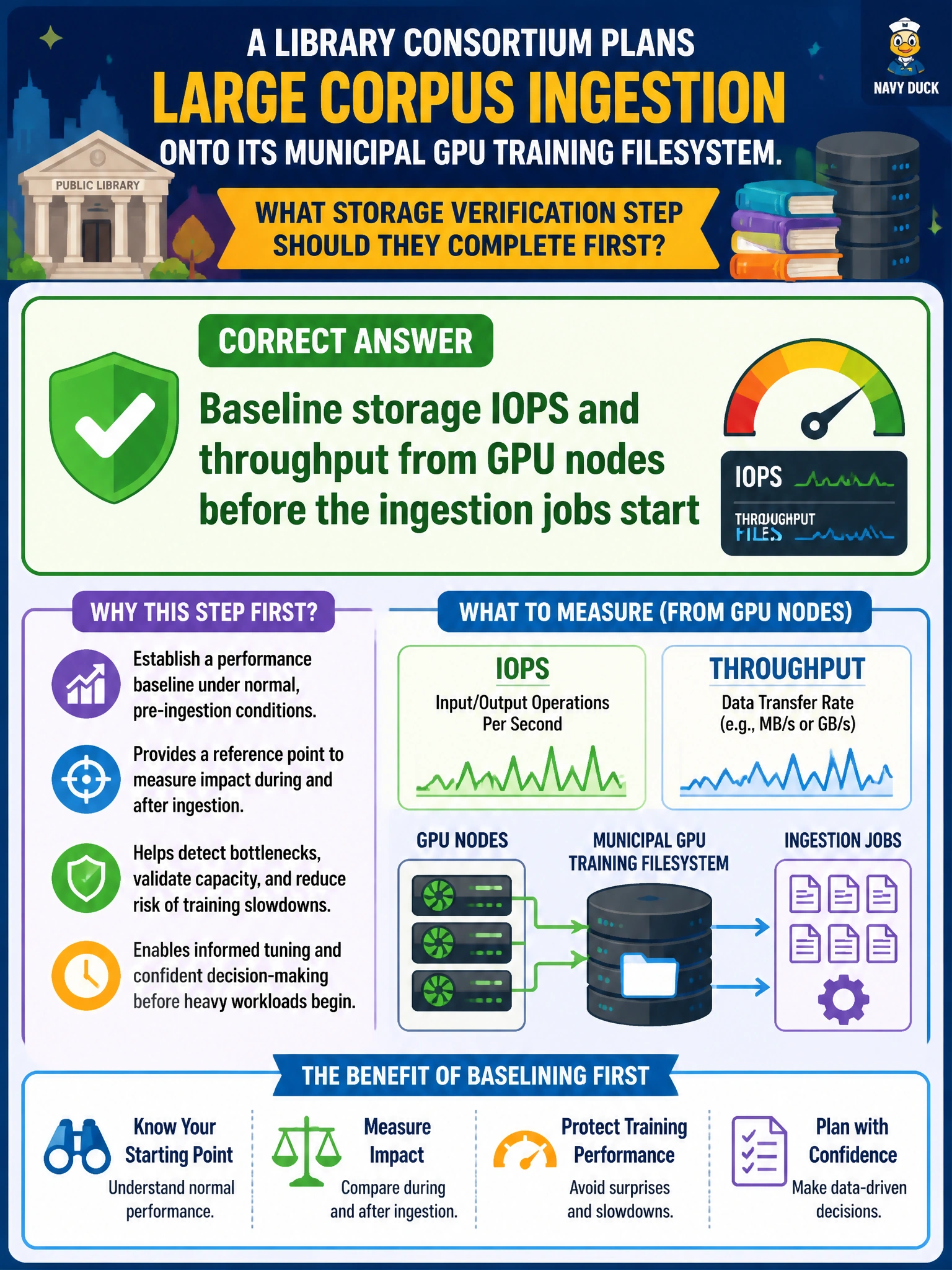
A library consortium plans large corpus ingestion onto its municipal GPU training filesystem. What storage verification step should they complete first?
Select an answer to reveal the explanation.
Short Explanation
Think of storage IOPS like a speed-limit sign before a parade of dump trucks hits the road—you want to capture that yardstick first. Measure IOPS and throughput from the GPU nodes before ingestion begins, so you have a baseline rather than guesses or LED blink rates.
Full Explanation
Before the library consortium loads a large corpus onto its municipal GPU training filesystem, operators should baseline storage IOPS and throughput from the GPU nodes. Those measurements provide a reference for regression detection, capacity planning, and judging the ingestion workload’s impact. Without a pre-load yardstick, later debates about whether storage slowed have no evidence, and storage verification remains incomplete. Raising MIG partition counts instead changes GPU share topology; it does not verify that the filesystem can absorb the corpus ingestion rate from those hosts. Measuring only the rack LED blink rate on the PDU is unrelated: it does not quantify client-side IOPS or bandwidth. Clearing prior IOPS and throughput measurements erases trend data and creates a false clean slate that can hide progressive degradation. Exam caveat: use representative filesystem paths and block sizes for the planned corpus, rather than relying on a synthetic micro-benchmark that does not match real read patterns. Practical check: from GPU nodes in the consortium training pool, record IOPS and throughput against the municipal filesystem before ingestion, archive the figures with the change ticket, and repeat the same tests after the first corpus wave to check for regression.