
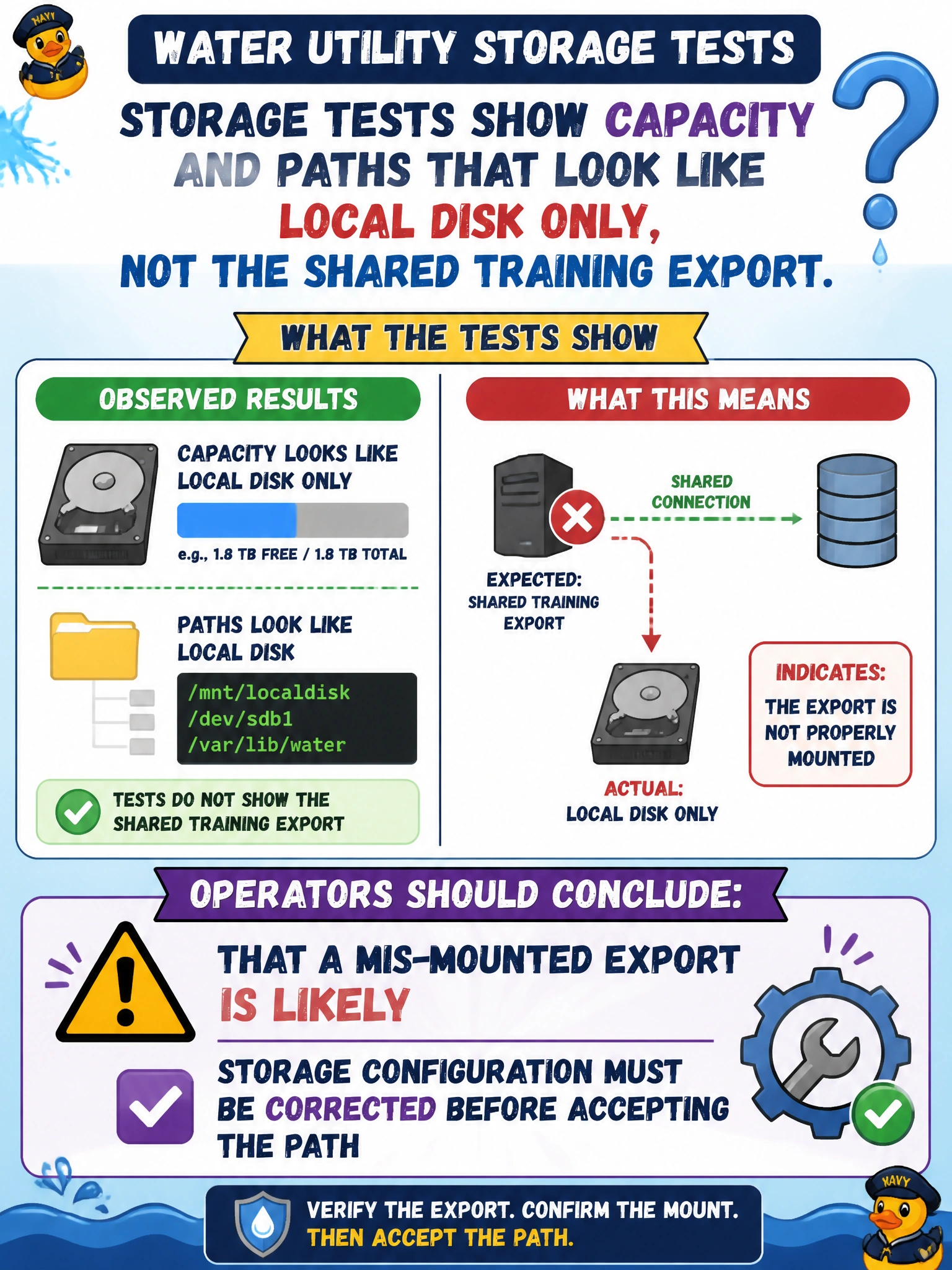
Water utility storage tests show capacity and paths that look like local disk only, not the shared training export. What should operators conclude?
Select an answer to reveal the explanation.
Short Explanation
If storage tests look like lonely local disk instead of the big water-utility export, you probably mounted the wrong thing—fix the path before you celebrate.
Full Explanation
When water-utility storage tests report capacity and paths that look like local disk only—not the shared training export—operators should conclude a mis-mounted export is likely and correct storage configuration before accepting the path. Domain 4 storage testing is also a configuration detector: wrong mount targets, bind mounts to node-local scratch, or stale fstab entries produce “success” metrics against the wrong filesystem. Treating local-disk-like results as proof the fabric is perfect misreads the signal; you may never have left the GPU node’s local disk. Calling capacity quirks cosmetic and safe to ignore risks training against insufficient or non-shared storage that will not hold municipal datasets. Assuming the shared export is healthy because nvidia-smi still lists GPUs confuses accelerator enumeration with filesystem correctness. Exam caveat: confirm mount source, export path, capacity, and filesystem type/UUID against the design—local NVMe can be intentionally used for scratch, but acceptance for the shared training tier must test that tier explicitly. Operational check: for the water utility, compare storage-test capacity and path output to the documented shared export, fix automount/NFS/parallel-filesystem configuration if it points local, re-run tests from GPU nodes against the corrected export, and accept only when identity and performance match the training filesystem design.