
Transit ops validates AI training storage and must cover resiliency, not only peak IOPS. What should storage tests include?
Select an answer to reveal the explanation.
Short Explanation
Transit storage validation needs a failover/multipath drill—peak IOPS on one quiet path is not the same as surviving a path loss mid-training.
Full Explanation
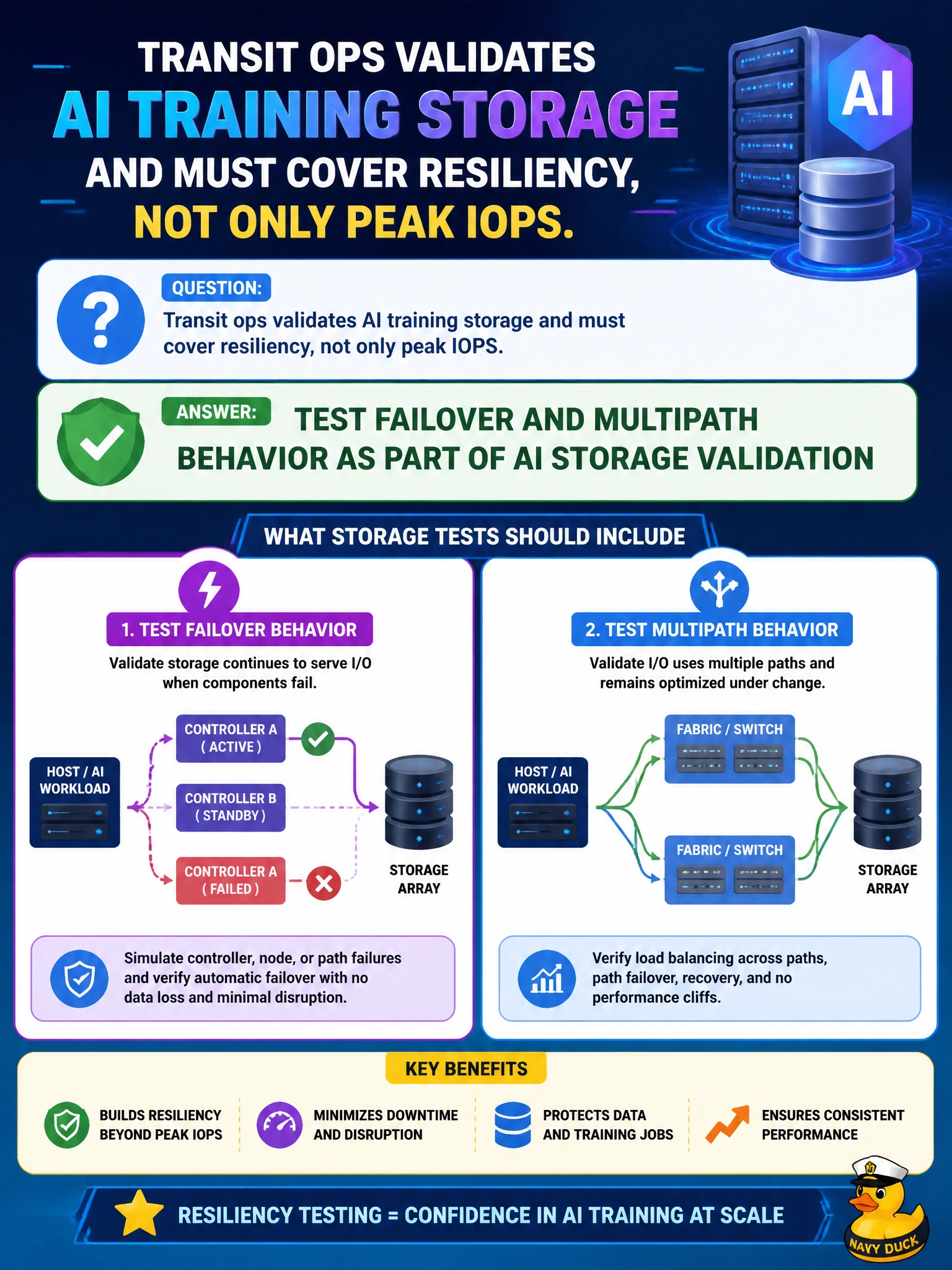
Transit ops AI storage validation must include failover and multipath behavior, not only peak IOPS, so training paths survive link or controller failures without silent single-path fragility. Domain 4 storage testing covers resiliency: multipath failover, path loss, and recovery are part of proving the municipal training filesystem is operationally sound. Running only a single happy-path sequential read with multipath disabled measures best-case bandwidth on a brittle configuration and misses failover gaps. Skipping failover checks because GPUs retry forever assumes client retries hide storage path loss; retries do not replace tested multipath design and can amplify outage length with timeouts. Restricting failover tests exclusively to the console serial cable validates console access, not storage path redundancy from GPU nodes to the training export. Exam caveat: perform failover tests during a change window—expect brief I/O disruption—and define success as continued access via alternate paths with metrics returning to policy, not as “no alerts ever.” Operational check: for transit AI storage, enable multipath as designed, induce controlled path failures from a GPU node test plan, confirm I/O fails over, archive the resiliency results with performance numbers, and reject storage sign-off that shows peak IOPS alone.