
County health storage tests report throughput and latency for the dataset pipeline. How should operators interpret them?
Select an answer to reveal the explanation.
Short Explanation
County health storage is ready when throughput and latency clear the dataset-pipeline bar—not when the share merely mounts and the GPUs are warm.
Full Explanation
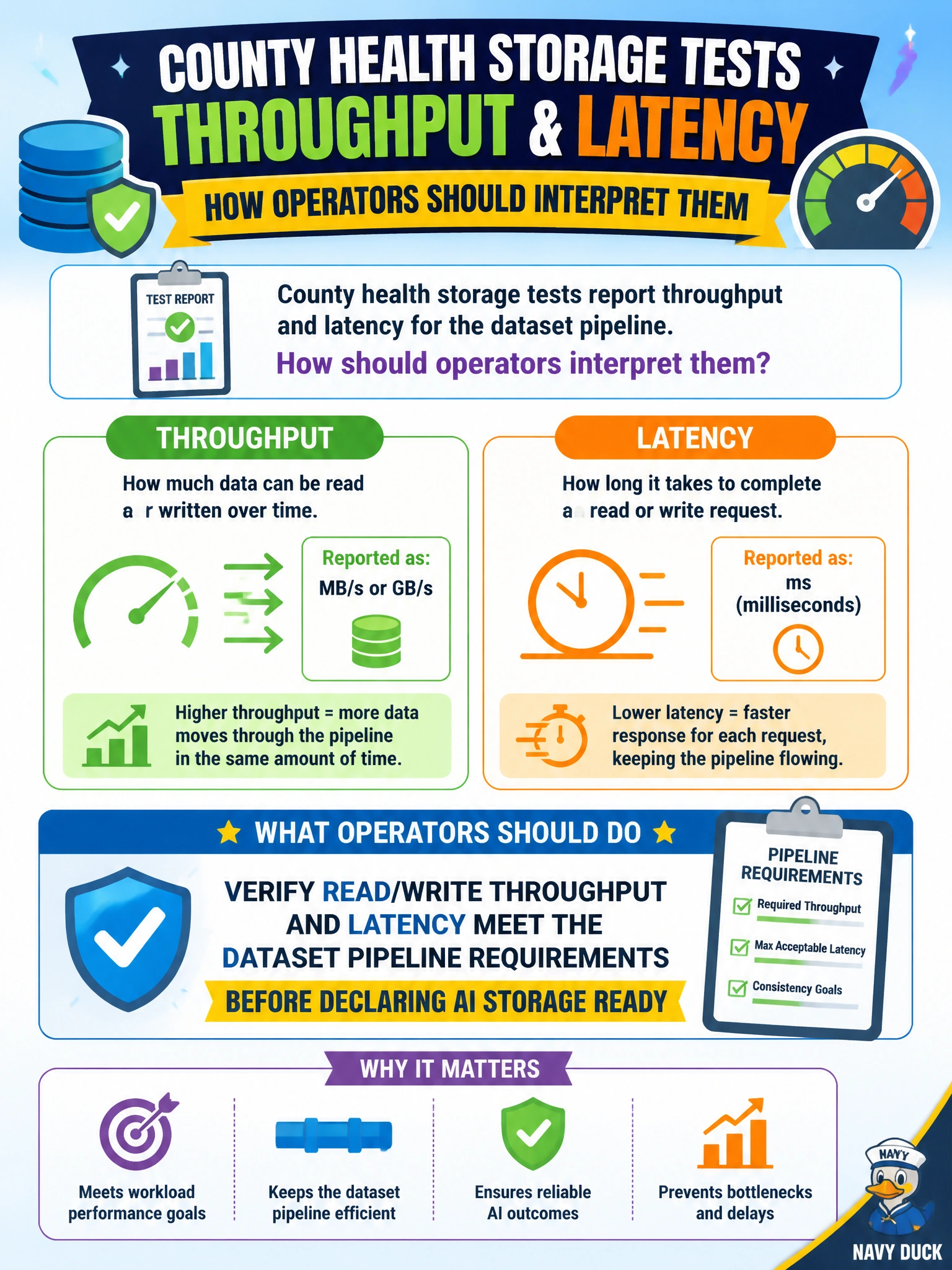
County health operators should verify that measured read/write throughput and latency meet dataset pipeline requirements before declaring AI storage ready. Domain 4 storage acceptance is metric-based: mounts that merely appear are not enough if epochs will stall on slow reads or blocking checkpoint writes. Ignoring metrics if the filesystem mounts at all accepts potentially unusable performance and shifts failure discovery into training time on GPU nodes. Accepting any latency as long as GPUs are powered on confuses accelerator power state with storage path quality and cannot prove the municipal dataset tier is fit for AI. Comparing storage metrics only to desktop USB drive folklore uses an irrelevant benchmark class and cannot represent parallel training I/O against shared exports from many GPU readers and writers. Exam caveat: requirements should reflect the pipeline’s sequential versus random mix, concurrency from multiple GPU nodes, and checkpoint write bursts—single-stream numbers can mislead if the real load is many-writer. Operational check: for county health, map dataset pipeline SLOs to concrete throughput and latency thresholds, run storage tests that approximate that mix from GPU nodes, compare results to the thresholds, and only then mark the AI storage path ready for production training.