
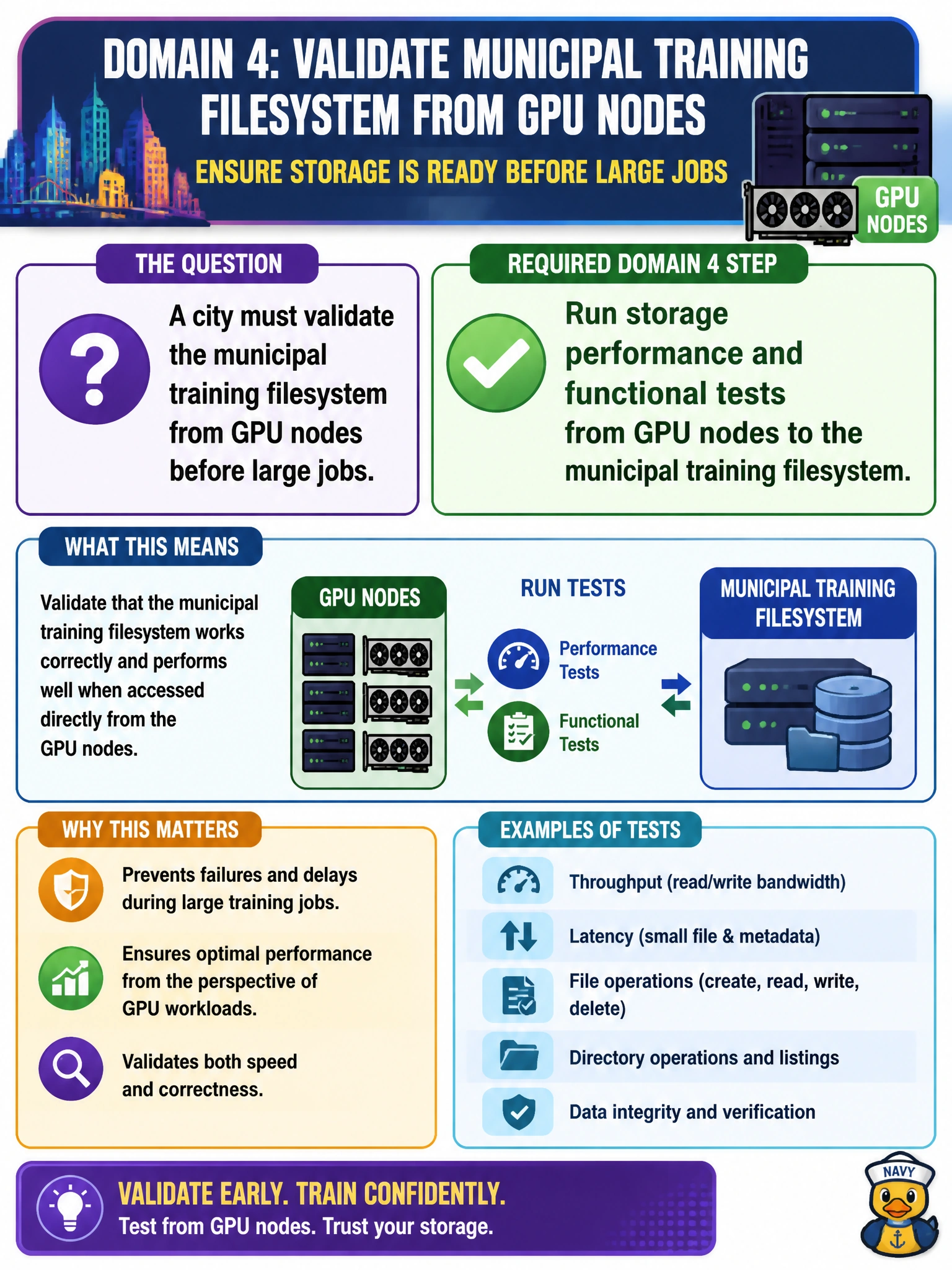
A city must validate the municipal training filesystem from GPU nodes before large jobs. What Domain 4 step is required?
Select an answer to reveal the explanation.
Short Explanation
Prove the city training filesystem from the GPU nodes themselves—pretty mount-path strings and guest Wi-Fi guesses are not Domain 4 storage tests.
Full Explanation
Before large municipal training jobs, the city must run storage performance and functional tests from GPU nodes to the training filesystem so Domain 4 validates the data path AI workloads actually use. Testing from the accelerators exercises mount options, RDMA or Ethernet storage fabrics, permissions, and throughput under the same network namespace training containers will see. Assuming storage is fine if the mount path string looks familiar checks naming, not performance, correctness, or that the export is the intended shared training tier. Testing storage only from a laptop on guest Wi-Fi measures an unrelated client path and can false-pass a filesystem GPU nodes cannot sustain at training rates. Skipping storage tests until the first training job fails mid-epoch makes production the discovery mechanism and risks wasted GPU hours and corrupted or partial epochs. Exam caveat: functional mount success is necessary but not sufficient—Domain 4 expects throughput/latency checks aligned to dataset pipeline needs from the GPU node perspective. Operational check: from representative city GPU nodes, run the documented storage functional and performance suite against the municipal training filesystem, record results in the verification package, and block large jobs until that path meets policy.