
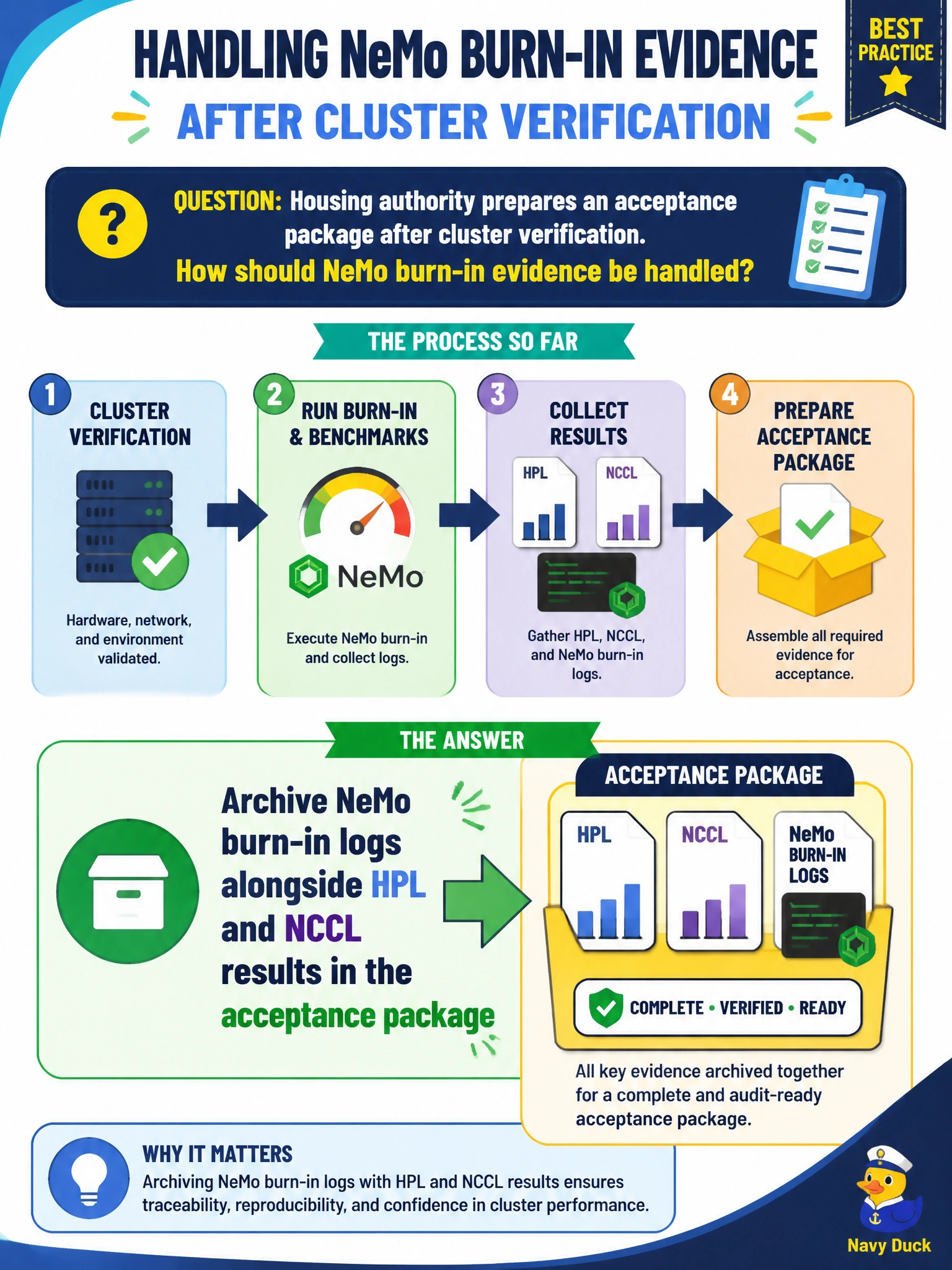
Housing authority prepares an acceptance package after cluster verification. How should NeMo burn-in evidence be handled?
Select an answer to reveal the explanation.
Short Explanation
For housing sign-off, you’ll want the complete evidence bundle: NeMo burn-in logs belong alongside HPL and NCCL results. That gives you an auditable record of the full verification, not evidence left in a private chat or missing from the package.
Full Explanation
The acceptance package should archive NeMo burn-in logs alongside HPL and NCCL results so housing authority sign-off reflects the full Domain 4 verification suite for AI infrastructure. NeMo evidence shows that the municipal software stack was exercised, not just compute and fabric microbenchmarks. Discarding NeMo logs because HPL screenshots are enough leaves a verification gap where training-stack defects may go undetected. Keeping NeMo results only in private chat threads is non-auditable, and the evidence may disappear when staff rotate or chats expire. Limiting NeMo burn-in logs to network switches misattributes the evidence: NeMo burn-in targets GPU nodes and the AI software path, not switch records, and GPU-node evidence belongs in the acceptance package. Exam caveat: include the config ID, node serials, timestamps, and pass/fail summaries so reviewers can reproduce what was tested; raw, unindexed dumps are not operationally useful. Practical check: before housing go-live, place NeMo logs in the same bundle as HPL and NCCL, verify every GPU node serial appears in all required evidence classes, and withhold sign-off if framework burn-in artifacts are missing.