
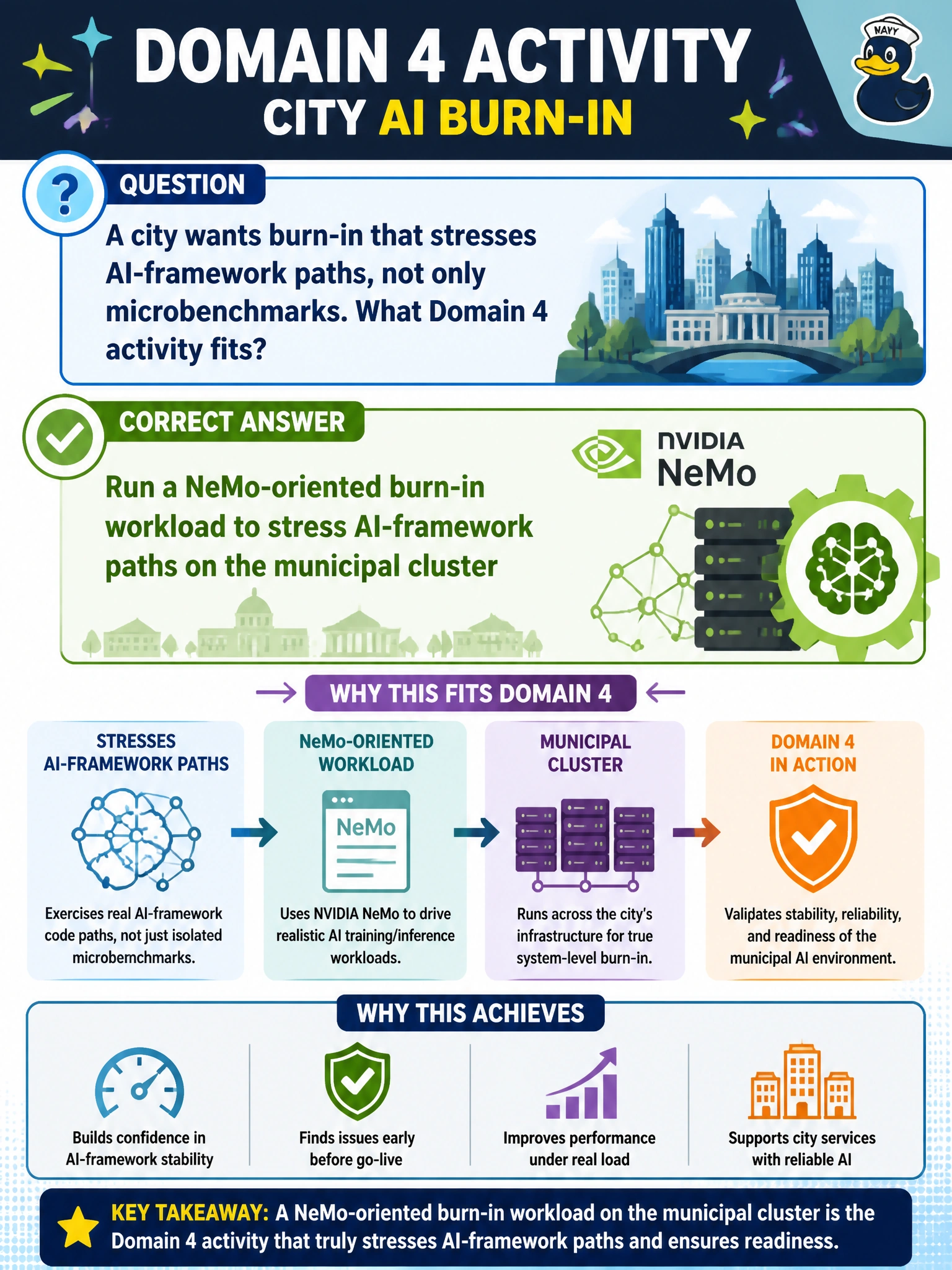
A city wants burn-in that stresses AI-framework paths, not only microbenchmarks. What Domain 4 activity fits?
Select an answer to reveal the explanation.
Short Explanation
City AI stacks need a NeMo-shaped burn-in—HPL is great cardio, but framework paths still need their own workout.
Full Explanation
City AI stacks need a NeMo-oriented burn-in workload to stress AI-framework paths on the municipal cluster—not only microbenchmarks—so Domain 4 validation covers framework, GPU memory patterns, and software-stack interactions training jobs will use. HPL and ping prove important but incomplete slices of readiness; NeMo-shaped load exercises model runtime, CUDA graphs or kernels typical of LLM/NLP stacks, and checkpoint/data plumbing quirks microbenchmarks miss. Running only ping and declaring AI-stack readiness validates reachability, not framework correctness under GPU load. Skipping framework burn-in because HPL already passed elsewhere imports compute-only evidence from another context and ignores local software images, drivers, and dataset paths. Burning in exclusively with keyboard LED toggles is irrelevant theater and supplies no AI-framework signal. Exam caveat: NeMo burn-in complements HPL/NCCL; it does not obsolete them, and the chosen NeMo config must be representative of intended municipal workloads without pretending one toy script equals every production job. Operational check: run a documented NeMo-oriented burn-in on the city cluster image candidates, capture framework errors, OOMs, and throughput stability, and require a pass alongside compute/fabric evidence before marking AI-stack readiness.