
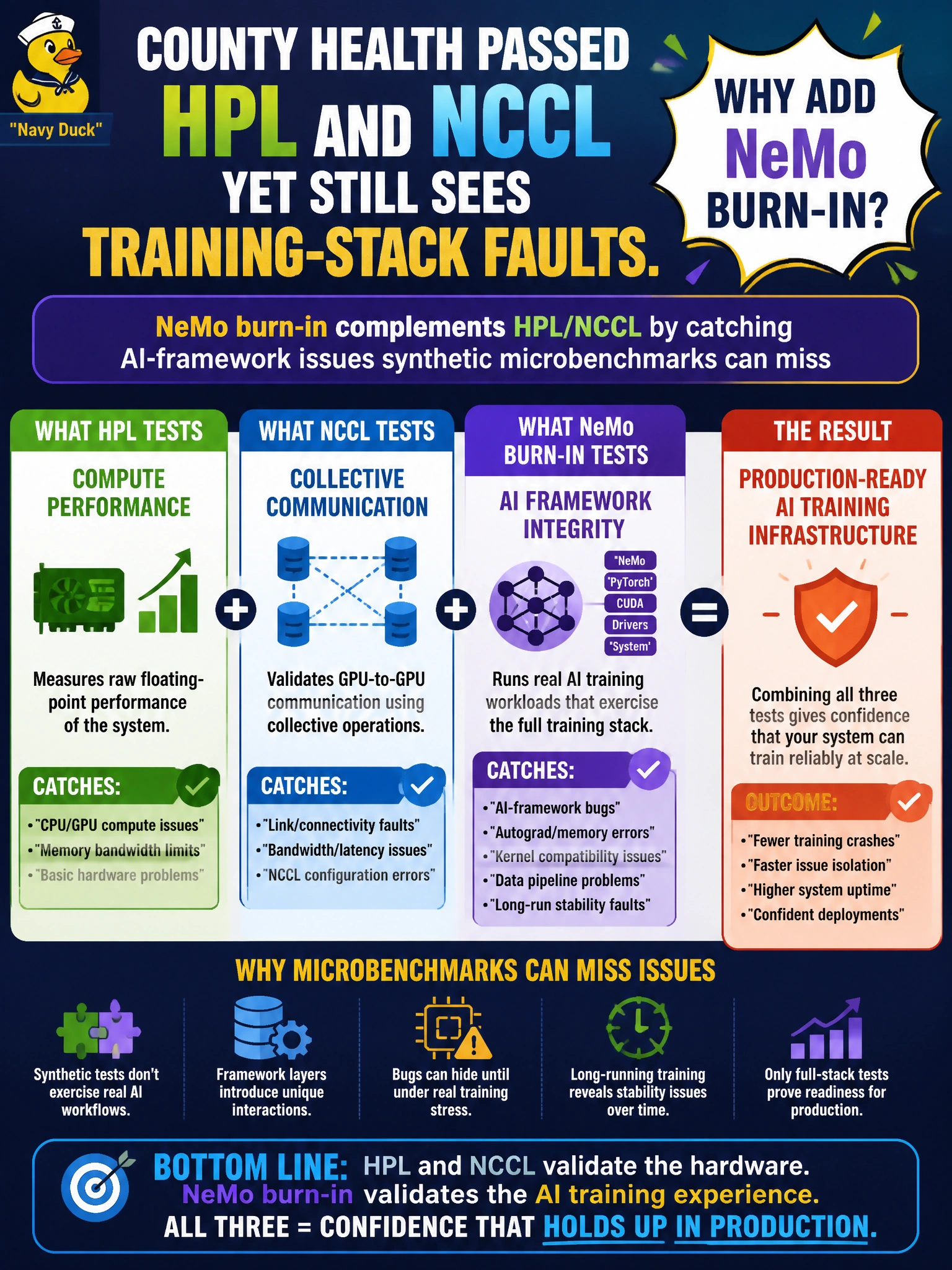
County health passed HPL and NCCL yet still sees training-stack faults. Why add NeMo burn-in?
Select an answer to reveal the explanation.
Short Explanation
HPL and NCCL can smile while the AI framework still trips—county health adds NeMo burn-in as the complementary reality check.
Full Explanation
County health can pass HPL and NCCL yet still see training-stack faults because those microbenchmarks do not fully exercise AI-framework paths; NeMo burn-in complements them by catching framework, memory-pattern, and software-interaction issues synthetic tests can miss. Domain 4 verification is multifaceted: compute stability, fabric collectives, and framework realism each close a different gap. Claiming NeMo burn-in replaces the need for any fabric or compute tests forever overstates its role and would leave east-west and Linpack defects undiscovered. Saying NeMo burn-in is only for non-GPU CPU clusters is false—NeMo workloads target GPU-accelerated AI stacks on the municipal accelerators under test. Calling NeMo burn-in redundant whenever ping latency looks fine confuses ICMP health with framework-level training readiness. Exam caveat: “complements” means add NeMo evidence to the suite after or beside HPL/NCCL, not run NeMo instead of fixing a known fabric fail; failing NCCL still blocks go-live regardless of framework burn-in enthusiasm. Operational check: for county health, keep HPL and NCCL gates, add NeMo burn-in for framework coverage, triage training-stack faults found only under NeMo as real node/image defects, and archive all three result classes in the verification package.