
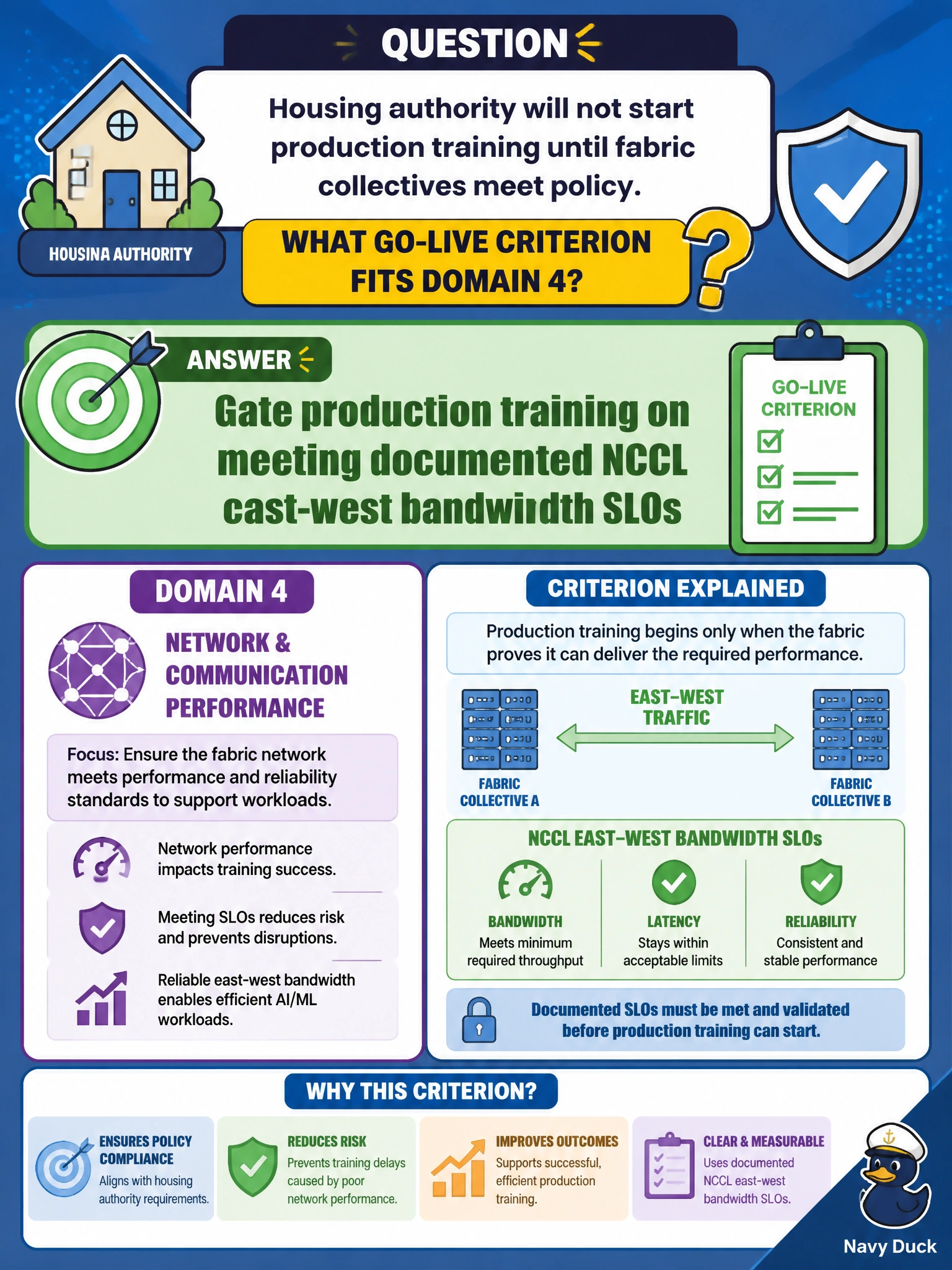
Housing authority will not start production training until fabric collectives meet policy. What go-live criterion fits Domain 4?
Select an answer to reveal the explanation.
Short Explanation
Housing training stays behind the velvet rope until NCCL E/W bandwidth hits the written SLO—green link lights are not a hall pass.
Full Explanation
Housing authority go-live for production training should gate on meeting documented NCCL east-west bandwidth SLOs so the municipal fabric is proven capable of sustaining collectives before tenant jobs arrive. Domain 4 treats E/W NCCL results as an acceptance control, not optional decoration after users are already training. Starting training whenever any NIC link light is green only proves link detection; it does not quantify collective bandwidth, congestion, or scaling under load. Treating fabric bandwidth SLOs as optional decoration invites unverified infrastructure risk and weakens accountability when housing ML jobs stall on the interconnect. Going live first and measuring NCCL only after tenant complaints reverses the verification order Domain 4 expects and turns production pain into the discovery mechanism. Exam caveat: SLOs must be written against the designed topology and job class—copying another city’s number without matching rail count, GPU generation, or fabric media can create false passes or false fails. Operational check: before housing production training, run the documented multi-node NCCL suite, compare results to the published E/W bandwidth SLO, record pass/fail in the go-live package, and keep training gated until the fabric clears that bar.