
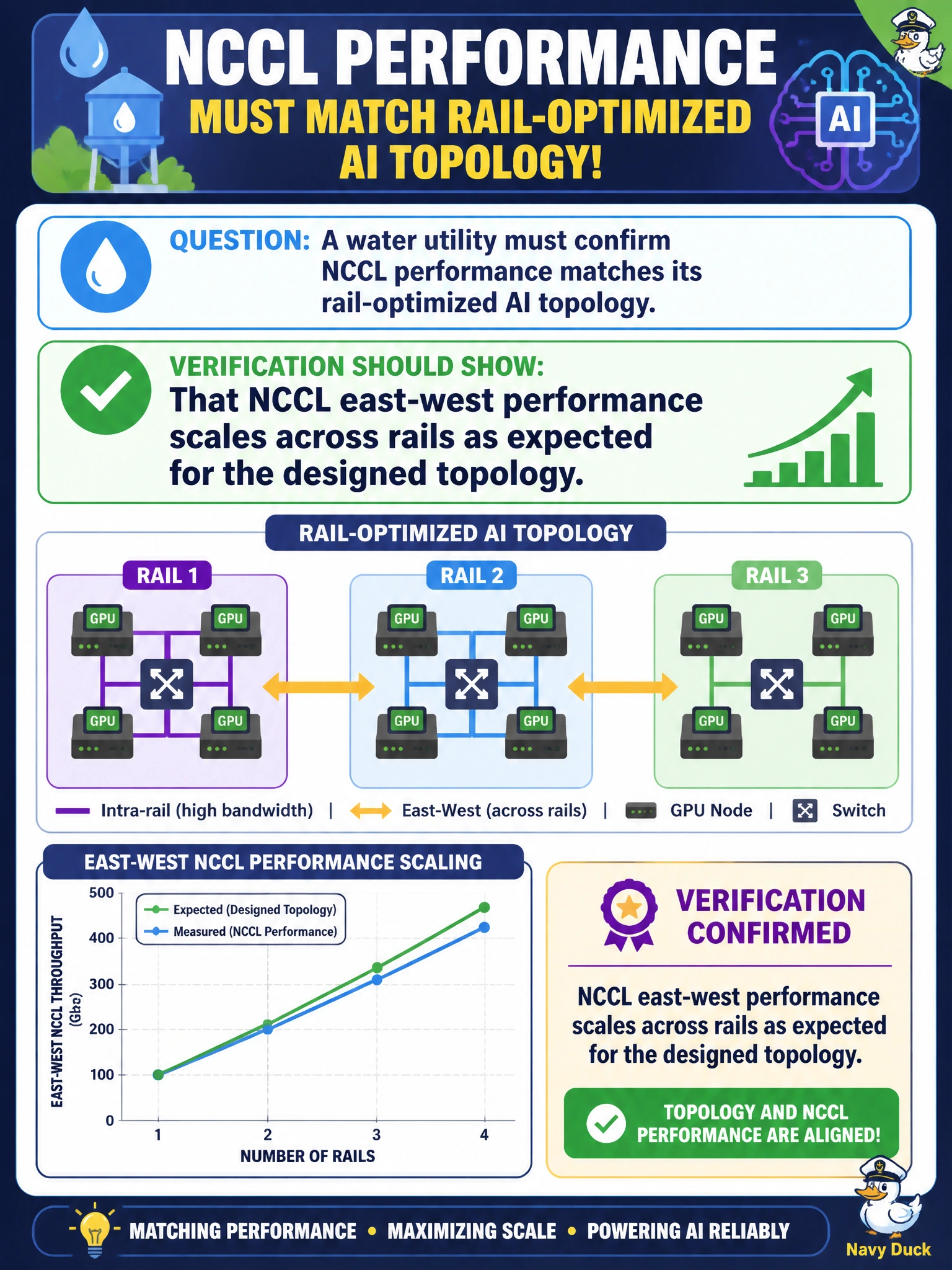
A water utility must confirm NCCL performance matches its rail-optimized AI topology. What should verification show?
Select an answer to reveal the explanation.
Short Explanation
Rail-optimized water-utility fabric? NCCL should climb the rails the way the design drawing says—not just pass a management ping and call it a day.
Full Explanation
Water-utility verification must show that NCCL east-west performance scales across rails as expected for the designed rail-optimized AI topology. Domain 4 fabric acceptance is topology-aware: collectives should behave consistently with rail mappings and non-blocking intent, not merely produce some non-zero bandwidth on a random path. Allowing NCCL results to ignore rails as long as ping succeeds confuses basic IP reachability with GPU collective performance on the AI fabric. Treating only management-plane bandwidth as what matters for training collectives validates the wrong plane; management links do not carry NCCL all-reduce traffic at training scale. Signing off the whole fabric from any random pair of GPUs can miss rail imbalance, leaf oversubscription, or broken paths that appear only when more GPUs or rails participate. Exam caveat: “scales across rails as expected” means comparing measured NCCL behavior to the design’s rail count, membership, and bandwidth model—passing one happy pair is not the same as proving the intended topology. Operational check: for the water utility, run NCCL east-west tests that intentionally span rails per the design drawing, compare bandwidth and scaling to the topology plan, and withhold fabric sign-off until rail-level collective behavior matches the AI factory design.