
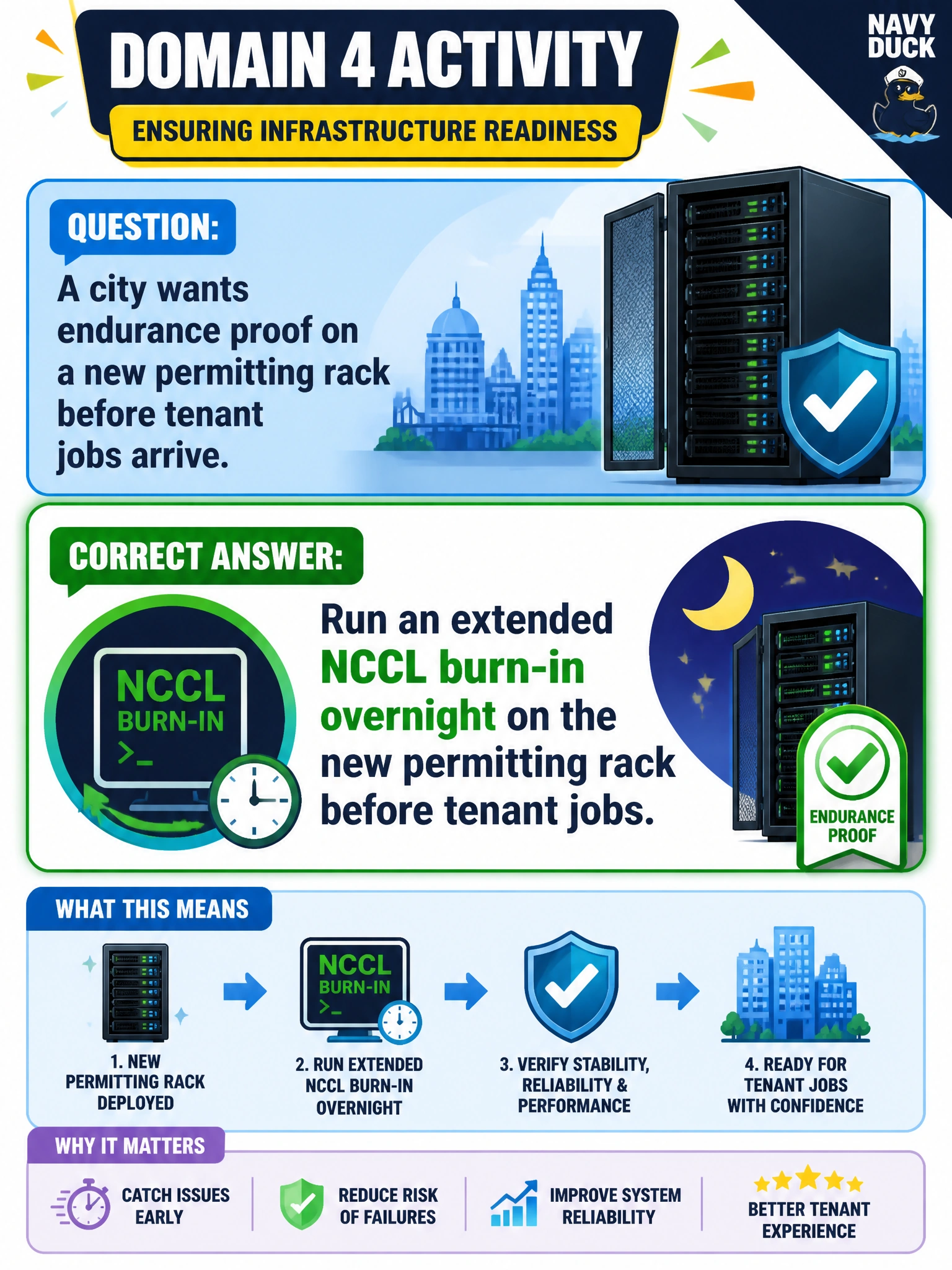
A city wants endurance proof on a new permitting rack before tenant jobs arrive. What Domain 4 activity is required?
Select an answer to reveal the explanation.
Short Explanation
New permitting racks earn tenant time with an overnight NCCL burn-in—not a polite five-second ping and a hopeful shrug.
Full Explanation
A new municipal permitting rack needs extended NCCL burn-in overnight before tenant jobs so Domain 4 endurance validation can expose intermittent link, GPU, and fabric faults under sustained collectives. Short connectivity checks rarely accumulate the error counts or thermal stress that appear only after hours of all-reduce traffic. Running a five-second ping sweep and declaring the rack burned in proves little more than ICMP reachability and cannot stand in for collective endurance. Rebooting once and assuming endurance without collective load verifies boot success, not sustained fabric or GPU communication stability. Skipping burn-in because HPL was run on a different site years ago imports irrelevant historical evidence and ignores local cabling, switches, and GPUs on this permitting rack. Exam caveat: burn-in duration and failure thresholds should be policy-defined; “overnight” is illustrative of multi-hour endurance, not a magic constant that replaces written municipal criteria. Operational check: schedule extended NCCL burn-in on the new permitting rack, capture bandwidth, XID, and link-error trends for the full window, and release tenant placement only after the rack meets the documented endurance pass criteria.