
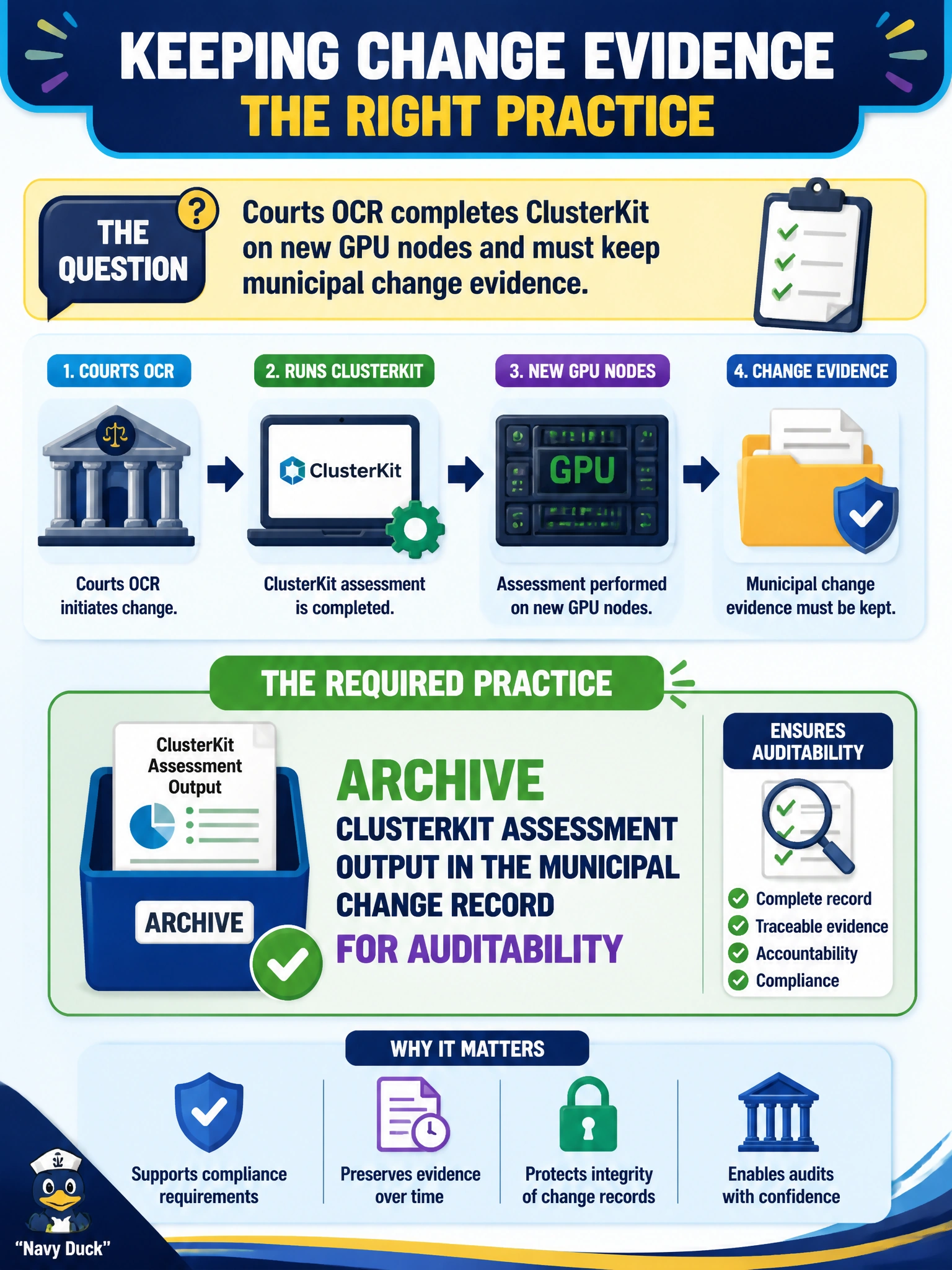
Courts OCR completes ClusterKit on new GPU nodes and must keep municipal change evidence. What practice is required?
Select an answer to reveal the explanation.
Short Explanation
You’ll want to keep the ClusterKit assessment output with the municipal change record, so auditors can see what passed. That gives you durable evidence instead of relying on memory or a record that doesn’t show the assessment results.
Full Explanation
Courts OCR acceptance requires archiving ClusterKit assessment output in the municipal change record so auditors can reconstruct which GPU nodes were tested, what checks ran, and what results were observed. Keeping this evidence supports later regression review after firmware, cabling, or topology changes. Deleting ClusterKit output after review, on the assumption that the assessment can be rerun for an auditor, removes the structured proof of what passed at the time of the change; a later run cannot establish those original results. Relying on hallway memory of which nodes looked green is informal and non-repeatable, and cannot provide timestamps, metrics, or failure modes if a dispute arises months later. Archiving only the BMC login banner records console reachability, not ClusterKit’s GPU, fabric, and cluster-health assessments, so it does not document the acceptance checks. Exam caveat: follow retention policies and preserve the ClusterKit assessment output, such as summaries, logs, and pass/fail matrices, without treating “keep evidence” as a requirement to retain unbounded raw dumps forever without classification. Practical check: after ClusterKit completes on the new GPU nodes, attach its assessment package to the change record, verify the ticket ID matches the tested node serials, and confirm another operator can reopen the evidence without relying on anyone’s memory.