
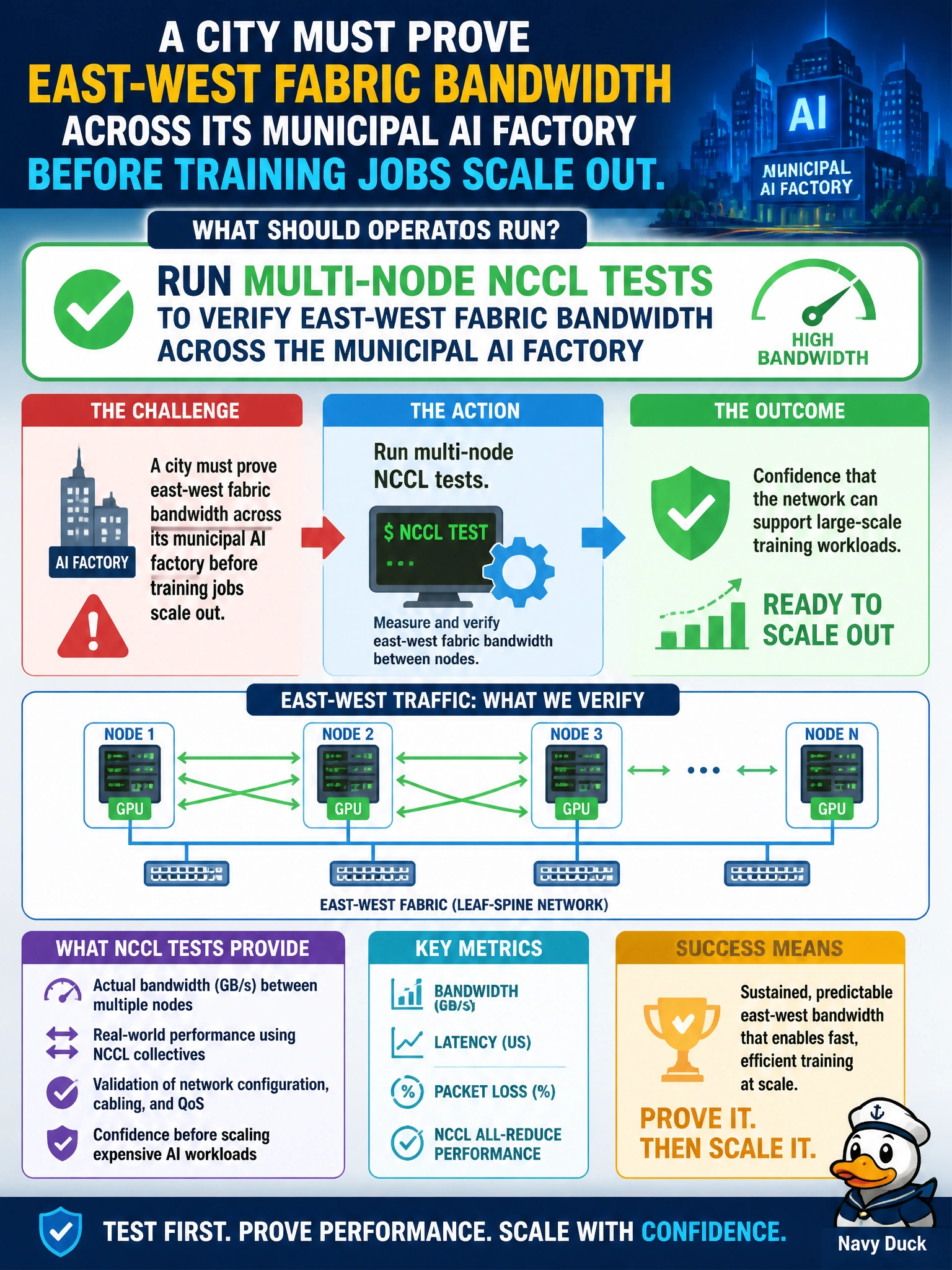
A city must prove east-west fabric bandwidth across its municipal AI factory before training jobs scale out. What should operators run?
Select an answer to reveal the explanation.
Short Explanation
Want proof the city AI fabric can move traffic side-to-side? Multi-node NCCL is the tape measure—stickers and idle fans do not count.
Full Explanation
Before municipal AI training scales out, the city must prove east-west fabric bandwidth with multi-node NCCL tests that exercise collectives across the AI factory interconnect. NCCL all-reduce and related patterns stress the same communication paths training jobs use, so measured bandwidth and scaling behavior become the objective gate for Domain 4 fabric verification. Checking only idle BMC temperatures and skipping fabric collectives validates environmental sensors, not bisection or rail throughput under GPU communication load. Measuring only single-GPU nvidia-smi clocks as a fabric substitute confirms local device clocks, not cross-node collective bandwidth on the east-west fabric. Declaring E/W bandwidth ready based on rack label stickers alone substitutes marketing or design intent for measured performance and cannot detect cabling mistakes, congestion, or oversubscription. Exam caveat: NCCL results must be interpreted against the designed topology and expected per-rail or per-hop bandwidth—not against an arbitrary “any number is fine” bar—and media type (Ethernet versus InfiniBand) still matters for absolute targets. Operational check: run multi-node NCCL from representative GPU nodes spanning the city’s AI factory rails, record bandwidth and scaling curves in the change package, and block scale-out training until results meet the documented east-west design target.