
Transit ops finishes a major firmware window on the GPU fleet. What ClusterKit practice should follow?
Select an answer to reveal the explanation.
Short Explanation
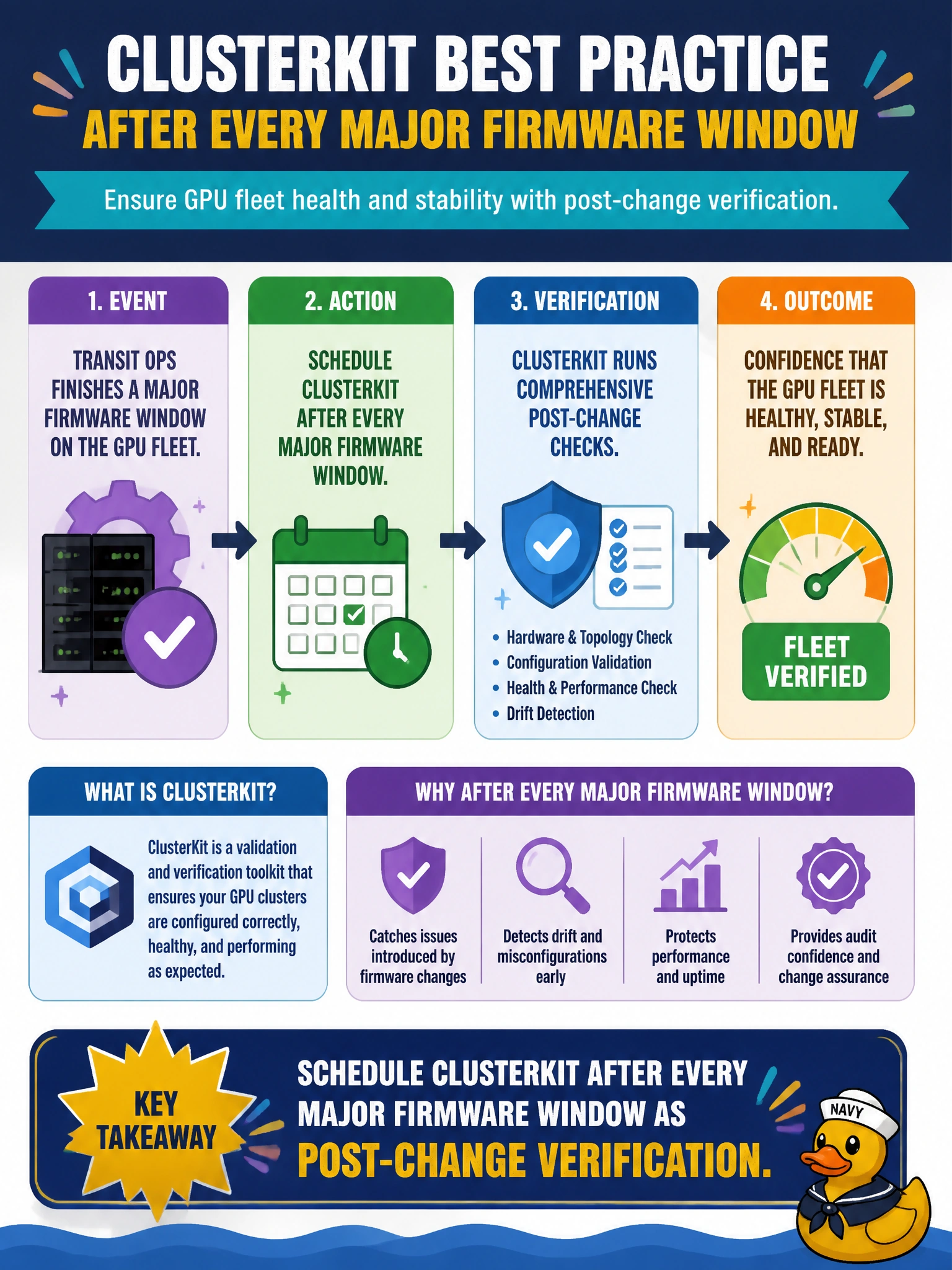
When you finish a major firmware window on the transit GPU fleet, schedule ClusterKit afterward as post-change verification. You’ll catch problems that a standup update or waiting for production failures could miss.
Full Explanation
After transit ops finishes a major firmware window on the GPU fleet, Domain 4 positions ClusterKit as structured post-change verification before tenants return to the fabric. Scheduling ClusterKit after every major firmware window detects regressions across compute and network checks that firmware waves commonly introduce, even when the update command succeeded. Skipping ClusterKit on the assumption that firmware updates never regress nodes ignores a frequent real-world failure mode and leaves silent damage in the fleet. Running ClusterKit only on nodes with confirmed production failures waits for rider impact instead of catching defects during the maintenance window. Replacing ClusterKit with an informal standup status update substitutes anecdote for measurement and cannot compare results against baselines. Exam caveat: not every tiny microcode tweak on a single accessory may need a full suite, but major firmware windows on GPU fleets do require structured verification. Practical check: after the transit firmware window, schedule ClusterKit fleet-wide or by change cohort, compare results with pre-change baselines, remediate regressions, retain reports with the change record, and only then reopen scheduling for production jobs.