
County health ClusterKit output fails in a way that points to network versus GPU. What should operators do with the results?
Select an answer to reveal the explanation.
Short Explanation
ClusterKit isn't a yes/no sticker—read the failing bits so county health can tell a sick NIC from a sick GPU before swapping the wrong part.
Full Explanation
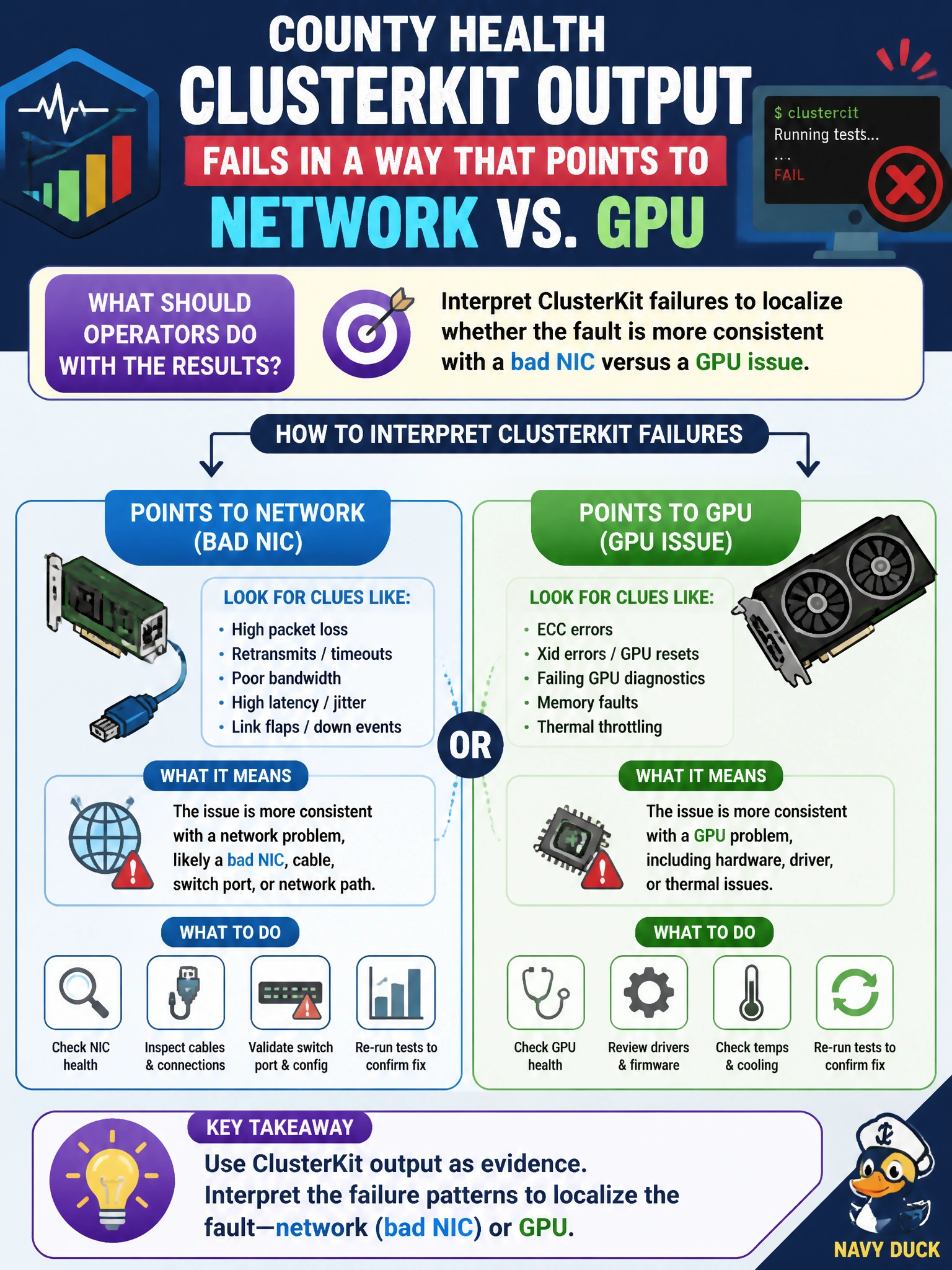
County health ClusterKit output that fails in a pattern pointing to network versus GPU is useful only if operators interpret it for localization instead of treating it as a vague red light. Interpreting ClusterKit failures to localize whether the fault is more consistent with a bad NIC versus a GPU issue focuses remediation on the implicated subsystem and avoids shotgun FRU swaps that waste parts and time. Ignoring failing subtests and accepting the node anyway discards the assessment’s purpose and imports known defects into the county health cluster. Treating every ClusterKit failure as solely a cooling problem applies one generic cause to diverse compute and network signals. Deleting ClusterKit logs before triage begins destroys the evidence needed for vendor escalation, RMA, and root-cause review. Domain 4 expects operators to use multifaceted assessment output for triage, not as a binary sticker or disposable noise. Caveat: some failures are environmental or cabling upstream of the NIC; localization still starts from which ClusterKit domains failed and what they implicate. Operational check: read the county health ClusterKit report by subsystem, map network-heavy failures to NIC/cable/switch paths and GPU-heavy failures to device/SMI paths, replace or retest the implicated component, and rerun ClusterKit before acceptance.