
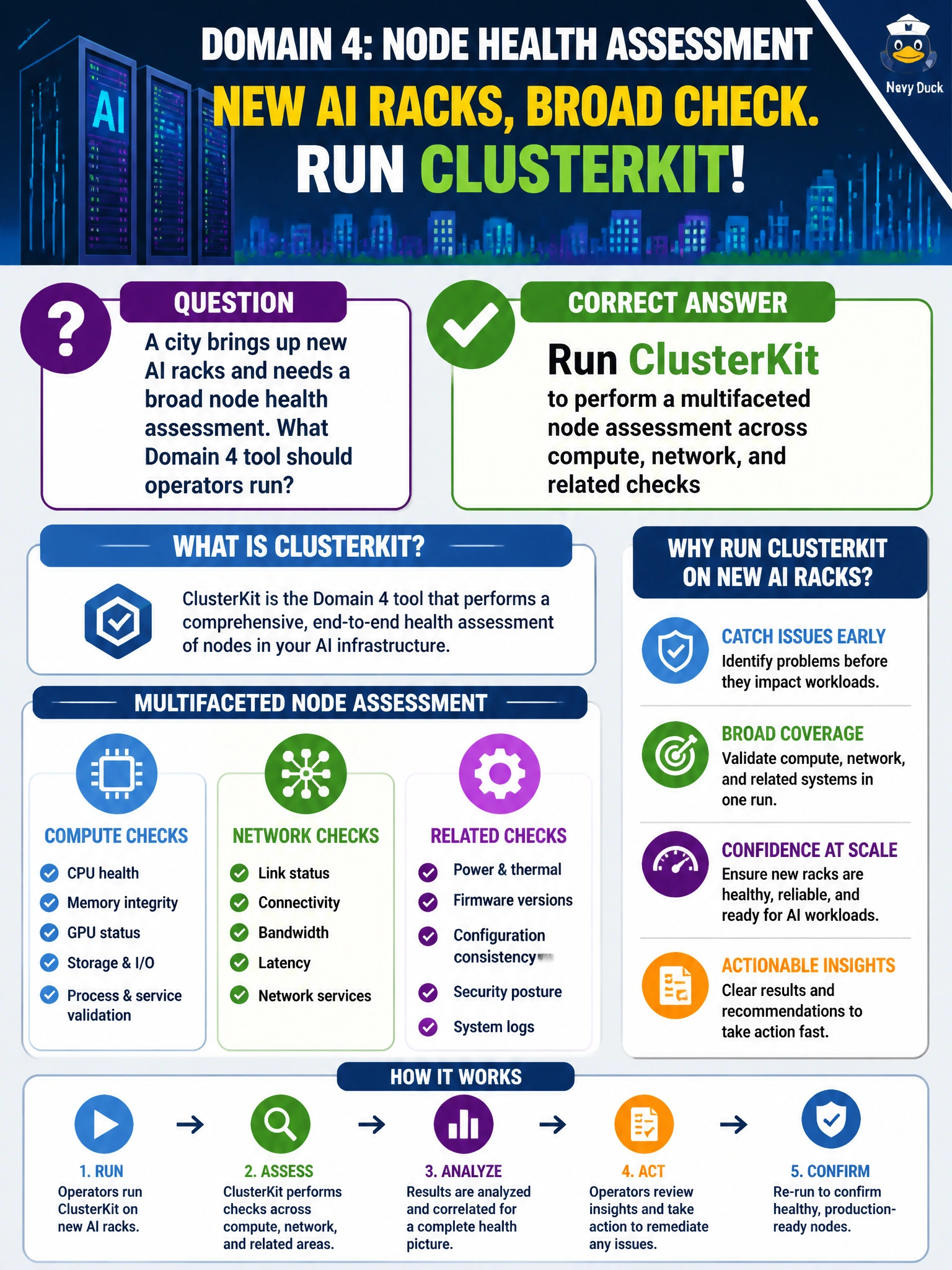
A city brings up new AI racks and needs a broad node health assessment. What Domain 4 tool should operators run?
Select an answer to reveal the explanation.
Short Explanation
For new city AI racks, you need more than a single ping or an LED check. Run ClusterKit to assess compute, network, and related node health checks before workloads arrive.
Full Explanation
When a city brings up new AI racks, Domain 4 skill 4.9 calls for a broad, structured node health assessment—not a single shallow probe. Running ClusterKit for a multifaceted assessment across compute, network, and related checks gives operators coverage suited to AI-factory risk before municipal workloads arrive. A single ping to the management VLAN gateway proves only limited Layer 3 reachability on the admin path; it says nothing about GPU health or fabric collectives. Manual eyeballing of front-panel LEDs without structured tests cannot quantify GPU, NIC, memory, or fabric health or provide pass/fail evidence. Production tenant jobs as the first and only assessment make citizens’ workloads the burn-in suite and may reveal defects only after they affect service. Exam caveat: site-specific wrappers may orchestrate ClusterKit; the requirement is a multifaceted assessment with retained results, not a particular UI brand. Practical check: after rack power, BMC, and basic fabric readiness, run ClusterKit across the new nodes, retain the reports, remediate failures, and clear only nodes that pass the agreed compute and network gates.