
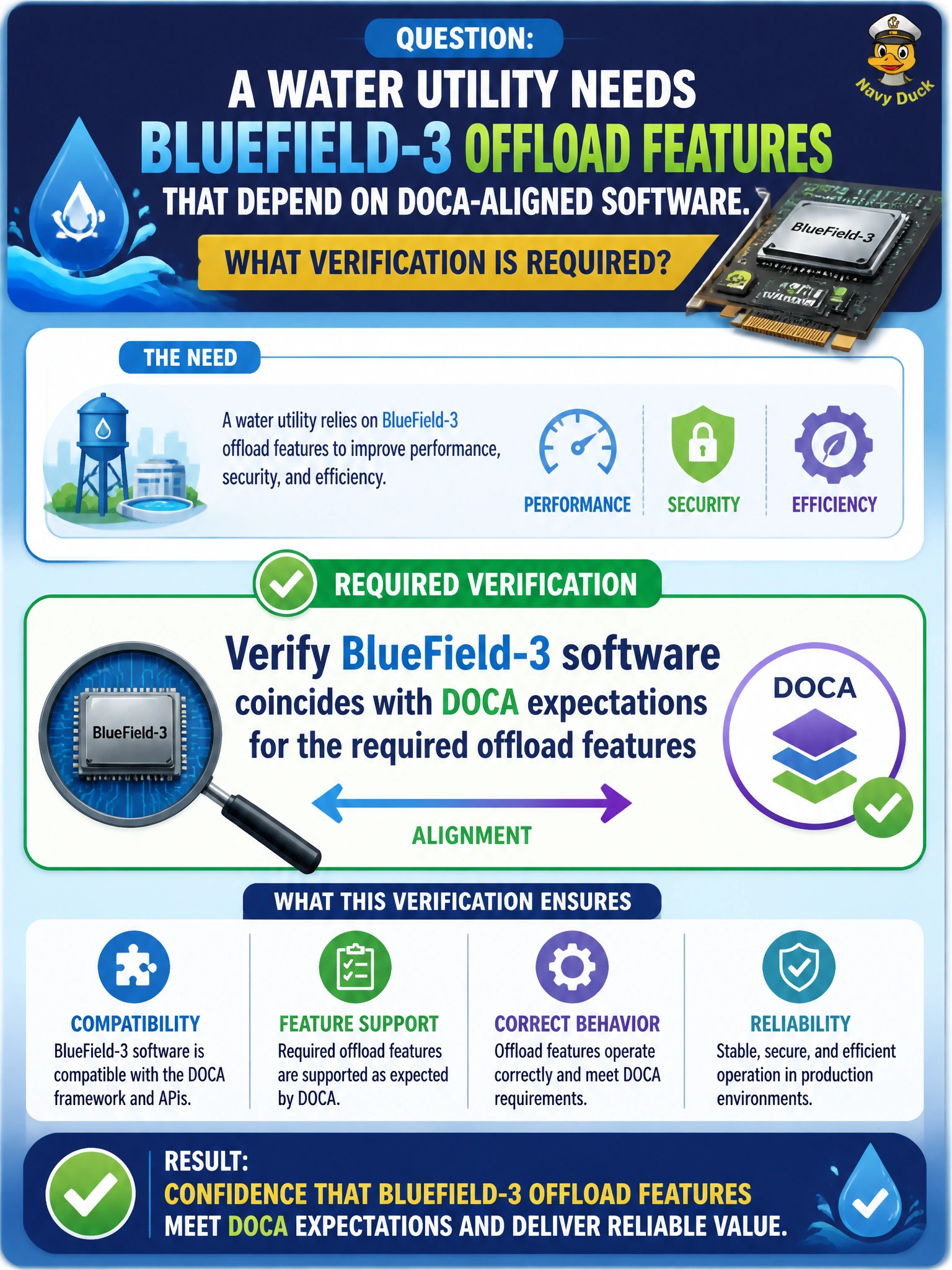
A water utility needs BlueField-3 offload features that depend on DOCA-aligned software. What verification is required?
Select an answer to reveal the explanation.
Short Explanation
If the water utility needs DOCA offloads, prove the BlueField-3 software lines up with those expectations—enumeration and link lights don't unlock features by magic.
Full Explanation
A water utility that needs BlueField-3 offload features dependent on DOCA-aligned software must verify software fitness, not mere device presence on the bus. Verifying BlueField-3 software coincides with DOCA expectations for the required offload features ensures the DPU can deliver the platform capabilities the digital-twin design assumes under load. Verifying only that the DPU PCIe device enumerates proves the host sees a device, not that DOCA-aligned services, firmware, and feature flags are correct. Ignoring software levels if any network port shows link confuses PHY link-up with offload readiness and feature enablement. Assuming offload features work on any BlueField-3 revision without checks skips the compatibility matrix that Domain 4 skill 4.7 expects operators to honor before declaring the node feature-complete. Exam writers often offer enumeration or link as sufficient; for DOCA-dependent designs they are necessary but not sufficient. Caveat: feature readiness is a software alignment problem even when hardware SKUs look identical on the faceplate. Operational check: on water-utility DPU nodes, confirm BF3 software/DOCA levels against the offload feature matrix, validate a representative offload or DOCA self-test where available, and only then declare offload-capable acceptance.