
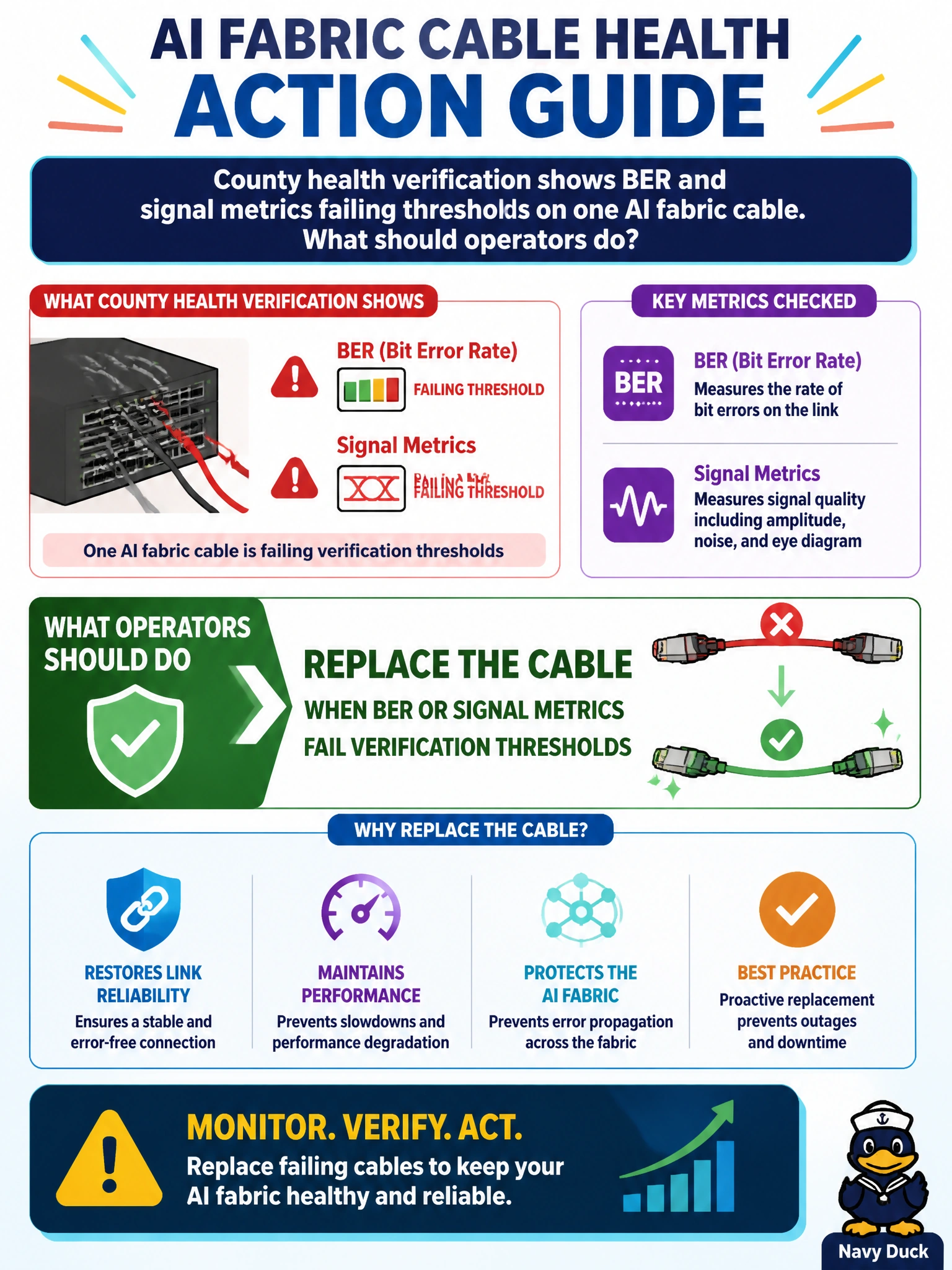
County health verification shows BER and signal metrics failing thresholds on one AI fabric cable. What should operators do?
Select an answer to reveal the explanation.
Short Explanation
You’re right to act on the verification results: a link-up port does not make failing BER or signal metrics safe. Replace the cable if those metrics fail their thresholds, rather than ignoring the faults, lowering the threshold, or relying on training workloads to conceal them.
Full Explanation
When county health verification shows BER or signal metrics failing their thresholds, the AI fabric cable has not passed acceptance, even if the port reports link-up. Replace the cable when verification thresholds fail so the county health cluster does not inherit a verified physical-layer fault. Ignoring the metrics because the port is link-up confuses link status with reliable transport; high BER can still disrupt collective communication and storage I/O under load. Lowering the threshold until the cable passes on paper changes the acceptance gate rather than correcting the measured failure. Keeping the cable deployed and relying on training workloads to conceal the faults makes production jobs bear the impact of errors instead of resolving the cause. Exam caveat: confirm that the applicable threshold profile is correct before acting, but do not waive a verified failure. Practical check: repeat the BER and signal measurements against the correct thresholds; if they still fail, replace the cable, revalidate it, and record the verification before returning the path to service.