
A city must declare an AI fabric row ready and needs proof interconnects are healthy. What cable validation should operators perform?
Select an answer to reveal the explanation.
Short Explanation
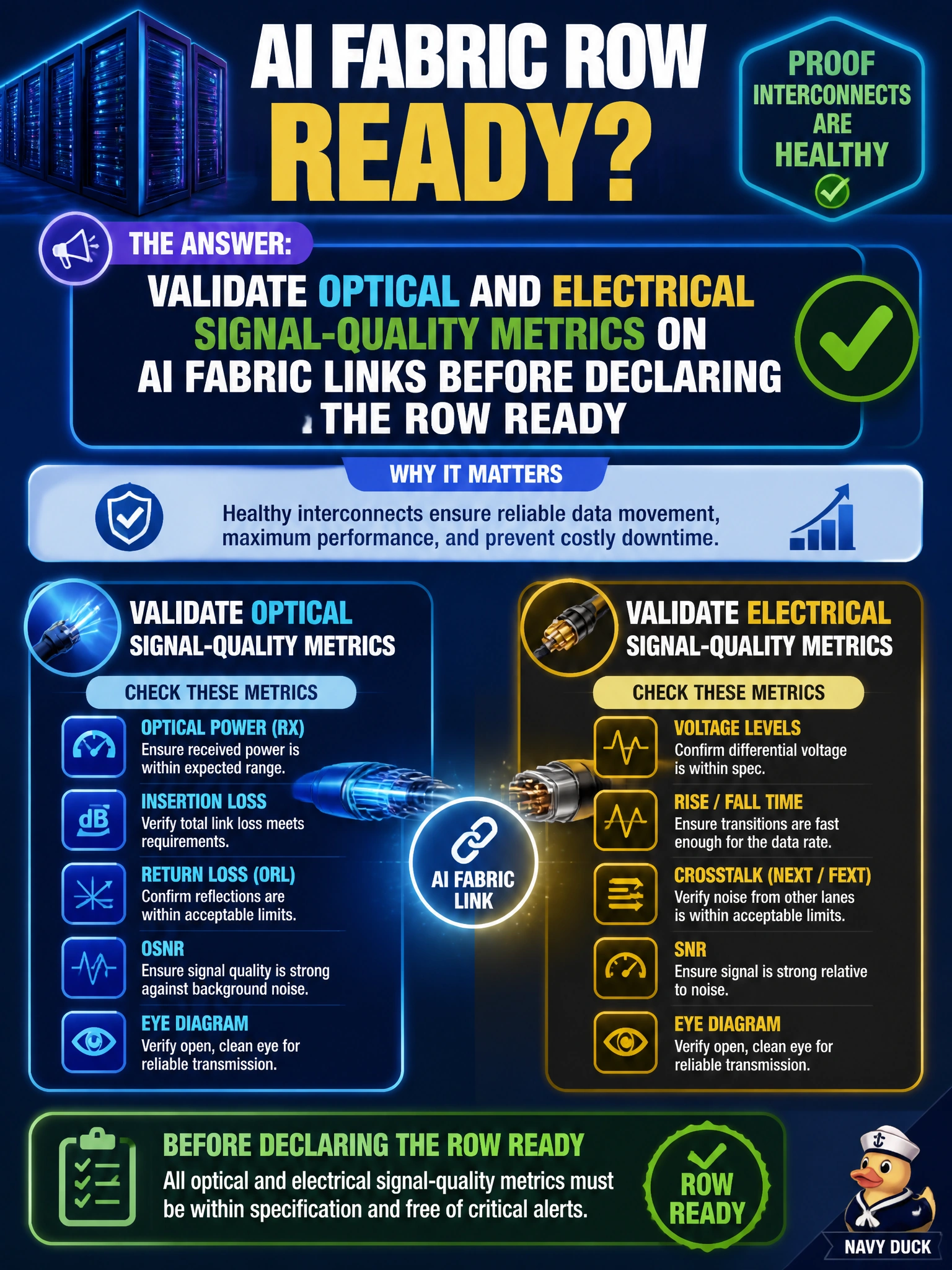
You’re right to look beyond appearance: cable color matching and sticker presence alone don’t verify a healthy link, and waiting for tenant complaints leaves problems undiscovered until production. Before declaring the row ready, check measured optical and electrical signal-quality metrics on each AI fabric link.
Full Explanation
Before a city declares an AI fabric row ready, operators need objective proof that interconnects can carry collective and inference traffic without silent degradation. Validating optical and electrical signal-quality metrics on AI fabric links—such as Rx/Tx power, BER, eye metrics, or vendor equivalents—provides pass/fail evidence for the municipal acceptance package. Accepting the row after only visual cable color matching confirms cosmetics and labeling habits, not that photons or electrons meet thresholds on every lane. Skipping signal checks and relying solely on later tenant complaints makes production workloads the discovery mechanism for bad DACs, dirty optics, or marginal links. Marking every link green based on sticker presence alone confuses inventory hygiene with physical-layer health. On the NCP-AII exam, Domain 4 skill 4.4 distinguishes cable signal-quality validation from superficial link or labeling cues; the exam caveat is that appearance or eventual user complaints are not verification. Platforms may expose metrics through switch CLI, DPU tooling, or vendor cable certifiers, provided thresholds are documented. As a practical check, capture each new-row city fabric link’s readings against the approved threshold table, record pass/fail per link, and withhold row-ready status until failing links are remediated.