
Courts OCR finishes hardware install on multi-GPU servers and needs a reference for later regressions. What single-node NCCL practice is required?
Select an answer to reveal the explanation.
Short Explanation
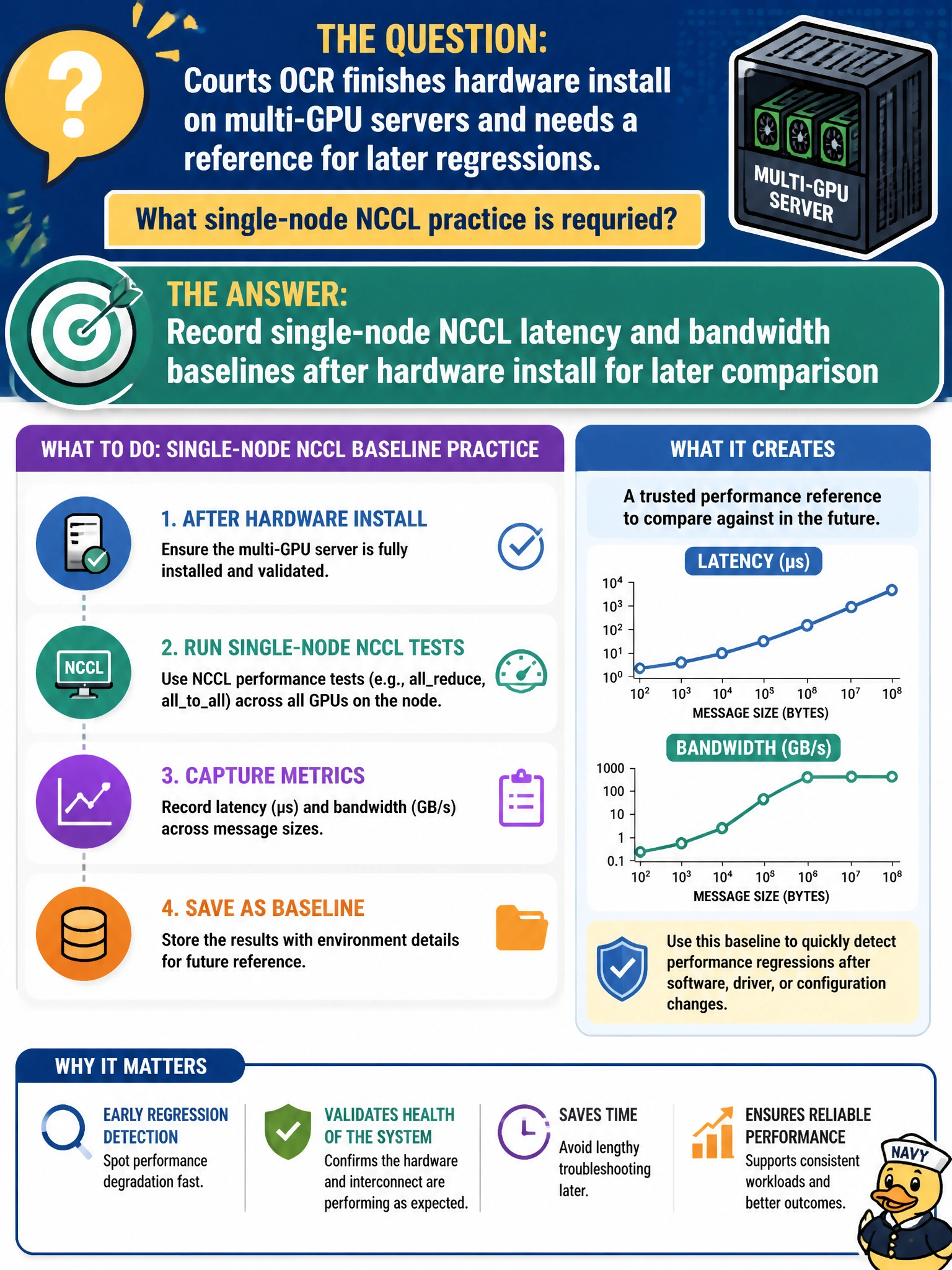
Write down those single-node NCCL latency and bandwidth numbers after install—future you (and the courts OCR farm) will need that yardstick.
Full Explanation
After courts OCR finishes hardware install on multi-GPU servers, operators must record single-node NCCL latency and bandwidth baselines for later comparison. Documented baselines turn future firmware changes, reseats, driver updates, and intermittent interconnect issues into measurable regressions instead of hallway anecdotes that cannot support change control or audit.
Discarding NCCL metrics after each reboot fails by concept because it erases the reference needed for trend and change analysis the next time OCR capacity or performance is questioned. Baselining only keyboard LEDs on the console fails as an irrelevant console cosmetic check with no relationship to GPU collective performance. Storing baselines exclusively in verbal hallway conversations fails because undocumented memory is not an auditable Domain 4 verification record for OCR farms or municipal auditors.
Exam caveat: Domain 4 expects retained NCCL baselines as part of cluster test and verification history after install—not ephemeral metrics discarded on reboot and not informal recollection.
Operational check: run the standard single-node NCCL suite post-install, store latency and bandwidth with server identity, firmware and driver versions, and topology snapshot in the courts CMDB or acceptance repo, and require comparison against that baseline after subsequent hardware or firmware work before returning servers to OCR production.