
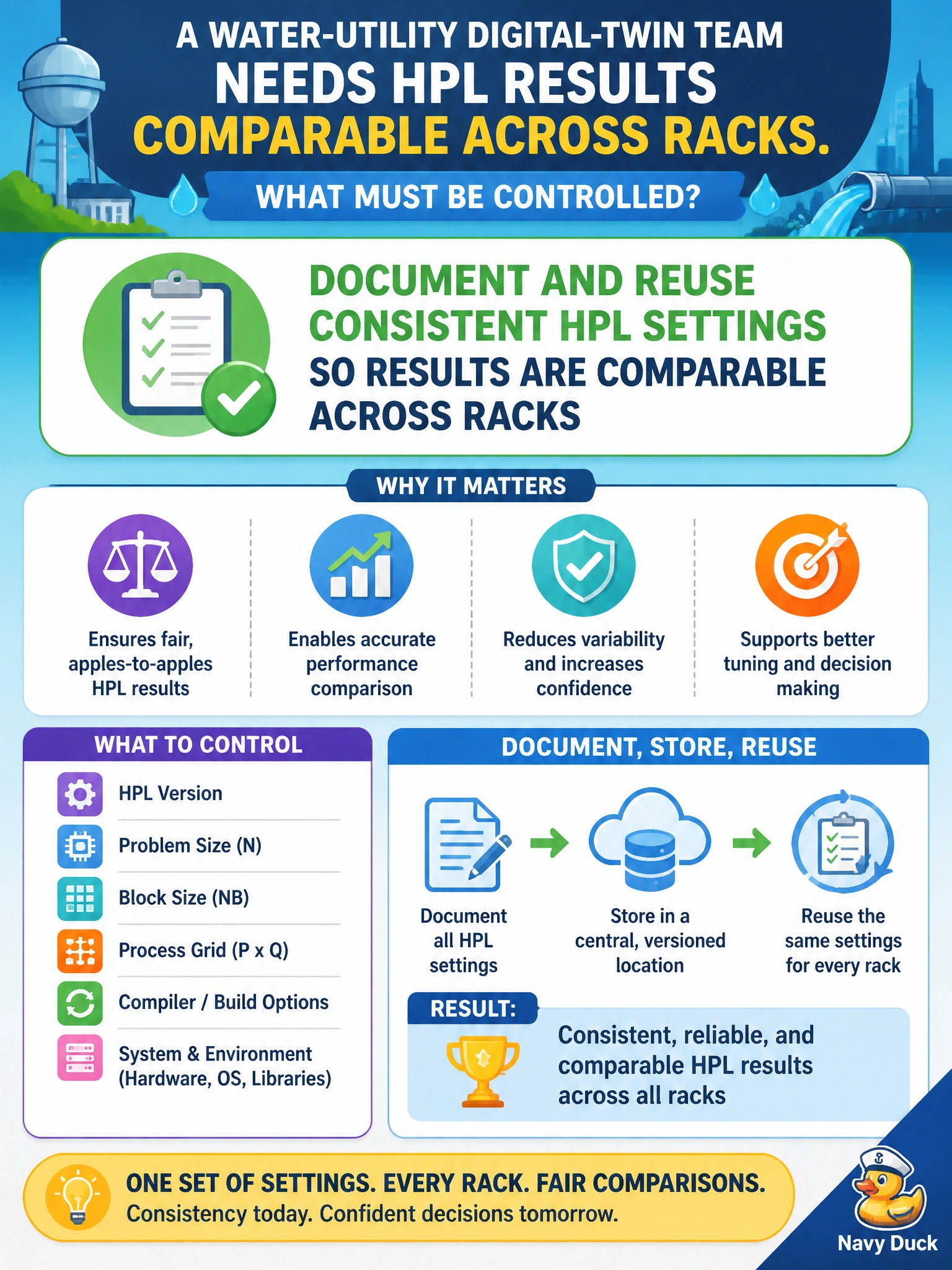
A water-utility digital-twin team needs HPL results comparable across racks. What must be controlled?
Select an answer to reveal the explanation.
Short Explanation
Same HPL recipe across racks—or you're comparing apples to intake pumps. Write the settings down and reuse them.
Full Explanation
A water-utility digital-twin team needing HPL results comparable across racks must document and reuse consistent HPL settings—problem size, process grid, and related flags—so cross-rack comparisons are fair. Without a fixed recipe, “faster” or “slower” racks may simply reflect different parameters rather than true hardware or configuration differences in the municipal fleet.
Randomizing problem size and process grid on every run for novelty fails by concept because novelty destroys comparability and turns acceptance into noise. Allowing each rack to pick undocumented HPL flags fails for the same reason and prevents audit when digital-twin capacity decisions depend on those numbers. Comparing runs only when ambient humidity differs by season fails because seasonal environmental confounds are not a substitute for controlled settings; humidity may matter operationally, but it is not the primary control this Domain 4 question asks for.
Exam caveat: Domain 4 verification discipline emphasizes controlled, documented benchmark parameters for cross-system comparison—consistency first, then interpret environmental factors separately if needed.
Operational check: publish a water-utility HPL parameter sheet, encode it in scripts used on every rack, require acceptance packages to include settings metadata alongside GFLOPS, and reject runs that omit or alter the documented recipe.