
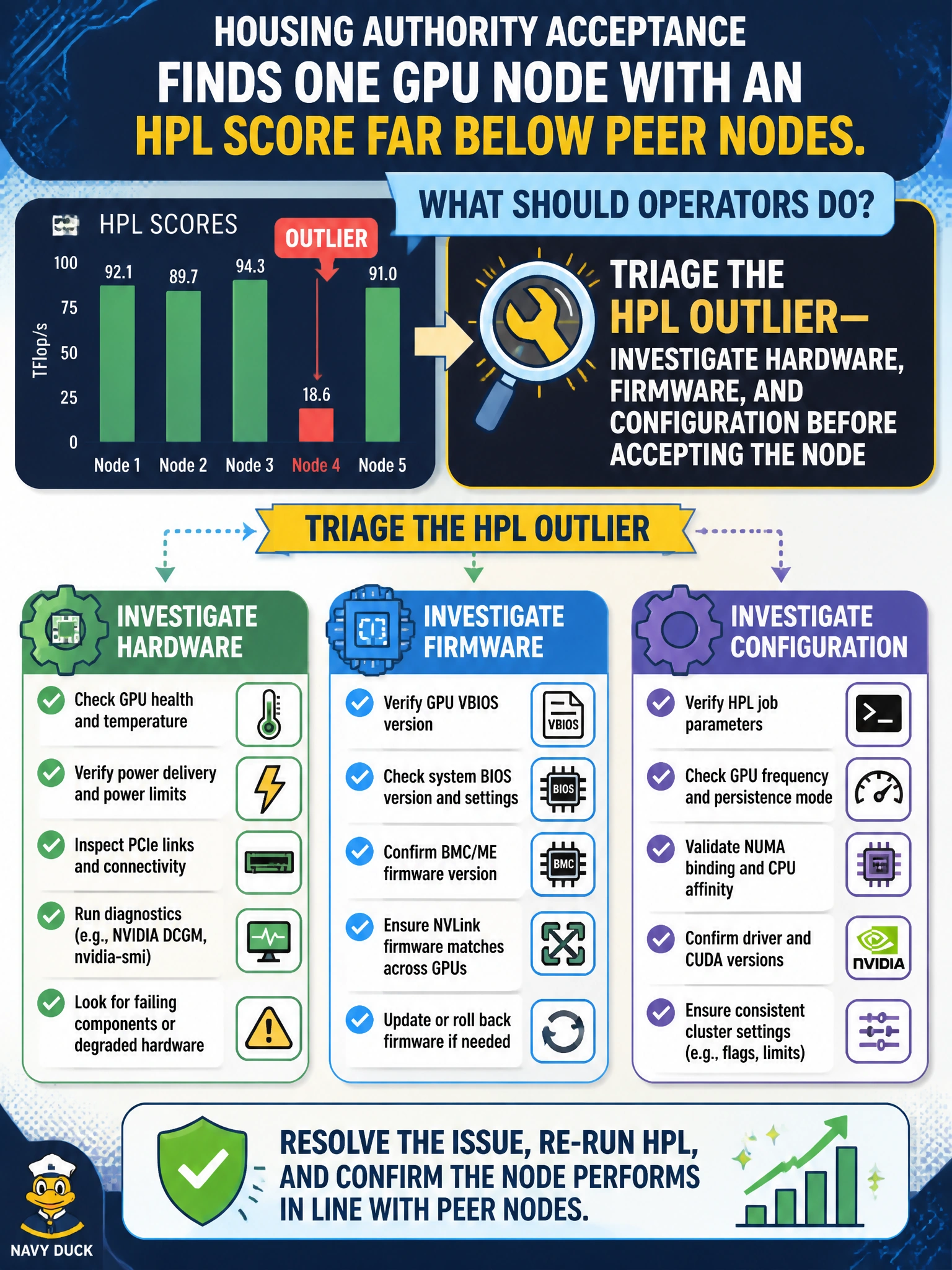
Housing authority acceptance finds one GPU node with an HPL score far below peer nodes. What should operators do?
Select an answer to reveal the explanation.
Short Explanation
One sad HPL score in a peer pack is a clue, not a rounding error—triage that housing node before you call acceptance done.
Full Explanation
When housing authority acceptance finds one GPU node with an HPL score far below peer nodes, operators should triage the outlier—investigate hardware, firmware, and configuration—before accepting the node. Peer divergence under identical settings is a strong signal of a local defect that averaging or peer success cannot erase from the housing analytics pool.
Averaging the outlier with peers and hiding it in the report fails by concept because statistics should not launder a defective node into civic production capacity. Accepting because other nodes scored well fails—the healthy peers do not rehabilitate the weak one and would leave a known underperformer serving municipal jobs. Disabling HPL permanently for the housing cluster fails because removing the benchmark eliminates future detection rather than fixing the host, and it destroys the Domain 4 performance gate the fleet relies on after bring-up and change windows.
Exam caveat: Domain 4 acceptance expects outlier triage relative to peers run with the same HPL recipe, not fleet-level rationalization, report smoothing, or abandonment of Linpack.
Operational check: re-run HPL on the outlier with the standard documented settings, compare nvidia-smi output, ECC counters, clocks, power limits, and firmware levels to peers, pursue remediation or RMA as indicated, and accept the housing node only after it matches peer performance bands under the same recipe.