
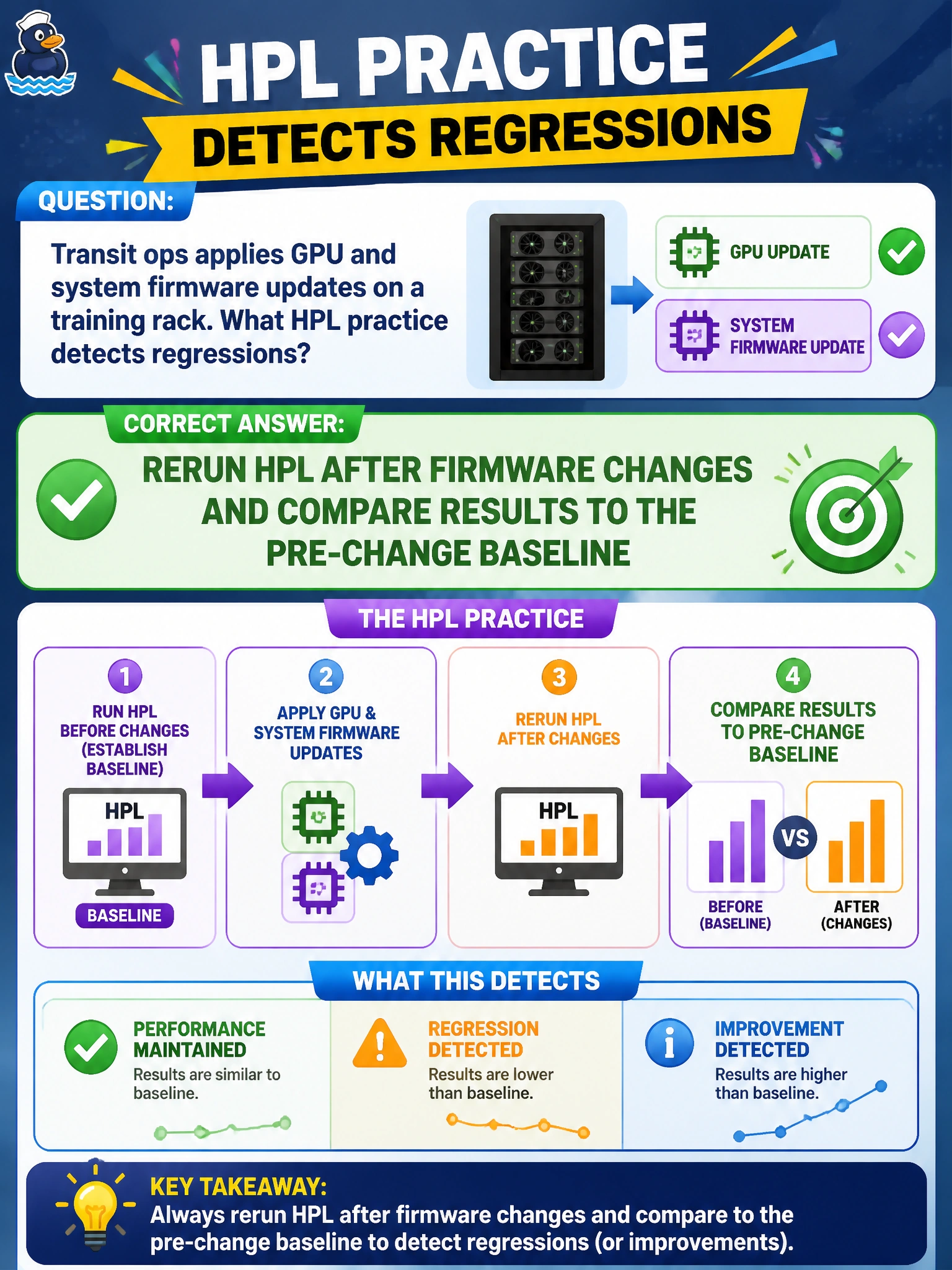
Transit ops applies GPU and system firmware updates on a training rack. What HPL practice detects regressions?
Select an answer to reveal the explanation.
Short Explanation
When firmware changes, rerun HPL and compare the results with the pre-change baseline—that’s how you catch quiet regressions before riders feel them. This comparison helps you spot a performance drop even when the latest run looks plausible on its own.
Full Explanation
After transit ops applies GPU and system firmware updates on a training rack, the HPL practice that detects regressions is to rerun HPL and compare results with the pre-change baseline. Firmware can change clocks, power behavior, and stability; comparing before-and-after benchmarks with identical settings makes quiet throughput loss visible before dependent training pipelines feel it. Never rerunning HPL after firmware changes abandons regression detection precisely when risk is elevated. Archiving old results elsewhere but validating the update using only its latest run leaves no active comparison against the prior performance, so a regression can go unnoticed. Running HPL only on CPU sockets and ignoring GPUs fails to check the GPU side when GPU firmware was updated; GPU-aware HPL remains relevant for training racks after GPU or system firmware work. Exam caveat: Domain 4 treats HPL as a living baseline for change control, not a one-time bring-up result to set aside after the first pass. Practical check: preserve the pre-change HPL results and settings, rerun with identical settings after the update, compare GFLOPS against baseline thresholds, and roll back or remediate if the regression exceeds policy before returning the rack to training.