
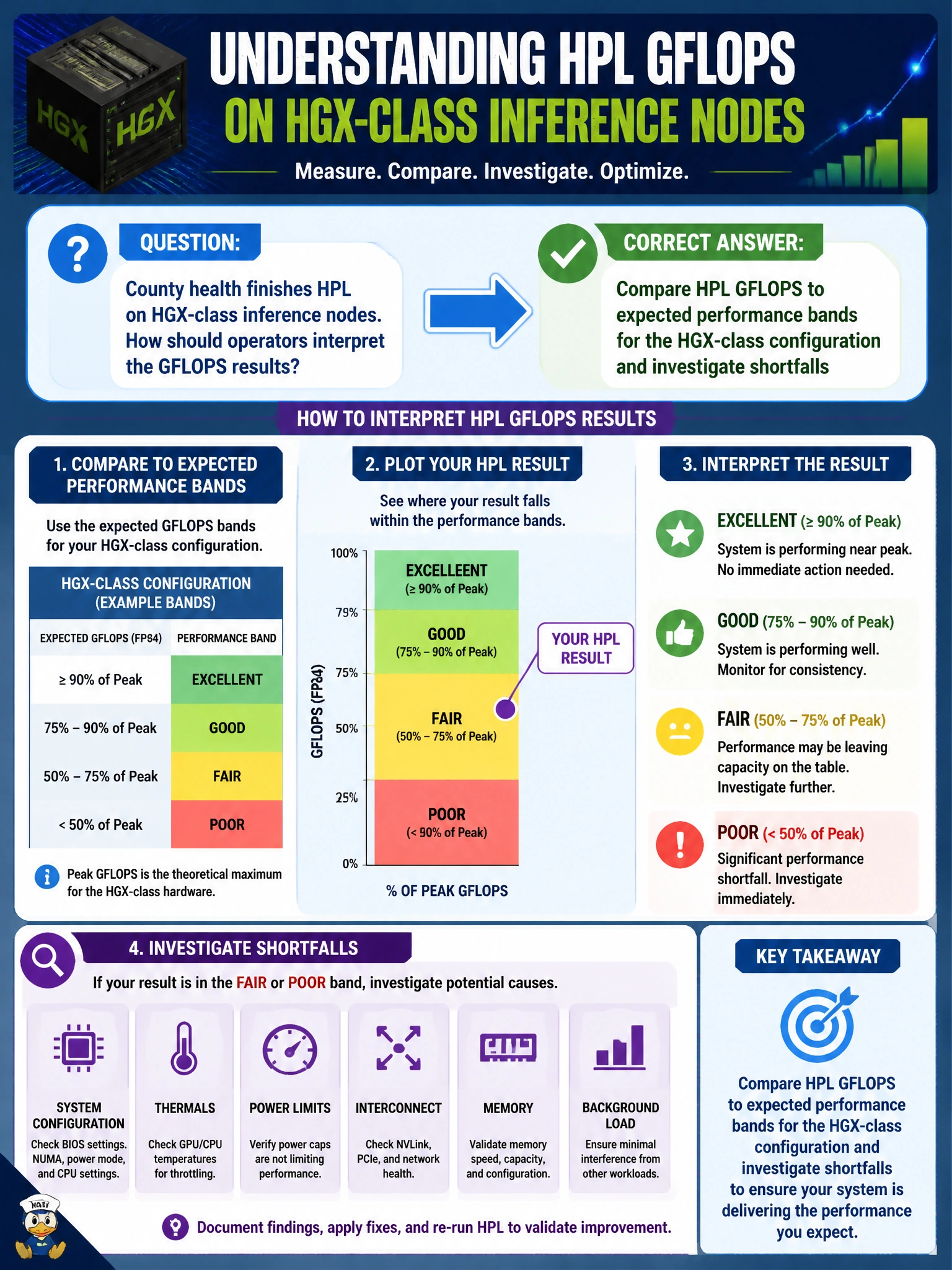
County health finishes HPL on HGX-class inference nodes. How should operators interpret the GFLOPS results?
Select an answer to reveal the explanation.
Short Explanation
Nonzero isn't 'good enough'—stack those HPL GFLOPS against the HGX-class band you expect. Shortfalls deserve a look before flu-season trust.
Full Explanation
County health finishing HPL on HGX-class inference nodes must compare HPL GFLOPS to expected performance bands for that HGX-class configuration and investigate shortfalls. Visibility of GPUs is necessary but not sufficient; Linpack throughput must land in the band implied by the installed GPU count, NVLink topology, and known-good peer results before flu-season production trust.
Accepting any nonzero GFLOPS without reference expectations fails by concept because a severely impaired node can still produce a token nonzero score that looks “successful” without being acceptable. Dividing GFLOPS by BMC users and discarding the rest fails as a nonsensical normalization unrelated to hardware capability or HGX-class ratings. Treating HPL as irrelevant if nvidia-smi lists GPUs fails because device enumeration does not prove sustained floating-point performance under the Domain 4 baseline.
Exam caveat: Domain 4 interpretation of HPL is comparative—against expected bands for the installed configuration—not a binary “nonzero” check and not replaceable by nvidia-smi alone.
Operational check: maintain expected GFLOPS bands for each HGX-class SKU in the health fleet, compare new results to the band and to peer nodes run with identical settings, and open hardware/firmware/power-cap triage when results fall short before accepting the node.