
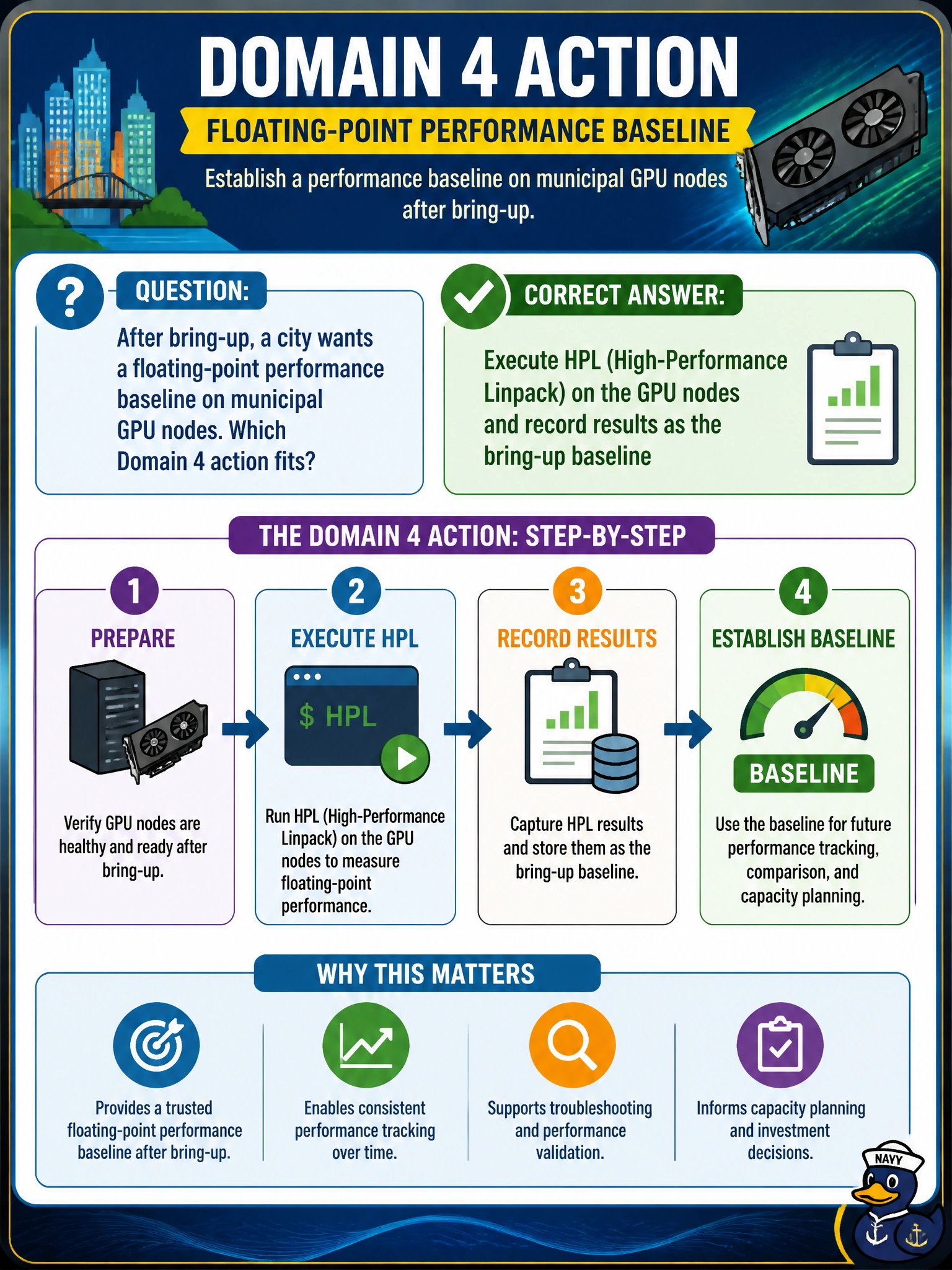
After bring-up, a city wants a floating-point performance baseline on municipal GPU nodes. Which Domain 4 action fits?
Select an answer to reveal the explanation.
Short Explanation
HPL is your municipal stopwatch for floating-point muscle after bring-up—run it and write the numbers down. Portal pings don't baseline GPUs.
Full Explanation
After bring-up, establishing a floating-point performance baseline on municipal GPU nodes is done by executing HPL (High-Performance Linpack) and recording results. HPL provides the Domain 4 compute benchmark reference used later to detect regressions after firmware, driver, BIOS, or hardware changes on city GPU fleets.
Measuring only disk idle temperature fails by concept because storage thermal idle checks are not floating-point GPU/CPU performance baselines and say nothing about Linpack throughput. Replacing HPL with a website uptime ping to the city portal fails because portal availability is an external service check, not node compute capability. Deferring all performance tests until after a year of production incidents fails because acceptance should create the baseline before production reliance, not after outages teach painful lessons about undetected regressions.
Exam caveat: Domain 4 explicitly uses HPL for performance baseline after bring-up. Non-compute “health” distractors (disk temperature, portal pings) are common traps.
Operational check: run HPL with documented problem size and process-grid settings on the municipal GPU nodes, store GFLOPS plus configuration and firmware/driver metadata in the acceptance record, and retain that baseline for mandatory post-change comparisons.