
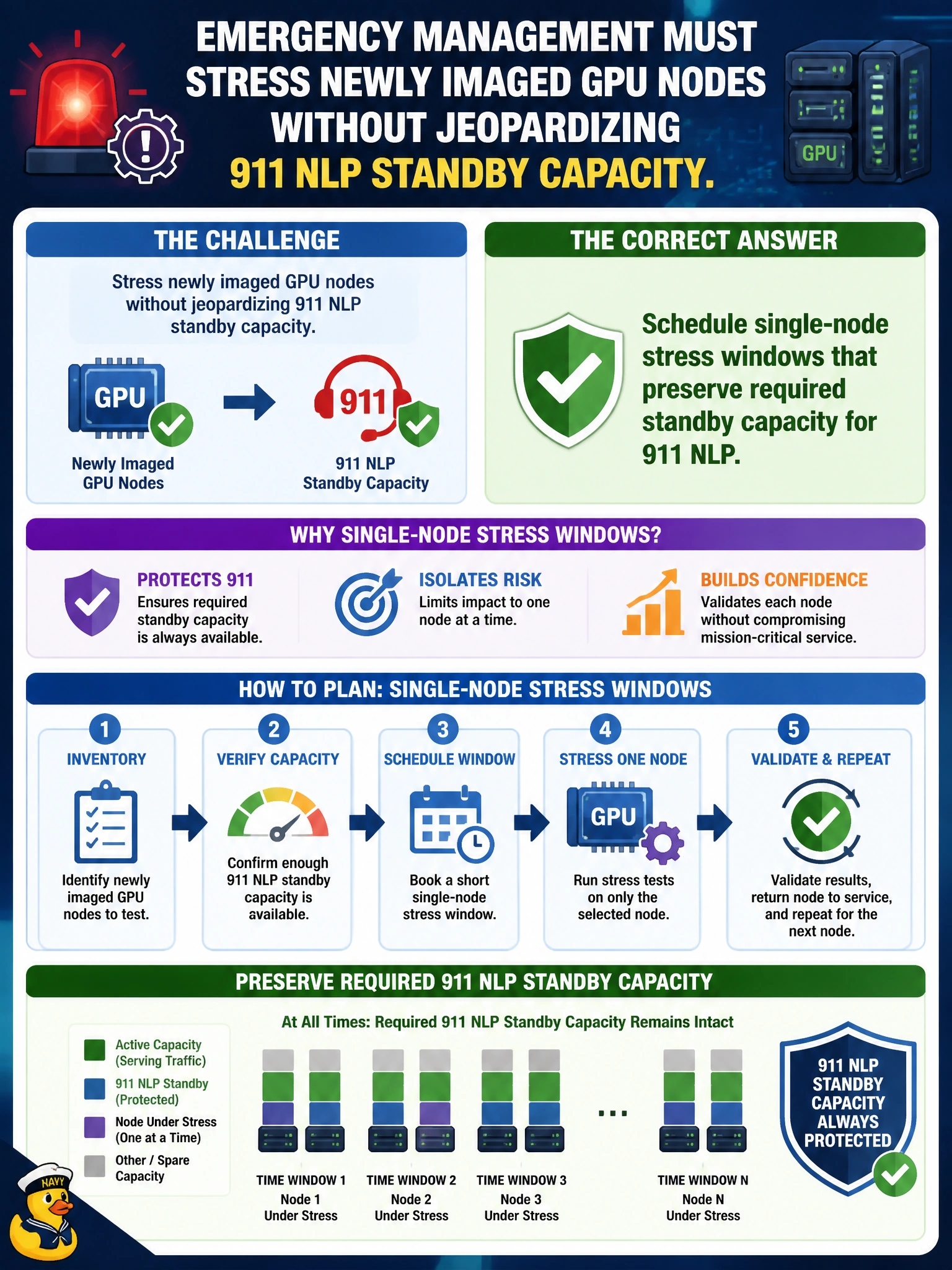
Emergency management must stress newly imaged GPU nodes without jeopardizing 911 NLP standby capacity. How should stress be planned?
Select an answer to reveal the explanation.
Short Explanation
Stress the new boxes, but leave enough 911 NLP standby warm—civic SLOs beat a tidy lab schedule. Plan windows, don't empty the cupboard.
Full Explanation
Emergency management stressing newly imaged GPU nodes must schedule single-node stress windows that preserve required standby capacity for 911 NLP. Verification is mandatory, but civic SLOs for emergency inference take priority over draining every standby host at once for a tidy lab calendar.
Stressing every production standby node simultaneously during peak call volume fails by concept because it removes redundancy exactly when emergency load may spike and leaves no healthy NLP capacity. Disabling 911 NLP services for the entire maintenance month fails as an excessive outage incompatible with emergency continuity and far beyond what Domain 4 single-node stress requires. Running unbounded stress on the only healthy inference host fails because that host is the remaining capacity lifeline; unbounded risk there directly endangers the SLO the city must keep.
Exam caveat: Domain 4 planning questions balance verification thoroughness with operational continuity—especially for life-safety-adjacent municipal services where standby capacity is part of the acceptance plan, not an afterthought.
Operational check: inventory minimum 911 NLP standby requirements, select a subset of newly imaged nodes for each stress window, keep required healthy capacity online and monitored, watch emergency queues during the window, and only rotate the next subset after prior nodes pass and return to standby.