
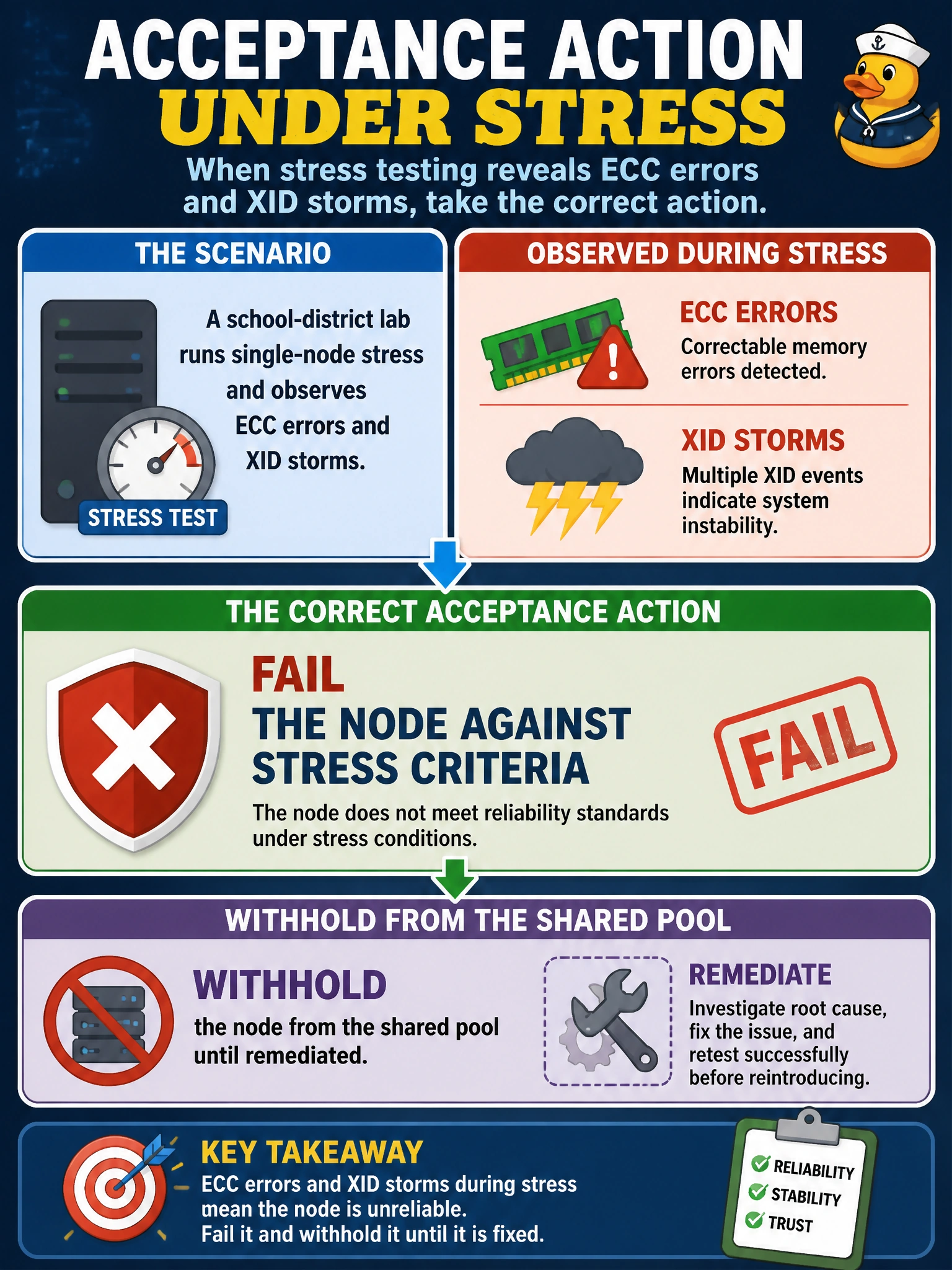
A school-district lab runs single-node stress and observes ECC errors and XID storms. What is the correct acceptance action?
Select an answer to reveal the explanation.
Short Explanation
ECC and XID storms during stress mean the node flunked—don't stamp it ready for the school lab pool. Fix or replace first.
Full Explanation
When a school-district lab’s single-node stress shows ECC errors and XID storms, the correct acceptance action is to fail the node against stress criteria and withhold it from the shared pool until remediated. ECC growth and XID storms under stress are explicit unhealthy GPU error behaviors; promoting such a node risks silent corruption or instability for student and research workloads that share the lab pool.
Clearing counters and accepting without investigation fails by concept because clearing evidence does not repair hardware, seating, power, or firmware root causes—it only erases the signal. Promoting because wall-clock stress finished fails because completion time is not a substitute for error-free health criteria; a node can finish the timer while accumulating fatal device errors. Ignoring GPU errors if the host OS still boots fails because OS boot proves little about accelerator integrity under load and would admit defective GPUs into the school lab fleet.
Exam caveat: Domain 4 failure criteria for stress include GPU error symptoms (ECC/XID), not merely “the job exited” or “Linux still boots.” Candidates are often tempted by finish-time distractors.
Operational check: quarantine the node from the school lab pool immediately, collect nvidia-smi, XID, ECC, and vendor diagnostics, pursue reseat/RMA/firmware remediation per policy, then rerun the full standardized stress profile to a clean pass before any reintroduction.