
County health sees thermal and power warnings only while single-node GPU stress is running. What should operators conclude?
Select an answer to reveal the explanation.
Short Explanation
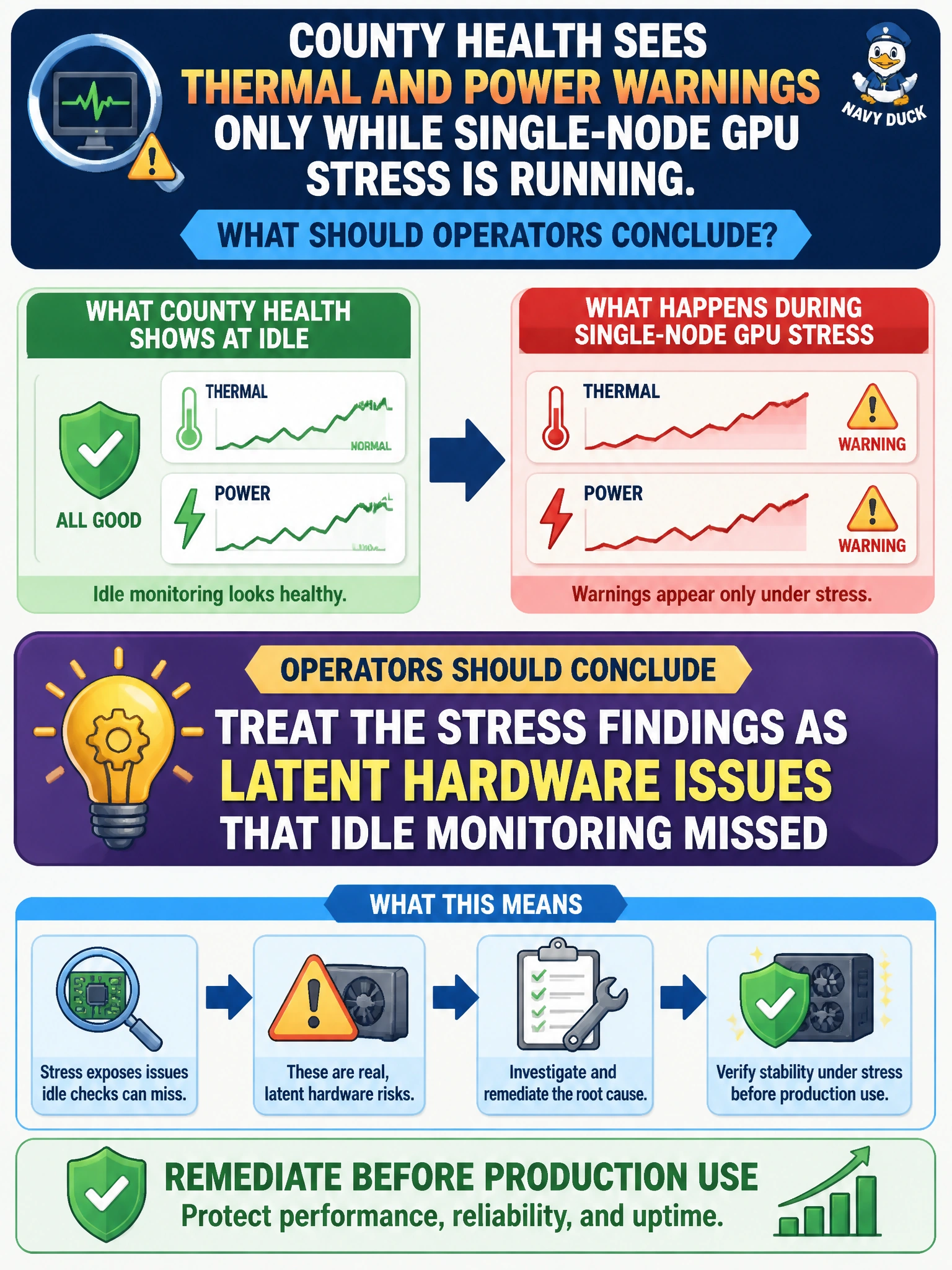
If stress wakes up thermal and power ghosts that idle never showed, believe stress—fix the hardware before flu-season inference trusts that node.
Full Explanation
If county health sees thermal and power warnings only while single-node GPU stress is running, operators should treat those findings as latent hardware issues that idle monitoring missed and remediate before production use. Stress is designed to reveal limits idle telemetry will not show; dismissing stress-only faults reintroduces flaky nodes into flu-season inference capacity.
Ignoring stress-only faults because idle telemetry looked fine fails by concept—the whole point of stress is to expose what idle misses. Disabling all thermal sensors to clear warnings fails because silencing sensors hides risk rather than fixing cooling, power delivery, or GPU faults. Marking the node production-ready if HPL was never run fails on two fronts: it ignores the stress evidence and skips another Domain 4 performance gate.
Exam caveat: Domain 4 stress interpretation treats load-induced thermal/power warnings as actionable acceptance defects, not noise to ignore when idle is green.
Operational check: capture stress logs with timestamps correlating GPU utilization to thermal/power events, inspect cooling paths, power capping, and hardware health, remediate or RMA, then rerun the same stress profile to green before returning the node to the health pool.