
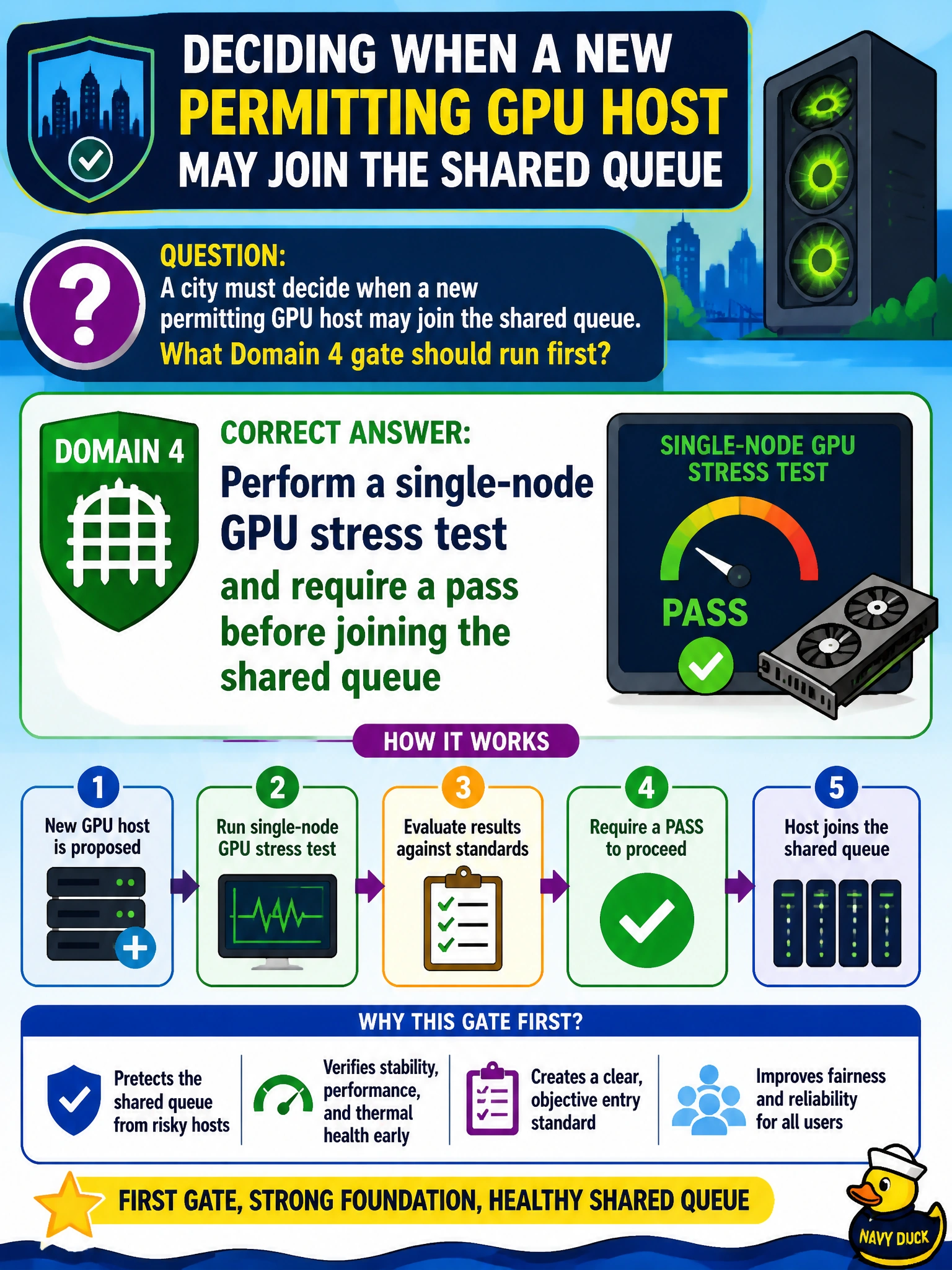
A city must decide when a new permitting GPU host may join the shared queue. What Domain 4 gate should run first?
Select an answer to reveal the explanation.
Short Explanation
New permitting hosts earn their queue badge with a single-node GPU stress pass—not by tossing live applicant jobs at them. Prove the box first.
Full Explanation
Before a new permitting GPU host joins the shared queue, Domain 4 expects a single-node GPU stress test that must pass. Stress exercises power, thermals, memory, and device error paths under load on that one node so latent hardware faults are caught before multi-tenant civic jobs depend on the box.
Launching production multi-tenant training with live applicant data as the first gate fails by concept because acceptance should not use live citizen data or shared-queue blast radius to discover broken GPUs. Skipping node-level tests and only running east-west fabric NCCL later fails because fabric tests assume healthy nodes; node-local defects then look like network problems. Declaring readiness from BMC fan presence alone fails because fans spinning prove cooling hardware presence, not GPU compute stability under stress.
Exam caveat: Domain 4 sequencing puts single-node stress (and related local verification) ahead of trusting a node in shared production pools. “BMC looks fine” and “we’ll catch it on the fabric test” are common wrong gates.
Operational check for permitting: run the site’s standard single-node GPU stress profile, review ECC/XID/thermal/power results against pass criteria, record evidence, and only then enable the host in the shared queue.