
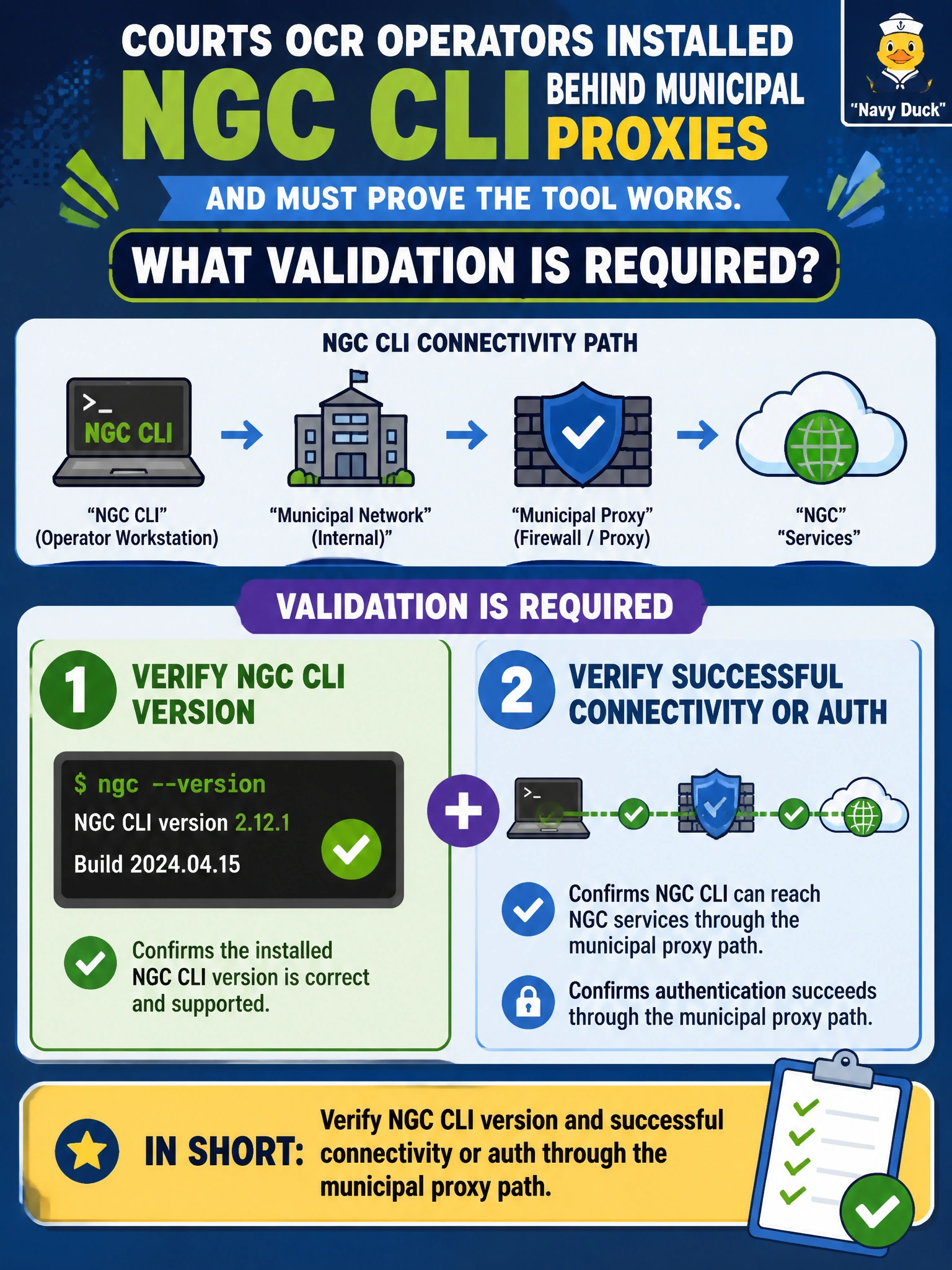
Courts OCR operators installed NGC CLI behind municipal proxies and must prove the tool works. What validation is required?
Select an answer to reveal the explanation.
Short Explanation
Behind court proxies, 'it installed' isn't enough—check the CLI version and that auth/connectivity actually works through the proxy path.
Full Explanation
Courts OCR operators who installed NGC CLI behind municipal proxies must verify NGC CLI version and successful connectivity or authentication through the municipal proxy path. Package install success does not prove the binary can reach NGC through corporate proxies, TLS interception, or allow-lists that OCR farms typically sit behind.
Assuming success if the package manager exited zero fails by concept because install exit codes ignore runtime network pathing and auth. Validating only that the CLI binary exists fails for the same reason—presence ≠ reachability. Replacing NGC CLI with an unsigned shell alias named ngc fails because an alias is not the supported client, cannot fulfill NGC API workflows securely, and breaks supply-chain expectations for OCR image retrieval.
Exam caveat: Constrained-network NGC questions emphasize end-to-end validation (version + connectivity/auth), not install-only checks.
Operational check: run the CLI version command, configure HTTPS_PROXY/NO_PROXY (or site equivalent) per municipal standard, authenticate, and perform a lightweight NGC API action (list/pull) from the courts OCR management host; capture failures as proxy/ACL tickets before blaming NGC itself.