
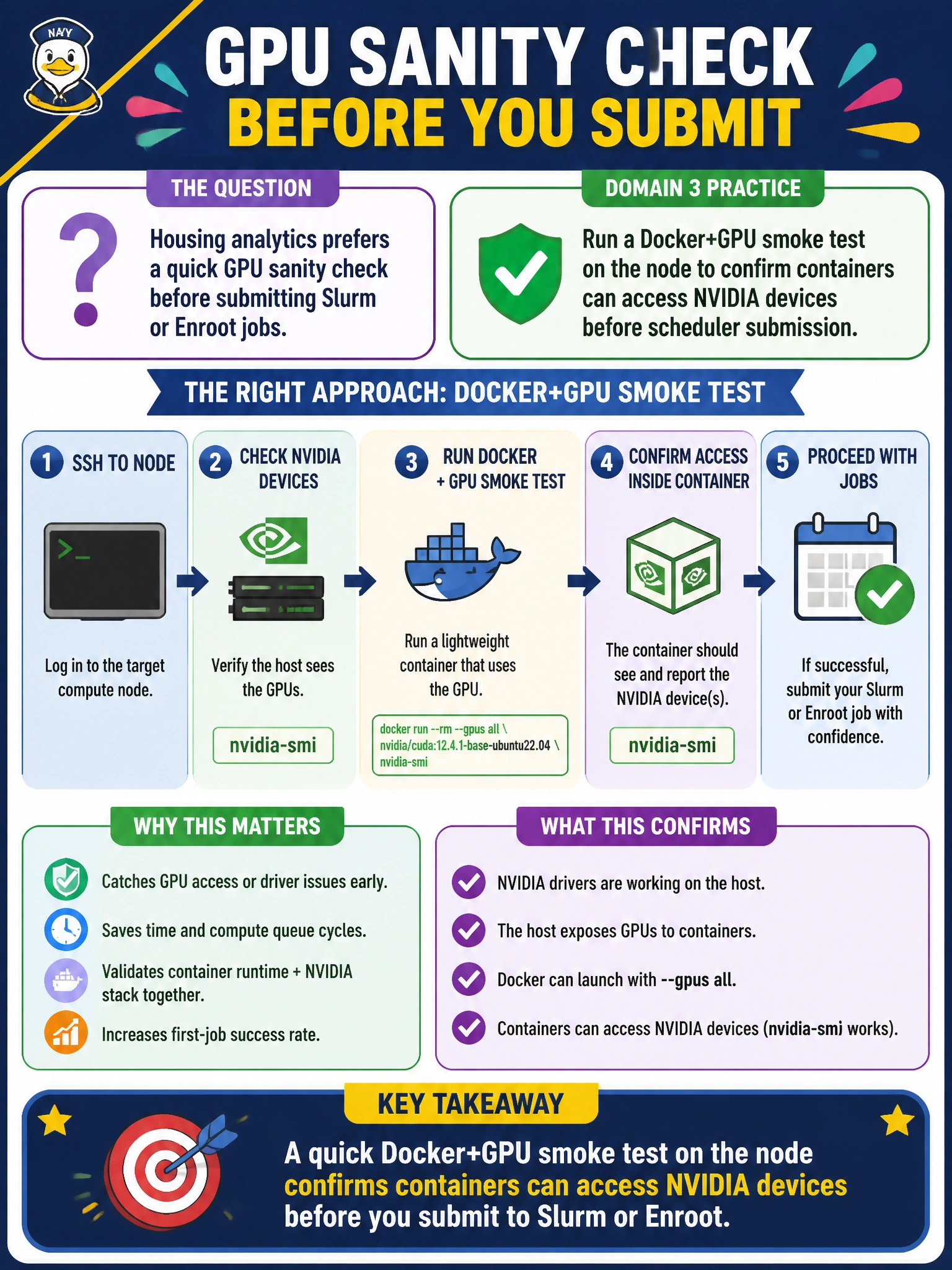
Housing analytics prefers a quick GPU sanity check before submitting Slurm or Enroot jobs. What approach fits Domain 3 practice?
Select an answer to reveal the explanation.
Short Explanation
Before you flood Slurm, poke the node with a Docker+GPU smoke test—like checking the lights before a long housing analytics run. Cheap proof beats a mystery queue failure.
Full Explanation
Housing analytics practice in Domain 3 uses a Docker+GPU smoke test on the node to confirm containers can access NVIDIA devices before submitting Slurm or Enroot jobs. A cheap local container proof isolates toolkit, runtime, and device exposure problems on that host so queue time and multi-node complexity are not wasted debugging a single miswired node.
Skipping host-level checks and immediately submitting the full multi-node job fails by concept because scheduler failures then mix network, topology, data, and per-node GPU exposure issues—obscuring a simple Docker runtime miss. Disabling Docker permanently so only Enroot is used fails because Docker remains a practical Domain 3 validation path and site tooling often still depends on it for smoke tests and image checks; banning it removes a useful control without proving Enroot GPU paths. Validating only CPU stress and treating GPU visibility as optional fails because housing analytics jobs need accelerators; CPU-only green lights do not prove NVIDIA device access.
Exam caveat: Domain 3 positions Docker+GPU as a demonstration and troubleshooting skill even when production may prefer Enroot/Pyxis or other runners. Pre-scheduler smoke tests are the operational expression of that skill.
Operational check for housing: on the target node, run a minimal GPU container with site flags, confirm nvidia-smi inside, then submit the Slurm/Enroot job. If the container check fails, fix toolkit/runtime before touching the queue.