
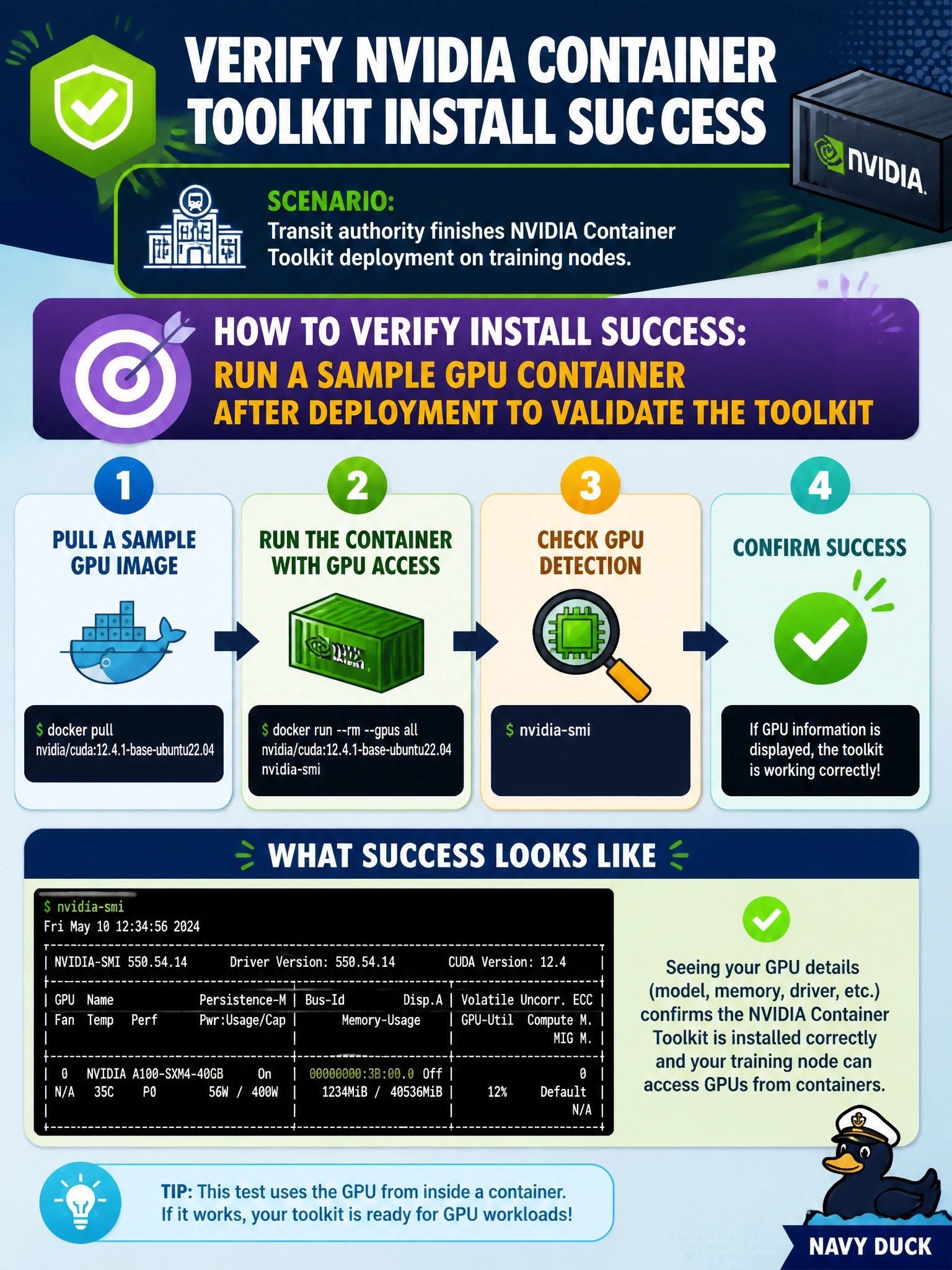
Transit authority finishes NVIDIA Container Toolkit deployment on training nodes. How should install success be verified?
Select an answer to reveal the explanation.
Short Explanation
Prove the toolkit with a sample GPU container on a transit node—packages saying “ok” last week is not today’s proof. Bolted-in GPUs alone do not test the runtime path.
Full Explanation
Transit authority should verify NVIDIA Container Toolkit deployment by running a sample GPU container after install. An end-to-end container proves the runtime hooks, driver interaction, and device injection work on training nodes—not merely that packages unpacked. That functional test is the acceptance gate before civic training jobs rely on the path across the fleet, and results should be captured with host and in-container GPU evidence in the change record.
Assuming success from a package manager exit code last week is stale and incomplete evidence that ignores today’s runtime state. Verifying only that /etc exists checks a universal directory, not GPU container capability. Confirming GPUs are physically bolted in without a container test validates hardware presence, not toolkit/runtime integration, and will miss hook or CDI misconfiguration.
Exam caveat: toolkit validation equals a sample GPU container run—not old package exit codes, trivial filesystem checks, or physical-bolt inspection alone.
Operational check: on a representative transit training node, run an NVIDIA CUDA sample or nvidia/cuda container with GPU flags, confirm GPU visibility inside the container, and record the result in the deployment checklist.