
A library consortium configures BCM interfaces for GPU nodes running NLP jobs. How should OOB and compute networking be treated?
Select an answer to reveal the explanation.
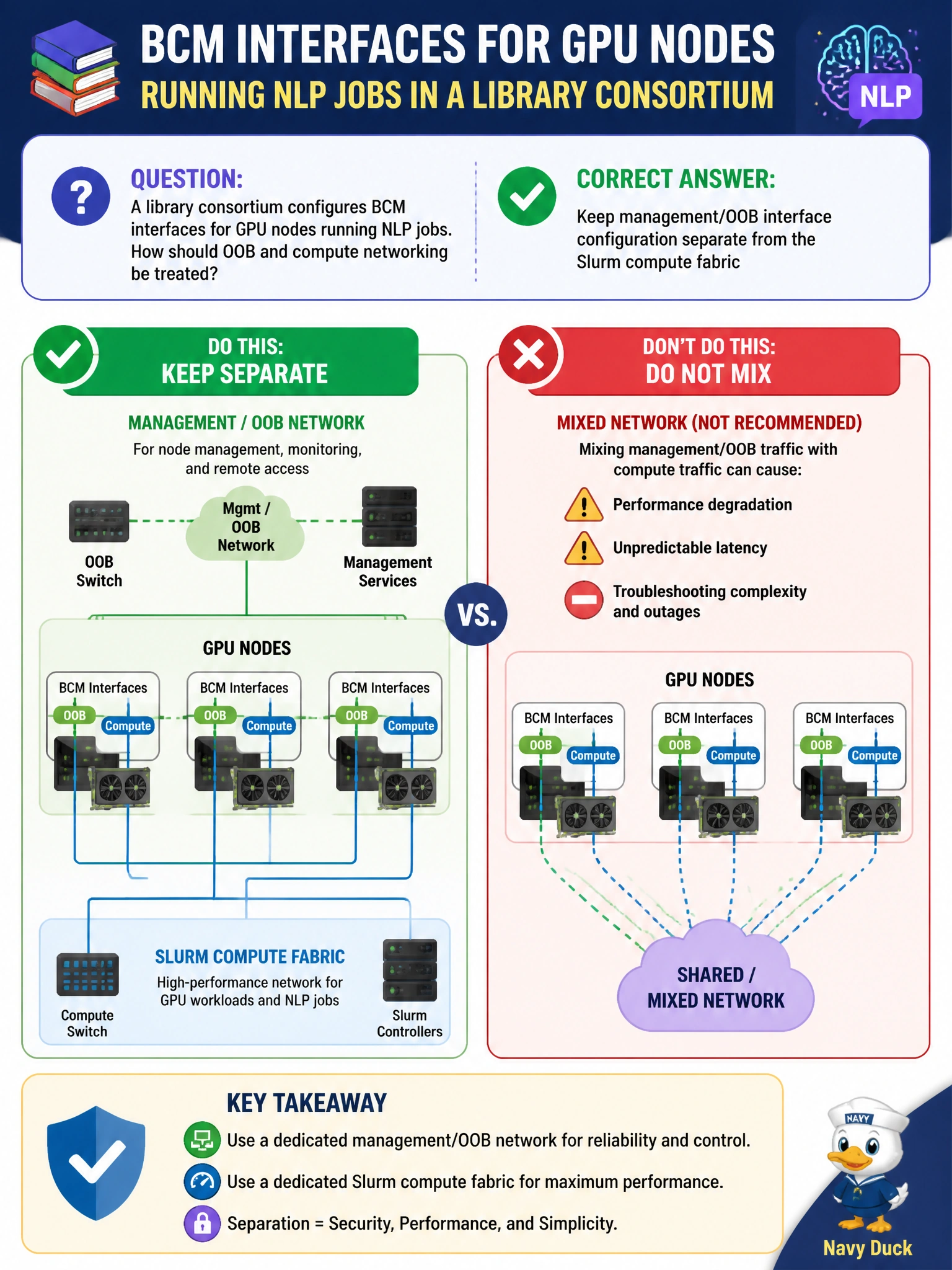
Short Explanation
Keep OOB/management off the Slurm compute fabric—like keeping the building alarm panel off the public Wi-Fi. Mixing them invites pain.
Full Explanation
For the library consortium’s BCM interface design, management/OOB networking should stay separate from the Slurm compute fabric. OOB/management provides resilient control access for BCM, firmware, and break-glass operations; the compute fabric carries job, MPI, and GPU east-west traffic engineered for performance. Keeping them separate preserves security boundaries and avoids coupling cluster data-plane congestion to management reachability for NLP job hosts.
Merging OOB into the Slurm compute fabric as one flat network collapses those roles and risks management loss during compute storms or misconfiguration. Disabling OOB entirely once Slurm is installed removes the independent recovery path operators need when the compute stack misbehaves. Routing all compute MPI traffic exclusively through BMC USB ports is not a viable high-performance fabric and confuses BMC peripherals with compute networking.
Exam caveat: OOB/management remains distinct from Slurm compute networking—flat merges, OOB disablement, or BMC-USB-as-MPI are distractors.
Operational check: document and configure separate management/OOB vs compute interfaces under BCM, verify BCM reaches nodes on management during a compute-fabric stress test, and ensure MPI/job traffic does not depend on BMC USB.