
Emergency management finishes Slurm and cluster software install on inference nodes. What validation is required?
Select an answer to reveal the explanation.
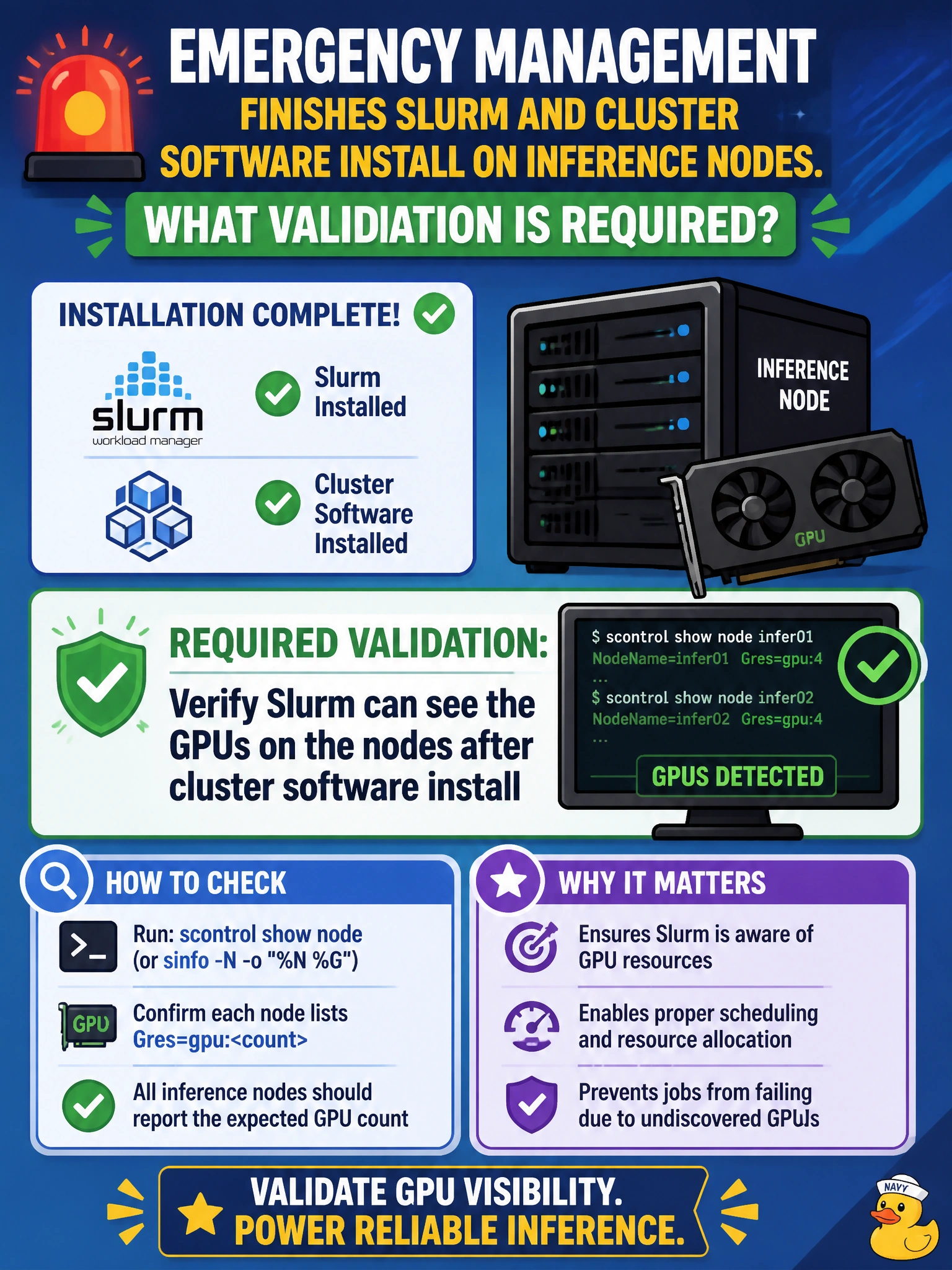
Short Explanation
After Slurm is in, check that it actually sees the GPUs—like making sure dispatch can see available ambulances. Ignoring accelerators on purpose is not validation.
Full Explanation
After Slurm and cluster software install on emergency-management inference nodes, validation must verify that Slurm can see the GPUs on those nodes. Scheduler visibility—GRES/GPU configuration reflected in sinfo, scontrol, or the site’s equivalent—proves the control path from resource manager to accelerators is live. Without that visibility, inference jobs cannot meaningfully request GPUs when activations demand capacity, and the install is incomplete regardless of package success on the head.
Configuring Slurm to ignore all GPUs by policy is the opposite of readiness for an inference fleet and would strand emergency models on CPU-only paths. Removing GRES/GPU configuration so jobs never request accelerators intentionally blinds the scheduler. Validating only that the head node can play audio files is unrelated to GPU scheduling and wastes the acceptance window with non-evidence.
Exam caveat: post-install Slurm checks focus on GPU visibility/GRES—not policies that hide GPUs or irrelevant head-node media tests.
Operational check: confirm nvidia-smi on nodes, confirm Slurm GRES matches installed GPUs, run sinfo/scontrol show node (or site equivalent), and submit a trivial GPU job on the inference partition before go-live.