
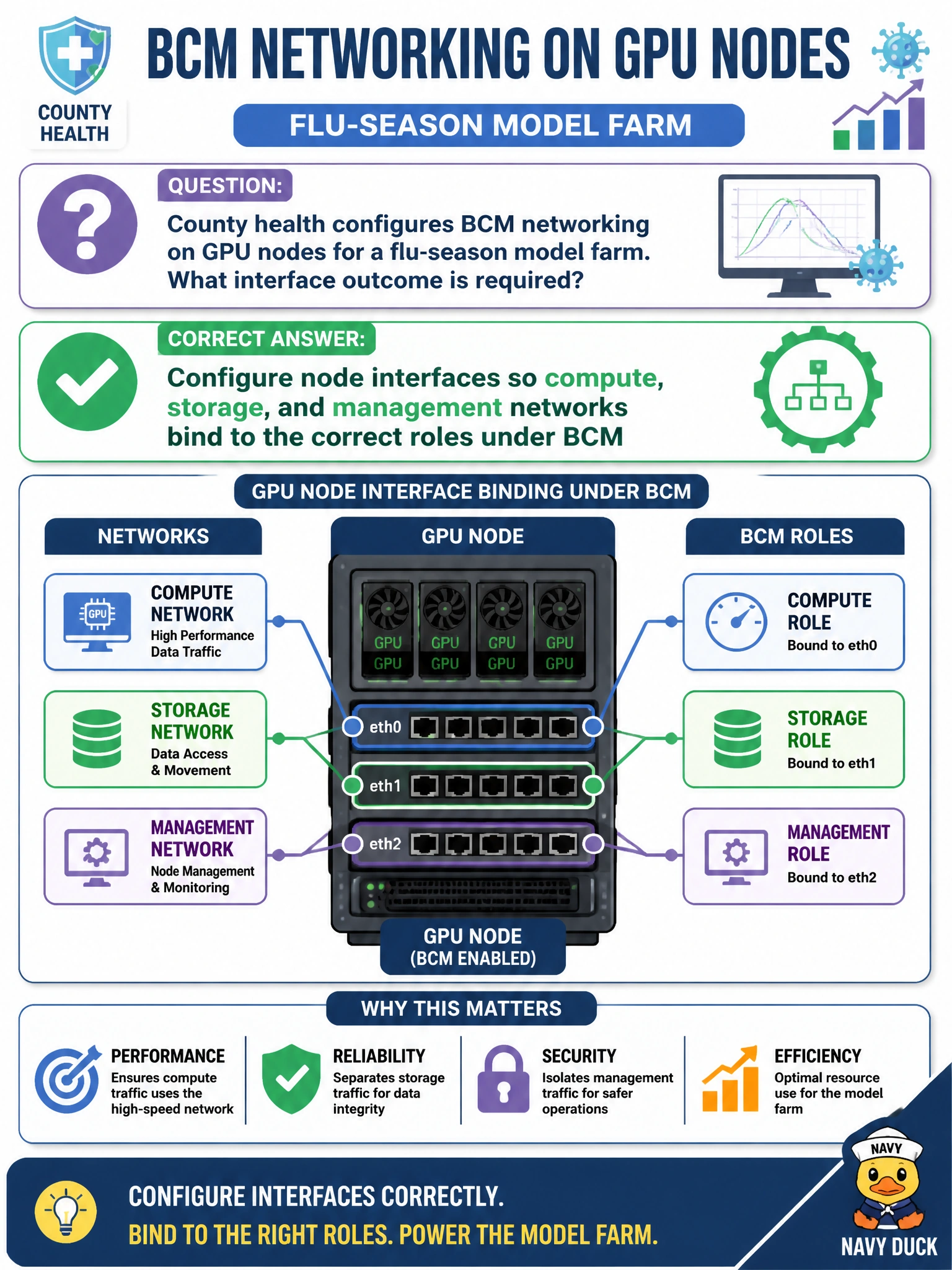
County health configures BCM networking on GPU nodes for a flu-season model farm. What interface outcome is required?
Select an answer to reveal the explanation.
Short Explanation
Point compute, storage, and management at the right NICs under BCM—like labeling the clinic’s LAN drops correctly. One mystery port for everything is a future outage.
Full Explanation
For the county health flu-season model farm, BCM networking must configure node interfaces so compute, storage, and management networks bind to the correct roles. Separating those planes protects control traffic, keeps storage I/O on the intended path, and places east-west/compute traffic where bandwidth and latency were engineered. Correct bindings under BCM are how GPU nodes participate safely in the municipal fabric without trampling management or storage.
Bonding all traffic onto a single mislabeled port with no role separation destroys isolation and troubleshooting clarity and often oversubscribes a path never designed for mixed roles. Disabling management networking so BCM can never reach the nodes removes the control plane path required to manage those GPUs. Mapping storage traffic exclusively onto the BMC serial console confuses OOB console access with high-throughput storage networking—serial consoles are not storage fabrics.
Exam caveat: interface configuration answers require correct role-to-NIC binding for compute, storage, and management—not single-port mush, management disablement, or BMC-as-storage.
Operational check: under BCM, verify each health GPU node’s interfaces map to the documented roles, pass connectivity tests on each plane, and confirm BCM management still reaches the nodes on the management path.