
Emergency management must declare the control plane ready after BCM HA install. What acceptance evidence should be recorded?
Select an answer to reveal the explanation.
Short Explanation
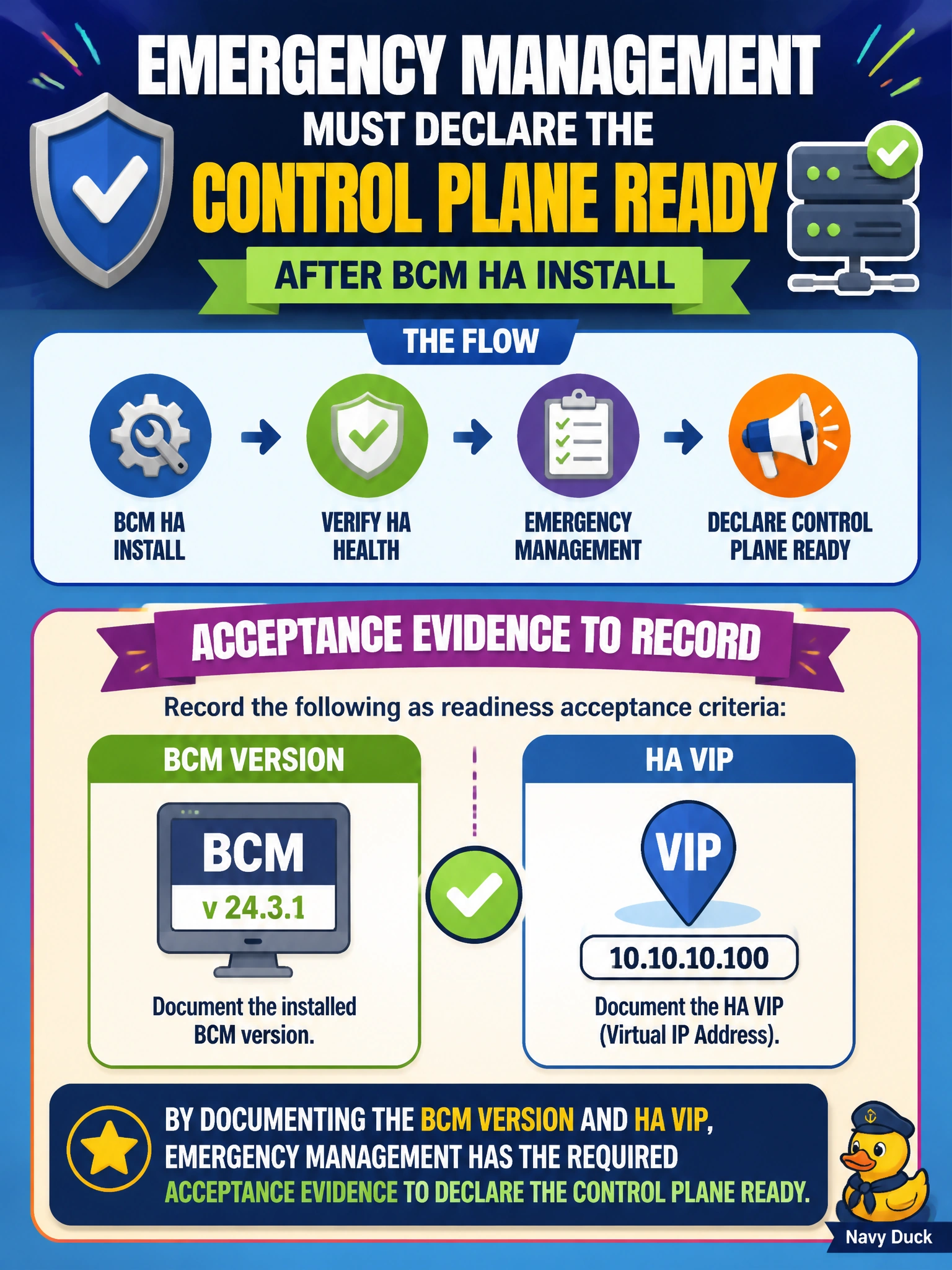
Before calling the control plane ready, write down the BCM version and the HA VIP—like logging the radio channel before a storm drill. Green lights alone are not acceptance.
Full Explanation
Emergency management should treat BCM HA acceptance as documented evidence, not vibes. Recording the installed BCM version and the HA virtual IP (VIP) used for management continuity proves which software is live and how clients reach the active head after failover. Those two artifacts are concrete readiness criteria: version pins the control-plane build under change control, and the VIP documents the stable management endpoint municipal operators and automation must use when a head fails.
A sticky note that rack lights are green fails as acceptance because LED status does not identify software revision or VIP ownership, and it is not durable evidence for audit or handoff. Planning to never record VIP ownership so failover stays mysterious intentionally removes the very continuity mechanism HA exists to provide. Screenshots of unrelated desktop wallpapers on the head nodes are not control-plane metrics and do not demonstrate HA readiness for storm-season or emergency workloads.
Exam caveat: HA readiness answers emphasize recorded version and VIP (or equivalent ownership endpoint), not informal visual checks or deliberate opacity about failover addressing.
Operational check: capture BCM version from the installed stack, ping/resolve the HA VIP from a management client, fail over in a controlled window if required by policy, and file version plus VIP in the readiness package before declaring the control plane ready.