
Courts OCR cluster runs a controlled BCM head recovery drill. What must operators confirm?
Select an answer to reveal the explanation.
Short Explanation
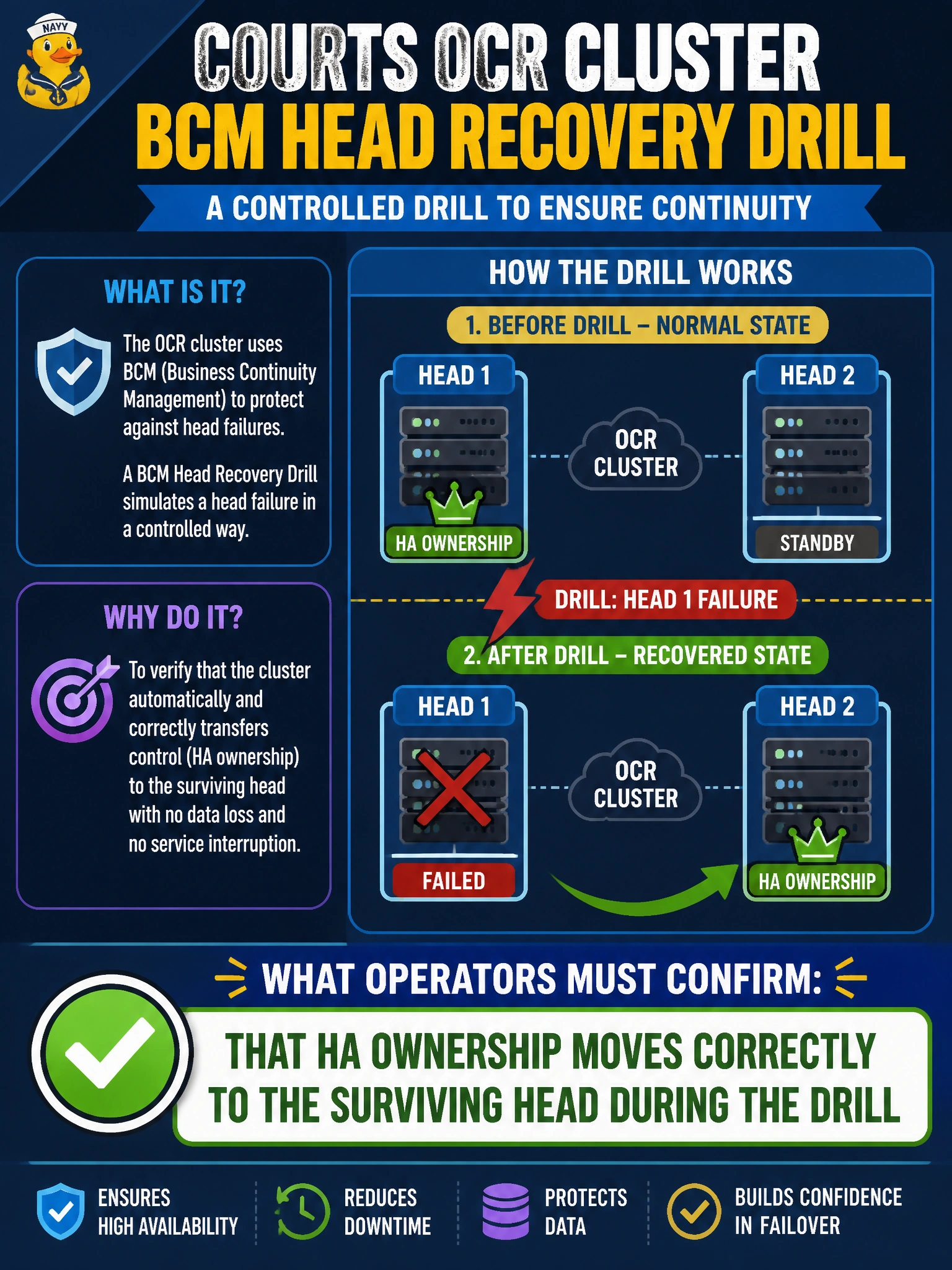
In a courts failover drill, watch the HA VIP or ownership flip to the good head—like a backup clerk taking the window without closing the office. Intentional management blackouts are not the point.
Full Explanation
In a courts OCR BCM head recovery drill, the required confirmation is that HA ownership moves correctly to the surviving head so node management continues. The drill’s purpose is to prove failover behavior under controlled conditions: VIP/ownership transfers, the surviving head serves management, and OCR GPU nodes remain reachable for provisioning and monitoring without waiting on physical replacement of the failed head.
Confirming that HA is disabled so ownership never moves inverts the drill—disabling HA prevents the ownership move you need to validate. Requiring that failover means shipping the failed head to another county treats logistics as the continuity plan and ignores in-cluster HA ownership transfer. Confirming that node management intentionally fails until the drill ends mistakes a successful blackout for a successful test; the goal is continued management, not proving outage.
Exam caveat: controlled HA drills validate ownership/VIP move to the survivor; answers that disable HA, demand physical relocation, or celebrate management failure are distractors.
Operational check: trigger the drill per runbook, watch HA ownership or VIP land on the surviving head, verify BCM management of OCR nodes from that head, restore the peer per procedure, and record pass/fail with timestamps.