
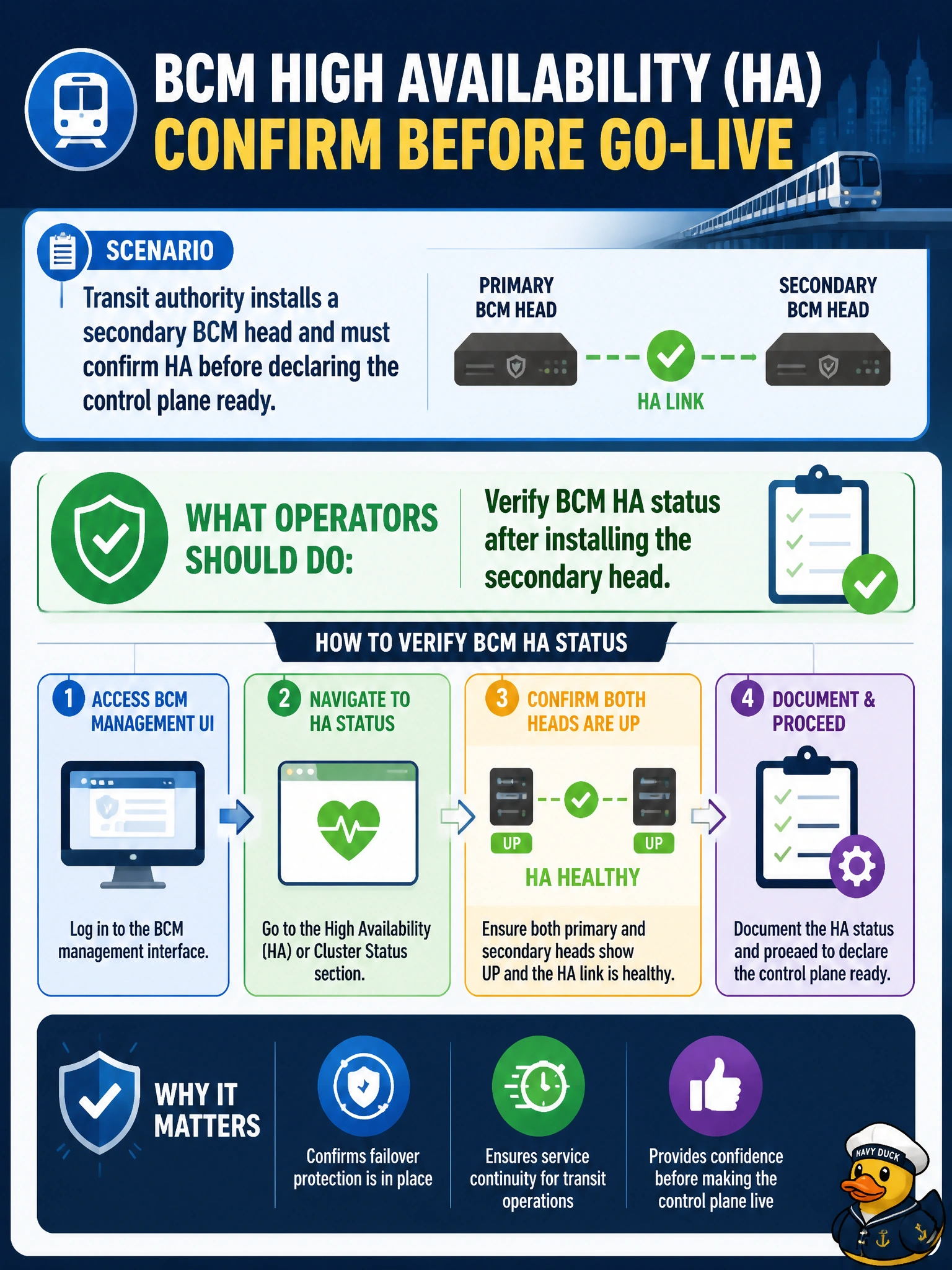
Transit authority installs a secondary BCM head and must confirm HA before declaring the control plane ready. What should operators do?
Select an answer to reveal the explanation.
Short Explanation
After the second BCM head is in, check HA status for real—power lights on two boxes is not proof they are a team. Transit needs that verification before go-live.
Full Explanation
Transit authority installing a secondary BCM head must verify BCM HA status before declaring the control plane ready. Powering a second server is not proof of HA membership, replication, or failover readiness; status verification confirms the secondary has joined the HA pair and that the municipal control plane meets its resilience design. Go-live without that check leaves transit AI management on hope. Assuming HA works because both servers are powered fails by concept: power is a prerequisite, not HA proof. Skipping status checks and starting to delete head-node logs fails by concept: destroying logs reduces diagnosability and does not validate HA. Only pinging the primary and ignoring the secondary head fails by concept: primary reachability says nothing about secondary HA role or sync state. Exam caveat: HA status should be checked with BCM’s HA tooling or documented status commands, not inferred from ICMP alone; a pingable secondary can still be out of sync or not in the HA pair. Operational check: after installing the secondary BCM head, run HA status verification, confirm both heads show the expected HA roles, perform a controlled failover test if policy allows, and only then mark the transit control plane ready.