
County public-health runs a BCM head pair during flu-season inference peaks. What HA outcome must be configured and verified?
Select an answer to reveal the explanation.
Short Explanation
BCM HA should keep managing nodes even when one head stumbles—like a second dispatcher staying on the radio during flu season. Hand-moving cables each failover is not the goal.
Full Explanation
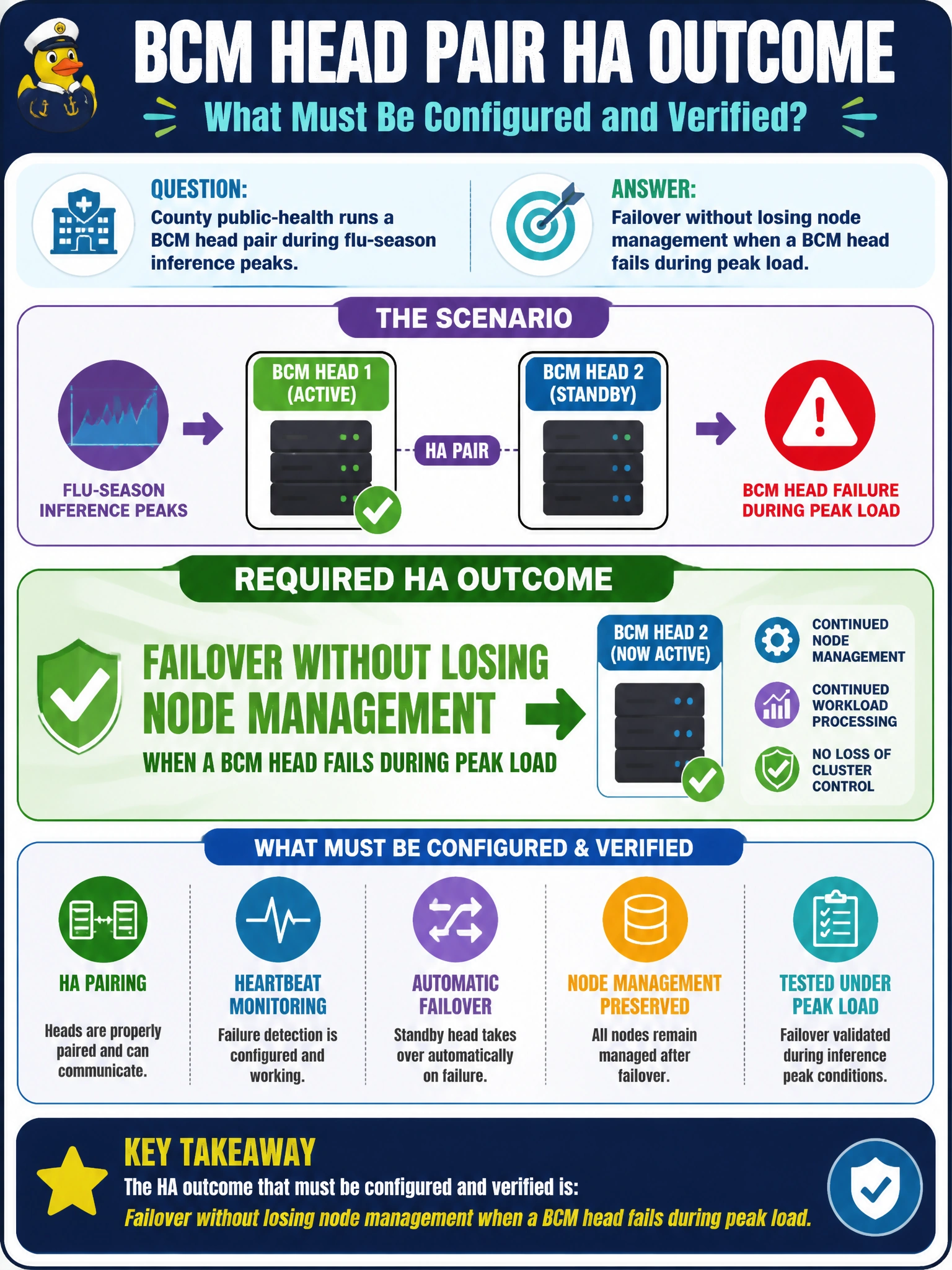
County public-health running a BCM head pair during flu-season inference peaks must configure and verify failover that preserves node management when a BCM head fails under load. HA for the cluster manager exists so GPU node provisioning, monitoring, and management continue when one head dies—especially when civic inference demand is high and operators cannot afford a management blackout. The required outcome is continuity of node management, not a planned weekend outage. Failover that drops all node management until a weekend outage window fails by concept: that is an outage, not HA. Active/standby that requires physically moving Ethernet cables by hand each time fails by concept: manual cable moves are not automatic HA and introduce human delay and error. Disabling HA so only one head ever exists by policy fails by concept: that abandons the HA requirement for flu-season resilience. Exam caveat: HA continuity covers cluster-manager operations; it does not claim zero impact on in-flight user jobs if other layers fail—focus the answer on node management surviving head loss. Operational check: induce or simulate primary BCM head failure in a controlled window, confirm the secondary takes over without losing node management, restore the pair, and document failover timing for the county public-health runbook.